
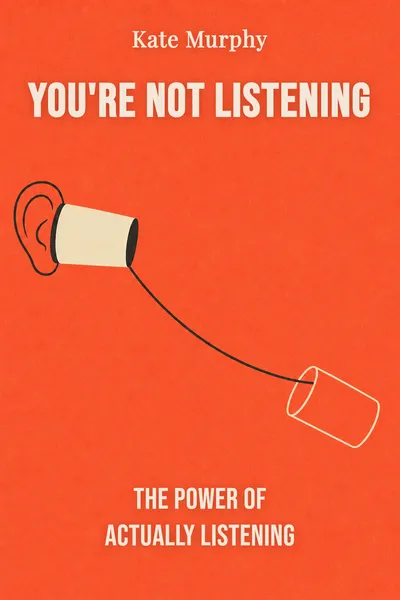
You're Not Listening
The power of actually listening
Description
Kate Murphy has spent a career on the other side of the notebook. As a longtime contributor to the New York Times, she has interviewed thousands of people — presidents and prisoners, scientists and swindlers, the famous and the accidentally newsworthy — and the through-line of all that reporting is a single act she began to notice was disappearing everywhere else: someone actually paying attention to what another person is saying. In her 2020 book You're Not Listening, she turns that observation into an argument. We live in the most connected moment in human history, wired for constant contact, and yet, she says, we have quietly stopped doing the one thing that connection was supposed to be for.
The symptom is loneliness, and it is not the loneliness of isolation. It is the loneliness of being surrounded — by messages, feeds, meetings, group chats — and still feeling unheard. Murphy noticed it in the way conversations had come to feel like alternating monologues, in the coaching that teaches us to lead and pitch and control the room, in the platforms that reward us for broadcasting rather than absorbing. Everyone, it seemed, was talking. Fewer and fewer people knew how to listen, or believed it was worth their time.
So she went looking for the people who still do it well, and for the science of why the rest of us don't. Bartenders, CIA agents, a focus-group moderator, a priest who takes confession, a radio producer who edits people's stories for a living. Alongside them, the psychology and neuroscience of attention, and a plainer question underneath all of it: what happens to us, individually and together, when we forget how to listen.
The question we’re asking : Why, in an age built for communication, have we become so bad at the one thing communication requires?What we’ll see : How the best listeners work, what the brain does to sabotage us, and what the loss actually costs.
Table of contents
01Chapter 1 — The listeners we never notice
Murphy's first move is to complicate the flattering story we tell about listening. We tend to imagine we're good at it — that being quiet while someone speaks is roughly the whole job. She dismantles that quickly. Listening, in her account, is an active, demanding thing: it means genuinely trying to understand what someone means, not just waiting for a gap to insert what we already planned to say. And the people who are best at it are rarely the ones we'd expect.
She spends time with a CIA agent trained to draw out sources, and finds the tradecraft is less interrogation than patience — letting silence do the work, following the other person's thread rather than steering. She sits with a top furniture salesman who outsells everyone because he asks about a customer's life and then actually remembers it, so that the couch becomes an answer to a real problem rather than a product pushed. A focus-group moderator named Naomi Henderson turns out to be a virtuoso of the follow-up question, the one that opens a door the speaker didn't know was there.

02Chapter 2 — Why the brain talks over the world
If listening is so valuable, why is it so hard? Murphy's answer runs through the wiring. There's a basic arithmetic problem to start: we can think far faster than anyone can speak. The average person talks at somewhere around 120 to 150 words a minute, while the mind can process several times that. That surplus of mental capacity is where trouble lives. The gap gets filled with rehearsal, judgment, planning, and the drift toward our own preoccupations, so that even when we're technically listening, a chunk of us has wandered off.
Then there's what she calls, borrowing from the research, the closeness-communication bias — the strange finding that we often listen worst to the people we know best. We assume we already know what our partner or oldest friend is going to say, so we stop actually attending. Strangers, precisely because we can't predict them, sometimes get better hearing than the people we love. Murphy treats this not as a curiosity but as a slow erosion, the way long marriages and old friendships can hollow out from the inside while both people are convinced they're still in touch.
03Chapter 3 — What we lose when we stop
The cost, in Murphy's telling, is not abstract. It shows up first as loneliness, and she is careful to separate loneliness from solitude. You can be perfectly alone and content; you can also be texting all day, posting to hundreds of followers, sitting in back-to-back meetings, and feel profoundly unheard. That second condition is the modern one, and it's what more communication keeps failing to cure. Volume is not the same as being listened to, and we've mistaken one for the other.
She traces how the habits compound. On social media we curate a self and broadcast it; the medium rewards declaration, not reception. At work we're coached to lead the conversation, to pitch, to command the room — listening reframed as a passive weakness rather than the source of nearly everything worth knowing. At parties we talk over each other. Our politicians model it at scale, treating dialogue as a contest of assertions in which whoever yields ground first has lost.
04Chapter 4 — The friend who read the book
Step back from the individual encounters, and Murphy's argument turns into something larger about the age we're in. We built the most communicative civilization in history on the assumption that connection was a bandwidth problem — that if we could just send more messages, faster, to more people, we'd feel more connected. The book is a patient demonstration that this assumption was wrong. Connection was never about transmission. It was always about reception, and reception is the thing all our tools quietly discourage.
This is why more communication has made us lonelier rather than less. A feed asks you to speak; it does not listen back. A platform optimizes for the reply that scores, not the pause that understands. Murphy isn't a technophobe — she's clear the devices aren't the enemy so much as the accelerant of a habit that predates them. But she's making a structural point: a culture that treats listening as the low-status half of conversation will keep producing people who feel surrounded and unheard, no matter how good the network gets.
05Conclusion
Murphy began as a reporter who listened for a living, and the book ends more or less where her career started: with the conviction that the most interesting thing in any room is usually the person you haven't fully heard yet. Her advice, when she offers it, is unglamorous — ask a real question, resist the urge to take the ball, tolerate a silence long enough for someone to fill it with something true. None of it is a hack. It's slower than talking, and that slowness is the point.