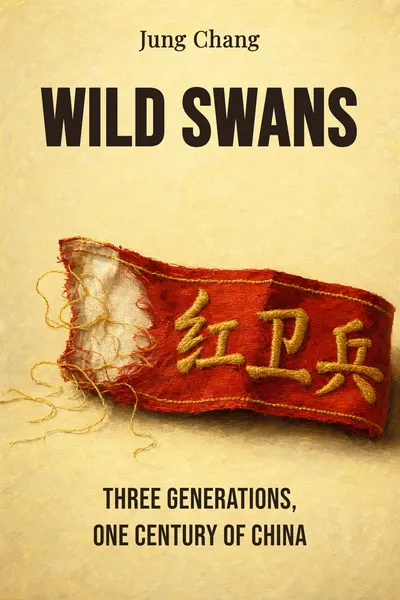
Wild Swans
Three generations, one century of China
Description
In 1909, in a Manchurian town called Yixian, a fifteen-year-old girl had her feet bound so tightly the bones broke, because a policeman with the right connections might one day want a pretty wife with small feet. That girl would become the grandmother in Jung Chang's Wild Swans, and the calculation around her feet — beauty as leverage, a daughter as an asset to be placed well — is where a hundred years of Chinese history begins to run through a single family. Chang published the book in 1991, and it went on to sell more than ten million copies in some thirty languages, while being banned in the country it describes.
The book does something unusual with scale. It tells the story of twentieth-century China — the warlords, the Japanese occupation, the civil war, Mao's revolution, the famine, the Cultural Revolution — entirely through three women: the grandmother, given as a concubine to a warlord general; the mother, who joined the Communist underground as a teenager and rose through the Party; and Chang herself, born in 1952, a Red Guard at fourteen who watched the movement she had believed in devour the people she loved. Three lives, one century, no distance between the private and the political.
What holds the whole thing together is a refusal to separate the two. The bound feet, the arranged marriage, the denunciation meeting, the food that ran out — these are not backdrops to history. They are how history actually arrives in a life, one decision at a time, at a kitchen table, in a family that keeps having to choose between loyalty and survival.
The question we’re asking : How does one family's story carry the whole weight of a century that reshaped a fifth of humanity?What we’ll see : Three women across three regimes, and what memory can testify to that the official record was built to erase.
Table of contents
01 Chapter 1 — A concubine's daughter and a warlord's price
The grandmother, Yu-fang, was born in 1909 into a China that was falling apart at the top and rigid at the bottom. The Qing dynasty had two years left. Warlords carved the country into fiefdoms. And in that world, a girl was a bargaining chip her father could spend once. Yu-fang's father, a minor official with ambitions bigger than his salary, spent her on a general named Xue Zhi-heng, a powerful warlord who took her as a concubine when she was fifteen and then left her, for years at a time, in a house he visited perhaps once a season.
Chang tells this without melodrama, which is what makes it land. Concubinage was not an outrage in that society; it was a system, with its own etiquette, its own hierarchy of wives, its own quiet violence. Yu-fang lived in a gilded isolation, watched by servants who were also spies, forbidden to leave, valuable precisely because she was decorative and idle. Her feet, broken and bound at fifteen so a suitor would find them dainty, are the book's opening image of what the culture asked of women: to make themselves smaller in order to be chosen.

02 Chapter 2 — The believer who gave her life to the Party
De-hong came of age as one China was dying and another was being born in fire. Manchuria under the Japanese occupation, then the Kuomintang, then the Communist advance — she lived through each in her twenties, and what she saw of Kuomintang corruption and cruelty pushed her, as it pushed a generation of idealistic young people, toward the Communist underground. She joined as a teenager, ran real risks, and believed, with a completeness that Chang renders without mockery, that the Party would build a just and honest China.
She married a fellow believer, Wang Yu, a committed Communist official whose integrity was almost punishing. Chang's portrait of her father is one of the book's most demanding: a man so devoted to the Party's principles that he would deny his own family the small advantages his rank could have bought, refusing favors, refusing shortcuts, once making his pregnant wife walk rather than ride in his official jeep because the rules did not entitle her to it. His conscience was heroic and, to those who loved him, sometimes cruel.
03 Chapter 3 — The daughter who watched the faith turn on itself
Chang was born in 1952 into privilege of a peculiar kind: the daughter of high-ranking officials, raised in a compound, taught that Chairman Mao was the sun and the Party the source of all good. She believed it as naturally as she breathed. When the Cultural Revolution began in 1966, she was fourteen, and like millions of teenagers she became a Red Guard, swept up in the intoxication of being told that the young were the purifiers of the nation.
The intoxication did not last. The same movement that flattered her turned on her parents. Her father, whose integrity had once seemed excessive, refused to denounce what he saw as madness — and for that he was tortured, paraded, and eventually broken in mind and body. Her mother knelt on gravel at struggle sessions and was made to stand for hours in the freezing cold. The compound emptied. Chang watched the ideology she had loved arrive at her own door and demand that she hate the people who had raised her.
04 Chapter 4 — What a family album does that a history book cannot
Step back from the three women and look at the form itself, because the form is the argument. A conventional history of twentieth-century China would give you the numbers: the tens of millions dead in the famine, the length of the Long March, the dates of the campaigns. Chang gives you those too, but she binds every figure to a face — the famine is her family thinning at the table, the campaigns are her father's mind coming apart. The claim underneath Wild Swans is that a regime's true cost is only legible at the scale of a single household, over enough time that the same house lives through the promise and the betrayal both.
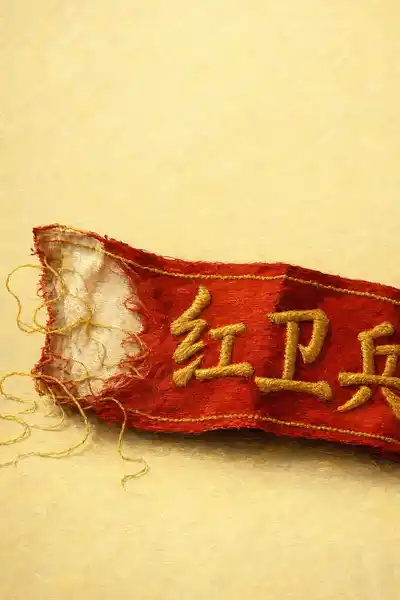
This is why three generations, specifically, matter. One life is an anecdote; a regime can dismiss it. But a grandmother, a mother, and a daughter placed end to end become a chain of evidence no propaganda can easily break, because the reader watches the same family judge the same country across seventy years, from bound feet to Red Guard armband. Continuity is the proof. The people doing the remembering knew each other, loved each other, and disagreed about what to believe — and that intimacy is exactly what an official record, built to smooth the story into a single triumphant line, is designed to remove.
05 Conclusion
The book ends where a story like this can only end — with the writer at a desk, in exile, turning a life of enforced silence into a hundred years of speech. Chang left China in 1978, studied in Britain, and wrote Wild Swans from a place her grandmother, whose feet were broken so a warlord might choose her, could not have pictured. Three women, one straight line, from a house in Manchuria to a book in thirty languages. The grandmother could not leave her courtyard; the granddaughter could not stop the world from reading.
Related books