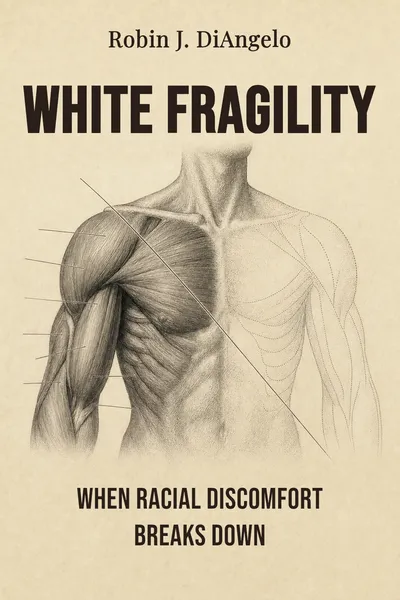
White Fragility
When racial discomfort breaks down
Description
In 2018, a sociologist named Robin DiAngelo published a book that grew out of years of running diversity workshops in corporate and institutional settings across the United States. The scene she kept describing was almost always the same. A room, a facilitator, a conversation about race — and then, the moment a white participant heard something that landed as an accusation, the temperature would spike. Someone would tear up. Someone would fold their arms and go silent. Someone would raise their voice about how unfair it was to be lumped in with racists, or quietly gather their things and leave. DiAngelo had watched this pattern repeat so reliably that she gave it a name: white fragility.
The name is provocative, and it has been read as an insult — fragile as in weak, delicate, easily offended. That's not quite what she means. Her argument is closer to a physics of comfort. White people in North America, she writes, grow up inside an environment engineered, mostly invisibly, to protect them from race-based stress. Schools, films, advertising, textbooks, the default faces in positions of authority — all of it builds an expectation that race is something other people have, a subject one can enter and exit at will. And an environment that protects you that thoroughly from a certain kind of discomfort never asks you to build the tolerance for it.
So when the discomfort finally arrives — a comment, a question, a moment where the racial familiar is interrupted — there's no muscle to meet it. The stress feels intolerable out of proportion to its size, and the reaction is defensive rather than curious. DiAngelo's book is an attempt to slow that reaction down and look at what it's actually doing.
The question we’re asking : Why does even a small amount of racial discomfort provoke such an outsized reaction in white people, and what does that reaction accomplish?What we’ll see : How a lifetime of racial insulation produces a low threshold for stress, and what it would take to raise it.
Table of contents
01Chapter 1 — The comfort we never notice
DiAngelo's starting point is that comfort is rarely something we register as comfort. We notice cold, not the absence of cold. Her claim is that white people in North America move through a social world calibrated, at a thousand small points, to keep race from ever becoming a source of stress for them. It isn't a conspiracy and it isn't personal. It's structural, and it's cumulative.
She catalogues the mechanisms without much drama, because the drama is in their ordinariness. The teachers are mostly white, the historical heroes in the textbook are mostly white, the protagonists of the films are white, the faces in the advertising are white, the people in charge at the office are white. A white child can grow up, she argues, without ever being made aware of race as something that touches their own life. They belong to a racial group, but the belonging is unmarked — the way water is unmarked to a fish. Race becomes a property other people have.

02Chapter 2 — When the familiar breaks
Racial stress, in DiAngelo's account, is what happens when the racially familiar is interrupted. The interruption can be tiny. A colleague suggests that a comment landed badly. A film frames a history from an unaccustomed angle. Someone points out that a room is entirely white and asks why. A person of color describes an experience that implicates the listener, however gently, in a system they'd never thought of themselves as part of. None of these are attacks. But each one breaks the smooth surface the insulated environment had maintained.
And here is where the insulation exacts its cost. Someone who has spent a lifetime protected from race-based stress has had no occasion to build tolerance for it. The muscle was never trained. So a small interruption doesn't register as small. It registers as an assault on something foundational — one's identity as a good person, one's sense of the world as fair, one's assumption that one's own perspective is simply the reasonable one.
03Chapter 3 — The moves that shut it down
What does making the stress stop actually look like? DiAngelo spends much of the book on this, because the reactions are so recognizable once named. They fall, roughly, into displays of feeling and patterns of behavior, and they all serve one function.
On the feeling side: anger — the flash of indignation at being implicated, the sense that an accusation has been made and must be repelled. Fear — a genuine anxiety, out of proportion to any real threat, that one is being cornered or morally condemned. And guilt, which can look like the opposite of defensiveness but often works the same way, drawing the conversation toward the white person's distress and away from the thing that caused it.
On the behavior side: argumentation, the impulse to debate the premise, to demand proof, to relitigate whether the interruption was fair. Silence, the shutting-down that reads as thoughtful but often functions as withdrawal. And leaving — physically exiting the situation, or checking out mentally, or announcing that the conversation has become too hostile to continue. DiAngelo notes how often the defensive move recasts the person under stress as the injured party, so that the burden of repair falls back on whoever raised the issue.
04Chapter 4 — The muscle we never had to build
Step back from the specific dynamic and DiAngelo is describing something with a shape we recognize from far outside the subject of race: the way protection from a kind of stress leaves us defenseless against it. We don't develop stamina for pressures we never encounter. This is why she frames her whole project not as an accusation but as a question of capacity — of building a skill, not proving innocence.
That reframing is the quiet argument underneath the provocative title. If fragility were a moral flaw, the response would be shame, and shame, as she shows, is just another defensive move that ends the conversation. But if fragility is an untrained muscle, the response is practice. The point of naming the reactions — the anger, the tears, the argument, the exit — is not to catch people being bad. It's to make the reactions visible enough that a person can notice their own defensiveness rising and choose, in that moment, to stay in the discomfort instead of extinguishing it.
05Conclusion
DiAngelo keeps returning to that room — the workshop, the facilitator, the moment the temperature spikes. It's where the whole book began, and it's where her argument stays anchored. The person who tears up, folds their arms, argues the premise, or quietly leaves is not, in her telling, a villain. They're someone meeting a kind of stress they were never equipped to handle, reaching reflexively for the tools that restore the comfort they'd always known. The reaction is predictable, patterned, and — until it's named — almost invisible to the person having it.
Related books