

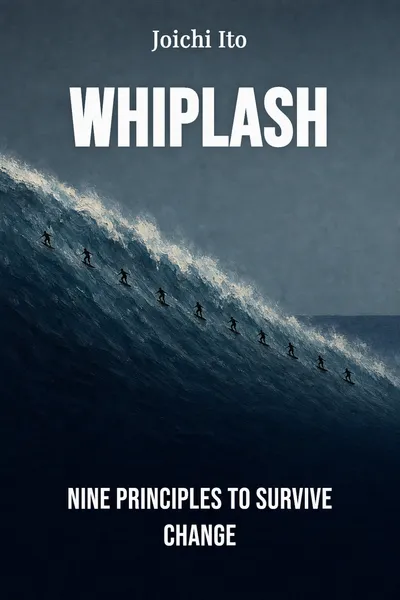
Whiplash
Nine principles to survive change
Description
In 2011, a college dropout with no engineering degree and no PhD became director of the MIT Media Lab, one of the most prestigious research institutions on the planet. Joichi Ito had built internet companies, invested early in Twitter and Flickr, DJ'd in nightclubs, and helped launch the Japanese arm of the early web — but on paper he had none of the credentials the job usually demanded. That was arguably the point. The Media Lab prided itself on the space between disciplines, on people who moved fast and didn't fit boxes, and Ito was a living example of the thing it wanted to study: how do you thrive when the ground keeps shifting under your feet?
Ito teamed up with Jeff Howe, a Wired journalist who a few years earlier had coined the word "crowdsourcing," to write a book about exactly that question. Whiplash, published in 2016, isn't a management manual in the usual sense. It's an argument that the pace of technological change has crossed a threshold — that the tools now evolve faster than our ability to understand them, let alone plan around them. When the world moves that quickly, the old reflexes stop working. Detailed five-year plans become fiction. Expertise curdles into rigidity. The instinct to control everything becomes the surest way to be blindsided.
So the two of them set out to name the new reflexes. Not rules, not a formula — the book is careful about that — but nine principles, each framed as a tension between an old instinct and a newer, more useful one. Together they sketch a way of holding oneself in a world that refuses to sit still.
The question we’re asking : How do we act well when technology changes faster than we can plan for it?What we’ll see : How a dropout running MIT's most famous lab and the journalist who named crowdsourcing distilled survival in an accelerating world into nine hard-won principles.
Table of contents
01Chapter 1 — The lab that thinks in principles, not plans
The Media Lab is an odd place, and Ito leans on that oddness to make his case. Founded in 1985 by Nicholas Negroponte, it was built to ignore the walls between fields — computer scientists working next to musicians, biologists next to designers — on the bet that the interesting ideas live in the gaps. When Ito arrived, he inherited a culture that already ran on improvisation more than on roadmaps. Whiplash reads, in part, as his attempt to explain to the wider world why that culture kept producing things nobody had asked for and everybody ended up needing.
The founding claim is almost meteorological. Ito and Howe argue that we have entered a period where change is not just fast but nonlinear and compounding — where networks, cheap computing, and near-zero communication costs let small things scale to global size overnight. In that environment, the future stops being a place you can forecast your way toward. The authors borrow a phrase from the internet's early builders: the network became smarter than the people running it. Institutions designed for a slower world — corporations, universities, governments — keep trying to steer with instruments built for a calmer sea.

02Chapter 2 — Pull, emergence, and the wisdom of not deciding
Several of the nine principles are about where power and resources should sit. The most quietly radical is "pull over push." The old model pushes: you stockpile people, budget, and inventory in advance, then deploy them according to plan. The pull model does the opposite — you draw resources from the network at the moment you need them, rather than hoarding them against a future you're guessing at. Ito and Howe point to the response after the 2011 Fukushima disaster, when a loose group of volunteers, Ito among them, built low-cost Geiger counters and an open radiation map faster than official channels managed to — because they pulled skills and parts from a global network instead of waiting for an institution to authorize them.
03Chapter 3 — Risk over safety, disobedience over compliance
The sharpest principles are the ones about how much trouble to court. "Risk over safety" argues that as the cost of experimenting collapses — a piece of software, a prototype, a small trial can now be spun up for almost nothing — the smart move is to run many cheap experiments and let most of them fail. The genuine danger has flipped. It's no longer the risk of a failed try; it's the risk of not trying while a faster rival learns something you didn't. Safety, pursued too hard, becomes the dangerous choice.
"Disobedience over compliance" is the principle that got the most attention, and it's the one that reads most personally coming from Ito. His claim is blunt: you don't win a Nobel Prize by doing what you're told. Real breakthroughs come from people willing to question the rules rather than follow them — not for the sake of rebellion, but because the rules encode assumptions from an earlier world. The Media Lab later put money behind this, creating a Disobedience Award for principled rule-breaking that serves the greater good. The book is careful to distinguish this from mere recklessness; the disobedience it praises is thoughtful, aimed, and willing to bear consequences.
04Chapter 4 — The map the book draws of a world moving faster than us
Step back from the nine and a single shape appears. Every principle names the same underlying gap: technology now changes faster than the institutions built to govern it. The corporation, the university, the regulatory agency, the career itself — these were all designed for a world where the future arrived slowly enough to be planned for. Ito and Howe's real subject isn't clever heuristics; it's that lag, the widening distance between the speed of the tools and the speed of the structures meant to hold them. Whiplash is the sensation of that distance, the neck-snap of a world accelerating past its own steering.
What's striking is where the book locates the solution. Not in better forecasting, not in more data, not in smarter central planning — the usual reflexes of institutions under pressure. It locates it in posture. Every principle is a way of standing that assumes you will be surprised, and tries to make surprise survivable rather than catastrophic. Pull instead of stockpile because you can't predict what you'll need. Compass instead of map because the terrain will change. Resilience instead of strength because the blow will come from a direction you didn't fortify. The whole framework is an argument that in an unpredictable world, adaptability beats optimization.
05Conclusion
The image the book keeps returning to is the one in its title: a passenger in a car that accelerates so hard the head snaps back. That's the felt experience of living through compounding technological change — not a smooth glide into the future but a jolt that leaves the body a beat behind. Ito, the dropout running the lab that studies exactly this, and Howe, the journalist who watched a crowd become a workforce, wrote Whiplash less to explain the jolt than to teach a way of riding it without being thrown.