
What Is This Thing Called Science?
How science actually justifies itself
Description
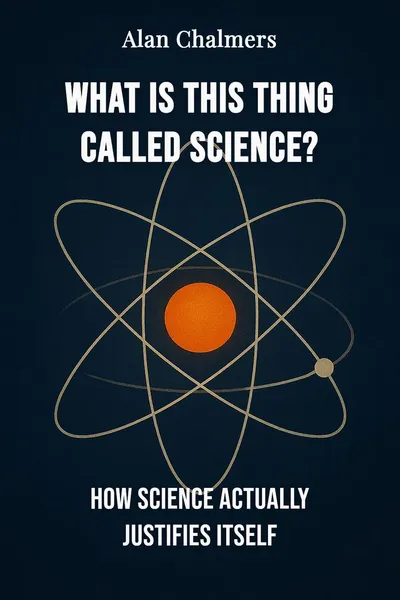
In 1976, an Australian philosopher named Alan Chalmers published a slim paperback with an oddly casual title: What Is This Thing Called Science? It looked like a student primer, and in one sense it was — generations of undergraduates got their first taste of philosophy of science from it. But the book was doing something sharper than an introduction usually does. It took the confident, common-sense picture most of us carry around — science is what happens when you gather the facts, run the experiments, and let the evidence decide — and it started pulling threads until the whole thing came loose in our hands.
We tend to treat science as the gold standard of knowing. When we want to end an argument, we say a claim is scientific, or that it isn't, as if the word settled everything. Behind that reflex sits an assumption we rarely examine: that there's a method, a recipe, something science does that astrology and palm-reading don't. Chalmers spent his book chasing that recipe. And the more carefully he looked, the harder it became to write it down in any form that survived scrutiny.
The interesting part isn't that he tore down naive faith in facts. Plenty of people have done that. It's where the demolition led — through some of the twentieth century's biggest quarrels about what knowledge even is, and out the other side into a position stranger and more honest than the one he started with. Chalmers wasn't out to embarrass science. He was trying to understand what, exactly, it is we admire when we admire it.
The question we’re asking : If science can't be defined by a single method, what actually separates it from everything that only dresses up like it?What we’ll see : How three great attempts to pin science down each cracked under pressure — and what Chalmers salvaged from the wreckage.
Table of contents
01 Chapter 1 — The dream of building knowledge from facts
Start where most of us start, because Chalmers does. Science, on the common view, is knowledge built up from observation. You look at the world without prejudice, you record what you see, and from enough careful observations you draw general laws. Facts come first, theory second. It's a picture with real dignity — it's what let science shake off dogma and authority in the first place. The scientist doesn't cite scripture; the scientist checks.
This is inductivism, and its engine is induction: reasoning from many particular cases to a universal rule. We've seen the sun rise every morning on record, so we conclude the sun always rises. We've observed metals expand when heated, so we announce that all metals expand when heated. Pile up enough confirming instances under enough varied conditions, and the generalization seems earned. It feels like the most reasonable thing in the world.

02 Chapter 2 — Popper turns it around
Karl Popper thought he had the way out, and Chalmers gives his solution a fair, admiring hearing before testing it. Popper's move was to stop trying to prove theories and start trying to break them. You can never confirm a universal law no matter how much evidence you collect — but a single genuine counter-example can refute it. So the logic of science runs the other way from what inductivism imagined. Science doesn't accumulate proof. It survives attempts at destruction.
This is falsificationism, and it comes with a demarcation test built in, which is exactly what Chalmers is hunting for. A theory is scientific if it forbids something — if it sticks its neck out and says here is what you will not observe. Einstein's general relativity predicted that starlight would bend by a precise, measurable amount near the sun; if it hadn't, the theory was finished. That's a bold, risky claim. Compare it, Popper said, with the kind of theory that can explain any outcome after the fact, whatever happens. A theory that can't fail can't teach us anything. The good scientist proposes daring conjectures and then tries hardest to kill them.
03 Chapter 3 — Kuhn brings in the crowd
Thomas Kuhn changed the subject, and Chalmers treats his intervention as the moment the whole debate shifted ground. Popper and the inductivists had argued about the logic of a lone theory facing the evidence. Kuhn, a historian as much as a philosopher, asked how science actually behaves over time, in communities, across generations. What he saw didn't match either picture. His 1962 book, The Structure of Scientific Revolutions, put a word into general circulation that has never left it: paradigm.
A paradigm, in Kuhn's telling, is the whole package a scientific community shares — the accepted theories, the standard techniques, the exemplary problems, the sense of what counts as a good question and a good answer. Most of the time, scientists aren't trying to overthrow anything. They're doing what Kuhn called normal science: solving puzzles inside the paradigm, taking its framework for granted, extending and refining it. Far from constantly testing their deepest assumptions, they lean on them. That's what makes the detailed work possible at all.
04 Chapter 4 — The line that keeps moving
Here is where Chalmers steps back, and his conclusion is quietly radical for a book that reads like a textbook. Each attempt to fence science off with a single, universal criterion — verify by induction, refute by falsification, judge by method — has failed on its own terms. So Chalmers stops looking for the fence. There is no timeless recipe, no formula you could hand to a Martian, that separates science from non-science once and for all. The very idea that such a thing must exist, he suggests, is itself a prejudice we should question.
This sounds like surrender, but Chalmers means it as clarity. Dropping the search for one grand method doesn't mean everything is equally good, or that anything goes. It means we assess sciences by looking at what their theories actually claim, how well those claims meet the world, and how they've fared under real pressure — physics judged by the standards physics has developed, not by a rulebook imported from outside. The aims and methods of a science can themselves change as the science grows. Standards evolve along with knowledge. There is no fixed point above the whole enterprise from which to grade it.
05 Conclusion
The book's title is a question, and Chalmers never pretends to close it with a definition. He takes apart three of the most powerful answers ever offered — facts build laws, bold theories court refutation, communities live inside paradigms — and shows that each captures something real while none captures everything. What's left standing is not a theory of science so much as a mature refusal to oversimplify one. The recipe we all half-assume exists turns out not to.
Related books











