Weeds
The secret lives of weeds
Description
Pull a dandelion out of a lawn and you perform an ancient gesture. The plant comes up with a taproot that snaps, leaving enough underground to grow back by next week, which is roughly the point. In his 2010 book Weeds, the British nature writer Richard Mabey opens on this small domestic war — the gardener on their knees, the plant that will not concede — and asks a question that turns out to have no botanist's answer. What, exactly, is a weed? There is no family, no genus, no measurable trait that marks one out. A rose in a wheat field is a weed. Wheat in a rose bed is a weed. The category is not in the plant. It is in us.
Mabey had spent decades writing about the British countryside, and he came to weeds not as pests to be catalogued but as a subject worth taking seriously on its own terms. He follows them through the Bible and Shakespeare, through medieval herbals and Victorian moral panic, through his own overgrown patch of ground and the bombsites of wartime London, which bloomed with rosebay willowherb while the city was still smoking. Along the way the plants stop being a nuisance and become something stranger: opportunists, travellers, survivors that thrive on exactly the disruption we create.
The book resists the obvious verdict. Weeds are not simply villains, and Mabey is too good a naturalist to flip the story and make them heroes instead. What he offers is closer to a portrait — of plants that shadow human activity so faithfully that they have become, in a sense, our companions, and of the long cultural habit of loathing them for it.
The question we’re asking : Why do plants we call weeds follow us everywhere, and what does our hatred of them reveal?What we’ll see : How a plant becomes a weed, why our disturbance is their opportunity, the stories we've told about them, and what the whole quarrel says about our idea of nature.
Table of contents
01 Chapter 1 — A plant in the wrong place
The definition everyone reaches for is the tidiest and the least satisfying: a weed is a plant in the wrong place. Mabey likes it precisely because it gives the game away. Wrongness is not a botanical property. It is a judgement, and the judge is always us. The same species can be a treasured wildflower on a chalk down and a menace three fields over. Ragwort is poison to horses and a nursery for the cinnabar moth. Nothing about the plant changes when it crosses the line we've drawn. Only the meaning does.
He traces how long that meaning has been in force. The word itself is old, and the trouble it names is older. The Book of Genesis has God curse the ground so that it brings forth thorns and thistles — weeds arrive in Western thought as a punishment, the soil's revenge for original sin. Farming and weeding are born together, because the moment you decide one plant matters more than the rest, everything else becomes competition. The gardener and the weed are the same invention seen from two ends.

02 Chapter 2 — The passengers of human disturbance
The deepest insight in Mabey's book is that weeds are, above all, followers. Wherever people break ground — plough a field, build a road, raze a house, dig a trench — we create the raw, sunlit, nutrient-rich conditions that these plants are built to exploit. They are the vegetation of disturbance, and no creature disturbs the earth like the human one. In this sense the weed is not an intruder on human territory. It is a product of it. We manufacture their habitat with every act of construction and cultivation.
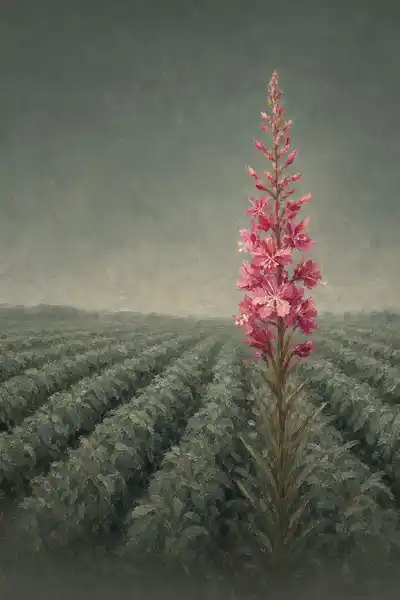
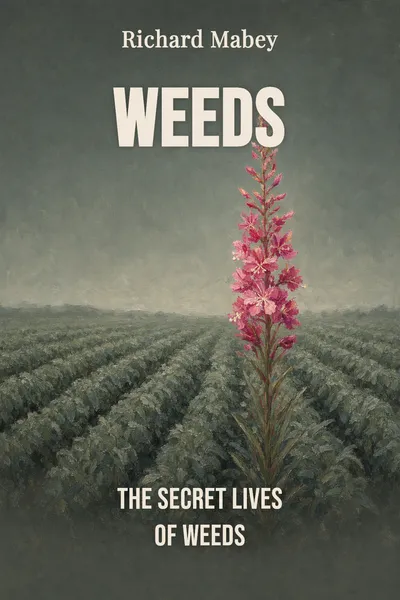
Mabey's most haunting example is the London Blitz. As bombs flattened whole streets, the ruins filled within a season or two with rosebay willowherb, its magenta spires rising over the rubble so thickly that Londoners nicknamed it bombweed. The plant had been relatively scarce a century before; the disturbance of war handed it a continent of bare ground. Oxford ragwort did something similar, escaping a botanic garden and spreading along railway lines, whose cinder beds mimicked the volcanic slopes of its native Sicily. The trains carried its seeds in their slipstream from town to town.
03 Chapter 3 — The story we tell about invaders
If weeds are so faithfully useful as survivors, why the depth of the loathing? Mabey argues that our reaction is rarely proportionate to any real harm, and that the language gives it away. We speak of weeds the way we speak of enemies — they invade, they choke, they smother, they take over. The vocabulary is military, and often moral. This, he suggests, is because weeds threaten something we care about more than the yield of a flowerbed: our sense of control, of a clean line between the cultivated and the wild.
He is sharp about how that anxiety spills into culture. Weeds and their botanical cousins have long served as figures for whatever a society fears is creeping in — foreignness, contamination, the loss of order. Mabey points to the triffids of John Wyndham's novel, walking predatory plants, and to the seed pods of Invasion of the Body Snatchers, where alien vegetation quietly replaces people while they sleep. The horror in these stories is vegetable: a green, patient, spreading thing that cannot be reasoned with and will not stop. It is the weed anxiety turned into nightmare.
04 Chapter 4 — What the weed says about us
Step back from the individual plants and Weeds becomes a book about a line — the one we draw between nature and the garden, the wild and the tended, what belongs and what intrudes. Mabey's real subject is that this line is entirely our own invention, and that weeds are the plants that live along it, refusing to stay on the side we've assigned them. They are wild things that have learned to thrive in our most managed spaces, which is exactly why they unsettle us. They prove that the boundary is not a wall but a fiction we maintain by constant weeding.
This reframes the whole quarrel. When we pull a weed we are not really defending nature against disorder. We are defending one arrangement of nature — our arrangement — against another that arrives on its own. Mabey notes that the plants we call weeds are often the ones doing the ecological work we claim to want: colonising ruined ground, holding thin soil together, feeding insects, healing scars in the land. A bombsite left to willowherb is not dying. It is recovering, in the only way bare earth knows how.
05 Conclusion
Mabey ends more or less where he began, on his knees in a patch of ground, except that the dandelion has changed its meaning. It is still in the wrong place. But wrongness now looks like the wrong word for a plant that is doing precisely what plants do when soil is opened to the sun. The war between the gardener and the weed has not ended; it simply can't be won, because every act of clearing prepares the next generation's welcome.
Related books