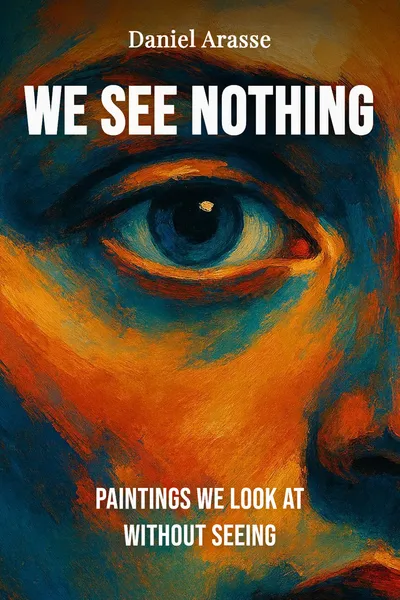
We See Nothing
Paintings we look at without seeing
Description
There is a small snail in the corner of an Annunciation painted around 1450 by Francesco del Cossa, sitting on the painted ledge, close enough to the frame that visitors lean in and then lean back, puzzled. It is roughly life-size, which is strange, because everything else in the picture is not — the Virgin, the angel, the tiled floor receding toward a vanishing point are all bound by the rules of perspective. The snail obeys nothing. For centuries the standard art-historical answer was that it symbolized something: the Virgin's purity, a medieval belief about how snails reproduce. Daniel Arasse, a French historian of Italian Renaissance painting, found that answer too quick, and spent a chapter refusing it.
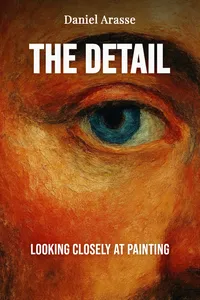
That refusal is the engine of his book, published in French in 2000 under a title that translates as "we see nothing." It is written as a series of letters, arguments, even a small quarrel with an imaginary colleague — a historian who reaches for the dictionary of symbols before the painting has finished being looked at. Arasse's complaint is not that iconography is wrong. It is that it lets us stop looking. We name the snail, file it under a meaning, and move on, having never actually seen where the painter put it or why it sits at that exact scale on that exact edge.
The book takes a handful of famous paintings — a Tintoretto, a Titian, a Bruegel, a Velázquez — and slows down in front of each one until the familiar image starts to come apart. What emerges is less a set of new interpretations than a way of standing before a picture, one that treats the painter as someone who thought with paint and expected to be caught doing it.
The question we’re asking : What happens when we stop naming what a painting shows and start seeing where the painter put it?What we’ll see : How a handful of overlooked details — a snail, a distant town, a mirror, a woman's downward glance — quietly rearrange pictures we thought we already knew.
Table of contents
01Chapter 1 — The snail nobody asked about
Del Cossa's Annunciation hangs in Dresden, and for most of its life the snail on its front ledge was explained away before anyone had really registered it. The going interpretation borrowed a medieval notion that snails were conceived from dew, without a mate — a neat parallel to the virgin conception happening behind it. Case closed, meaning assigned. Arasse's objection is disarmingly simple: that reading tells us what the snail means, but it says nothing about where it is. And where it is turns out to be the whole point.
The snail is not really in the painting. It sits on the painted ledge at the very bottom edge, roughly at the scale of a real snail — which means it is on the threshold between the depicted scene and our own space. Everything inside the picture shrinks according to perspective; the tiles, the columns, the two figures all recede. The snail alone is life-sized, as if it had crawled up out of the room where we stand rather than out of the story. It belongs to us, not to Mary and the angel.

02Chapter 2 — What the guidebook forgets to see
The same impatience distorts our reading of larger pictures, where a title tells us what we are looking at and our eye obediently confirms it. Arasse is drawn to paintings whose ostensible subject sits in one corner while the canvas spends most of its energy elsewhere. Bruegel's landscapes are his favorite kind of trap: a scene labelled with a great biblical or mythological event, in which that event has been shrunk almost out of sight and the world around it carries on, indifferent.
The famous case is the fall of Icarus, a small pair of legs vanishing into the sea while a ploughman turns his furrow and a ship sails past, none of them looking. Whether or not that particular panel is entirely by Bruegel's hand has been debated, but the structure is one Arasse traces across the painter's work: the named subject is not where the painting looks. We come armed with the title, find the tiny catastrophe, tick it off, and miss that the picture is built to make us miss it.
03Chapter 3 — The private joke of a woman in a painting
Arasse's boldest chapter reads Titian's so-called Venus of Urbino, painted in 1538, a reclining nude who has been described for centuries in the vocabulary of ideal beauty, marital allegory, or discreet eroticism. He notices instead the woman's hand, resting between her thighs, and the fact that she is looking directly out at us. And he asks the question the art-historical tradition has worked hard to avoid: what if the gesture is exactly what it appears to be, and the painting knows it?
He constructs the chapter as a mischievous, almost gossipy argument, imagining the objections of a more decorous colleague and answering them one by one. The point is not to be provocative for its own sake. It is that the machinery of respectable interpretation — allegory, symbolism, the nuptial reading — functions here as a way of not seeing a woman's frank, self-possessed gaze and the deliberate placement of her hand. The learned frame becomes a veil over the plainest thing in the picture.
04Chapter 4 — Looking as a discipline, not a reflex
Behind every one of these close readings sits a single claim about attention. Arasse is not really arguing about snails or gazes; he is arguing that we have largely lost the ability to look at a painting, and that the loss is disguised as knowledge. We recognize instead of seeing. We match the image to a caption, a symbol, a movement, a name, and the speed of the match feels like understanding when it is closer to the opposite — a way of being finished with the picture before it has begun.
His title is deliberately double-edged. "We see nothing" is both an accusation and a starting point. It names our habit of standing before great paintings and registering almost none of what is there, and it also names the humility the book asks for: the willingness to admit that we have not yet seen, that the picture is still ahead of us. Seeing, in this account, is not a passive reception of an image. It is slow, effortful, and easy to fake.
05Conclusion
The snail is still there on the edge of del Cossa's Annunciation, life-sized, refusing perspective, waiting on the border between the painted mystery and the room we stand in. Arasse's achievement is not that he decoded it, but that he made us pause in front of it long enough to feel how odd it is — and then to feel how much of every painting we have been walking past. Across a Titian, a Bruegel, a snail, the same lesson accumulates: the meaning we reach for first is usually the one the picture is least interested in.
Related books