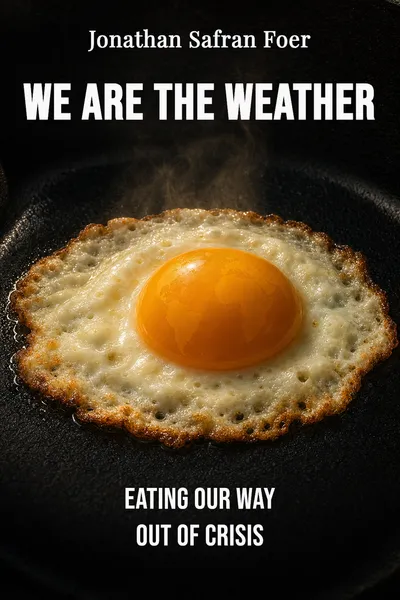
We Are the Weather
Eating our way out of crisis
Description
In 2016, a novelist better known for family sagas than for carbon math sat down to write about the planet warming and found he could not get through a single chapter. Jonathan Safran Foer, the author of Everything Is Illuminated and Extremely Loud & Incredibly Close, kept walking away from his own manuscript. He knew the science. He believed it. And still he could not make himself feel it the way he felt the death of a grandparent or the birth of a child. That failure — his own, not the reader's — became the subject of the book he eventually published in 2019, We Are the Weather.
The book is not another inventory of melting ice and rising seas. Foer takes the facts as settled and asks a stranger question: why, when we know all of this, do we behave as if we don't? He turns the lens on the least glamorous corner of the crisis — the food on the plate, and specifically the animals we raise to eat. Livestock, it turns out, sit near the center of the emissions story, and the fork sits within reach of nearly everyone. No summit required, no policy passed. Just breakfast.
What follows is part memoir, part reportage, part uncomfortable ethics lesson delivered by someone who counts himself among the guilty. Foer is not writing as an expert issuing instructions. He is writing as a person who eats cheeseburgers on the road while telling his sons the planet is dying, and who cannot square the two. That honesty is the engine of the book — and its provocation.
The question we’re asking : If we genuinely believe the planet is in danger, why is the gap between what we know and what we actually do so wide — and can something as small as changing breakfast begin to close it?What we’ll see : A novelist's reckoning with denial, the hidden weight of what we eat, and the argument that collective daily choices matter as much as the systemic fixes we keep waiting for.
Table of contents
01 Chapter 1 — The grandmother who saved her own life
Foer opens far from any climate conference, with his grandmother. She survived the Holocaust as a girl, fleeing on foot across occupied Europe, starving. In one story she tells, a farmer offered her a piece of meat, and she refused it because it was pork and she kept kosher even then, even close to death. The child Foer, hearing this, cannot understand. His grandmother's answer is the sentence the whole book turns on: if nothing matters, there's nothing to save.
He uses her not as decoration but as a measuring stick. Her survival depended on people who acted — who hid her, fed her, took a risk when it would have been easier and safer to look away. The great crises of history, Foer suggests, are not resolved by the few who do something extraordinary but by the many who do something small and inconvenient at the right moment. The problem is that the right moment rarely announces itself as urgent. It arrives disguised as an ordinary Tuesday.

02 Chapter 2 — What the plane ticket hides
When people picture their carbon footprint, they picture a car, or a flight, or a coal plant somewhere out of sight. Foer wants to redirect that gaze to the least examined thing in the room: the animal on the plate. Raising livestock for food is responsible for a large share of human-caused greenhouse emissions — the figure most often cited sits around a sixth of the global total, and Foer notes that animal agriculture rivals the entire transportation sector, cars, planes and ships combined.
The mechanism is not just the obvious one. Cattle emit methane, a gas that traps far more heat than carbon dioxide over its lifetime in the atmosphere. But the story runs deeper: forests cleared to grow feed and graze herds, land that would otherwise pull carbon out of the air, water consumed at scales hard to picture. Foer is careful here. He is a former vegetarian who has lapsed and returned more than once, and he does not pretend the numbers are simple or that any single study is gospel. He phrases the science as a weight of evidence, not a verdict.
03 Chapter 3 — The gap between believing and doing
The heart of the book is not information; it is the strange distance between knowing and behaving. Foer stages an argument with himself, at times literally, in a chapter written as a dialogue between his convinced self and his skeptical self. The skeptic keeps winning small victories. What difference does one person's breakfast make? Isn't this just guilt theater while corporations pollute freely? Won't giving up meat make me miserable and self-righteous without saving a single glacier?
Foer refuses to wave these away, because he feels their pull himself. He admits he continued eating meat while writing a book urging others to stop. He is not the reformed sinner preaching from safety; he is reporting live from the middle of his own hypocrisy. That refusal to pose as clean is what keeps the book from tipping into the lecture he clearly dreads becoming. He knows that nothing hardens resistance faster than a moralist who has already won his private battle.
04 Chapter 4 — A revolution that starts at breakfast
Step back, and the book's real argument comes into focus, and it is not really about food at all. It is about the shape we expect salvation to take. We imagine that a crisis of this size must be met by something equally grand — a technology, a treaty, a hero. Foer's provocation is that the crisis will more likely be met, if it is met, by something almost embarrassingly modest: a great many people declining animal products before dinner, most days, without applause and without certainty that it matters.
This runs against every instinct we have about virtue. We are drawn to the dramatic sacrifice, the one big gesture, precisely because it is legible and finite. What Foer asks for is harder in a subtler way — a small change sustained forever, invisible to others, whose payoff is statistical and delayed. It is the opposite of heroic. It is closer to the unglamorous decency of the people who hid his grandmother, who did not think of themselves as saving history but simply did the next needed thing.
05 Conclusion
The book ends where it started, with the failure that produced it. Foer never becomes the confident advocate the subject seems to demand. He remains a person tempted by the burger, unsure his restraint will register in any ledger, aware that he is asking of others a change he has struggled to make himself. That unresolved honesty is what makes the plea land. He is not standing above the gap between knowing and doing; he is standing in it, waving.
Related books