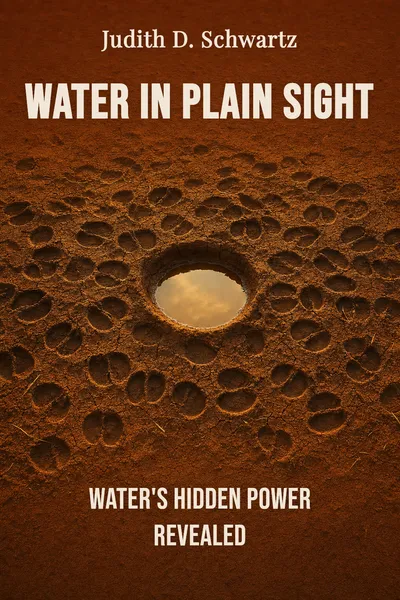
Water in Plain Sight
Water's hidden power revealed
Description
In the highlands of Zimbabwe, at a research station called Dimbangombe, Judith Schwartz stood on land that had been given up for dead. The rivers ran only after storms and then vanished. The soil was bare, crusted, the color of old bone. Then she watched something that contradicted everything the standard account of desertification would predict: cattle, herded in tight bunched groups the way wild grazers once moved, were bringing the grass back. Where the herds had trampled and dunged the ground, water no longer ran off in sheets. It sank in. A seasonal river had started flowing year-round again. The land was learning, against expectation, to hold onto its own rain.
Schwartz, an American journalist, had come to write about carbon and soil. She left convinced she had been looking at the wrong element the whole time. Water, she argues in Water in Plain Sight, is the thing hiding in every environmental story we tell — droughts, floods, failing farms, warming air — and it behaves nothing like the way most of us picture it. We treat it as a stock: so many gallons in the reservoir, so many inches of rain, a fixed amount to fight over. She kept meeting people who treated it instead as a flow, a cycle they could nudge, and who were getting results that the stock model said were impossible.
The book travels from Zimbabwean rangeland to Texas ranches, Mexican watersheds, and Australian farms, collecting cases of land brought back to life by managing water differently. What links them is a claim that sounds almost too simple: much of what we call water scarcity is not a shortage of water but a failure to keep the water we already get. The solutions, Schwartz insists, are not exotic. They are, mostly, already there, waiting to be noticed.
The question we’re asking : What if most of what we call water scarcity is not a lack of rain but a landscape that can no longer hold what falls?What we’ll see : How degraded land loses its water, how living soil and moving herds win it back, and why the water cycle is something we take part in rather than merely endure.
Table of contents
01 Chapter 1 — The water we stopped seeing
The way most of us learned the water cycle, it happens somewhere above us. Water evaporates from oceans, forms clouds, falls as rain, runs to the sea, repeats. Rain is weather; weather is what arrives. In that picture, the land is a passive floor the water lands on. Schwartz's book is a long argument that this floor is doing far more than we credit — and that when it stops, the consequences show up as drought and flood that we then blame on the sky.
Consider what happens to an inch of rain on bare, compacted ground versus on ground covered in living plants and porous soil. On the bare ground, the water hits a crust, pools, and races off toward the nearest gully, carrying topsoil with it. Very little soaks in. On living ground, roots and soil organisms have built a spongy structure riddled with channels; the same inch sinks down, gets held, feeds plants, recharges what lies beneath. Same rainfall, two completely different outcomes. One landscape is functionally in drought after a storm; the other is fine.

02 Chapter 2 — How land learns to hold water
The engine of the slow water cycle, it turns out, is soil that is alive. Healthy soil is not dirt; it is a dense community of bacteria, fungi, and organic matter that together create structure — the crumbs and pores that let water enter and stay. A key player Schwartz introduces is a sticky protein called glomalin, produced by mycorrhizal fungi living on plant roots. Glomalin binds soil particles into aggregates, and those aggregates are what give soil its sponge-like ability to soak up and hold moisture. Kill the biology, and the sponge collapses into something closer to concrete.
This is why the grazing story at Dimbangombe is not a curiosity but a principle. The approach, developed by the biologist Allan Savory and often called holistic management, works from the observation that grasslands evolved alongside large herds of grazers that moved constantly, bunched against predators. The animals ate, trampled old growth into the soil as mulch, dunged, urinated, and moved on, leaving the land to recover. Remove that disturbance, or replace it with cattle that linger and nibble the same spot forever, and the grassland degrades. Restore the movement, and the soil starts rebuilding — which means it starts holding water again.
03 Chapter 3 — The rain that plants make
If the first surprise in Schwartz's book is that land holds water, the second is that land helps make rain. Here she leaves the soil and follows the water up into the air, into territory that even now sits at the edge of mainstream climate science. The claim is that vegetation does not simply receive precipitation — it participates in generating it, and clearing forests and grasslands can shut down rainfall over huge areas.
The mechanism has several strands. Forests transpire enormous volumes of water into the atmosphere, and that moisture becomes rain downwind; a molecule that falls on the coast can be transpired and re-rained inland many times, in what researchers call a flying river. Cut the forest and you cut the relay, so the interior dries. Schwartz also relays a striking and still-debated idea from two Russian physicists, Anastassia Makarieva and Victor Gorshkov — the biotic pump — which proposes that the condensation of moisture over intact forests creates low-pressure zones that actively draw moist ocean air inland. In this view, great forests do not merely enjoy rain; they pull it toward themselves.
04 Chapter 4 — A different set of instruments
Step back from the case studies and the argument of Water in Plain Sight comes into focus as a change of instruments. For a century we have managed water almost entirely as engineers of the fast cycle: dams to store it, pipes to move it, allocations to ration it, models that treat rainfall as a fixed input from an indifferent sky. It is a mindset of accounting — count the gallons, divide them, defend your share. Schwartz's people work with a different set of tools, because they are managing a cycle rather than a quantity.
This shift matters because it changes who has agency. If water is a stock handed down by the climate, then the only responses are to build bigger reservoirs, drill deeper wells, or move away. If water is a cycle the land participates in, then a rancher, a farmer, a village, a watershed committee can influence how much water their landscape holds and even how much rain it draws. Scarcity stops being a fate and becomes, at least partly, a consequence of stewardship. That is a far less comfortable idea than it sounds, because it makes degradation something we did rather than something that happened to us — but it is also the source of the book's stubborn hope.
05 Conclusion
The seasonal river at Dimbangombe that started flowing again is the image Schwartz returns to, because it compresses her whole case into one observable fact. Nobody piped water in. Nobody prayed for extra rain. Herds moved, grass returned, soil rebuilt its structure, and the land began holding what the sky had always given it. What looked like a permanent loss turned out to be a reversible condition, and the reversal cost less than the fight over the dwindling supply would have.
Related books