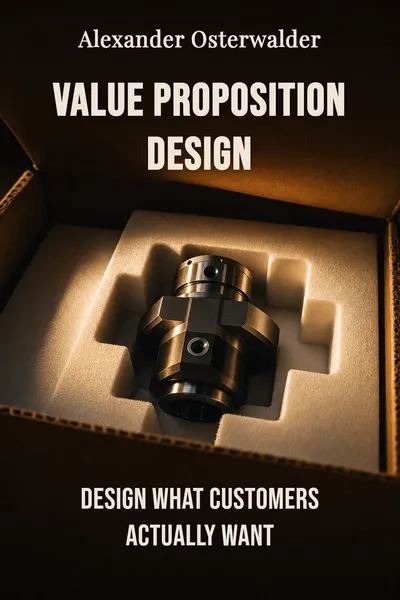
Value Proposition Design
Design what customers actually want
Description
Most products that fail don't fail because the engineering was bad. They fail because nobody wanted them. Alexander Osterwalder, the Swiss thinker who a few years earlier had given the business world the Business Model Canvas, kept running into the same graveyard: teams that built beautifully, launched confidently, and watched the market shrug. In 2014, with Yves Pigneur, Greg Bernarda and Alan Smith, he published a book to attack that specific problem head-on — not how to build a company, but how to figure out, before you spend a fortune, whether the thing you're building matches what someone actually needs.
The book is called Value Proposition Design, and it's less a book to read than a book to work in. It's built around a single tool, the Value Proposition Canvas, and around a stubborn idea: that the gap between what a team assumes customers want and what customers actually want is enormous, invisible, and expensive. We fill that gap with our own conviction. We fall for our idea. And conviction, it turns out, is a terrible substitute for evidence.
What Osterwalder and his co-authors offer instead is a method — visual, repeatable, almost mechanical — for making that gap visible, then closing it deliberately rather than hoping it closes on its own. The promise is not inspiration. It's a way to be systematically less wrong about strangers.
The question we’re asking : How do we design something people actually want, instead of something we're merely proud of?What we’ll see : A single tool, a way of thinking about customers, and the uncomfortable discipline of testing our best ideas before betting on them.
Table of contents
01 Chapter 1 — The trap of falling in love with your own idea
The book opens on a confession disguised as a diagnosis. Teams don't usually fail because they can't execute. They fail because they build something the world greets with indifference. Osterwalder calls this the value proposition problem, and its root cause is almost embarrassingly human: we get attached. We spend months, sometimes years, on an idea, and somewhere in that time the idea stops being a hypothesis we're testing and becomes a truth we're defending.
The trouble is that a value proposition — the bundle of products and services a company offers, and the reasons a customer should care — lives entirely in the customer's head, not the founder's. What matters isn't how elegant the offer is. It's whether it lands on something the customer is genuinely trying to get done, or a pain they'd genuinely pay to remove. And the customer rarely tells us this in advance, partly because they can't articulate it, partly because we're not really listening.

02 Chapter 2 — The Value Proposition Canvas, in two halves
The heart of the book is a single diagram with two sides that must eventually meet. On the right sits the customer profile, a circle. On the left sits the value map, a square. The whole discipline is getting the square to fit the circle — literally, in the drawing, and figuratively, in the market. The visual language is deliberate: Osterwalder wants teams to draw, argue, move sticky notes, and see their thinking rather than bury it in prose.
The customer profile breaks a person down into three things. First, their jobs — the tasks they're trying to complete, the problems they're trying to solve, the needs they're trying to satisfy, whether functional, social, or emotional. Second, their pains — everything that annoys, blocks, or scares them before, during, and after getting those jobs done. Third, their gains — the outcomes and benefits they want, from the strictly necessary to the delightful surprise. The move here is to describe the customer on their own terms, not through the flattering lens of what we happen to sell.
03 Chapter 3 — From fit on paper to fit in the market
Getting the square to fit the circle on a whiteboard produces what the book carefully calls problem-solution fit: our assumptions line up. That's a real milestone, and also a mirage if we stop there. Fit on paper is still a set of hypotheses drawn in marker. The customer hasn't voted yet. The second half of the book is about earning the votes.
This is where the method borrows the logic of lean startup thinking and makes it concrete. Every element on the canvas — every job we assumed, every pain we claimed to relieve — is a bet. The task is to identify which bets, if wrong, would sink the whole thing, and to test those first. The book pushes teams to get out of the building and into contact with actual customers, running small, cheap experiments: interviews, prototypes, landing pages, mock sales, anything that produces a signal from a real person spending real attention or money.
04 Chapter 4 — What the canvas is really arguing about
Strip away the sticky notes and the diagrams, and Value Proposition Design is making a quiet argument about where value actually lives. We tend to talk as if value were a property baked into a product — the way weight is baked into a stone. Build a good enough thing, the reasoning goes, and its value is simply there, waiting to be noticed. The canvas rejects that flatly. Value isn't inside the product. It's something the customer grants, from their side, based on their jobs, their pains, their gains. The same object is worth a fortune to one person and nothing to the person beside them.
That reframing has teeth. It means the creator is never the authority on how good their own offer is. The customer is. And since the customer is a moving, half-articulate, often surprising target, value can never be settled once and declared. It has to be discovered, and re-discovered, in an ongoing negotiation the company doesn't get to win by fiat. The canvas is really a device for keeping that negotiation honest — for making sure the loudest voice in the room isn't automatically the most confident one.
05 Conclusion
The book ends more or less where it began, with the customer's head as the one place value actually gets decided. The Value Proposition Canvas doesn't promise a great idea; it promises a way to keep checking whether the idea we have is the one someone else wants. Map the customer honestly, map your offer against it, find the fit on paper, then go earn it through experiments cheap enough to survive being wrong. That's the whole loop, and its power is that it's boring, repeatable, and hard to fool yourself inside of.
Related books