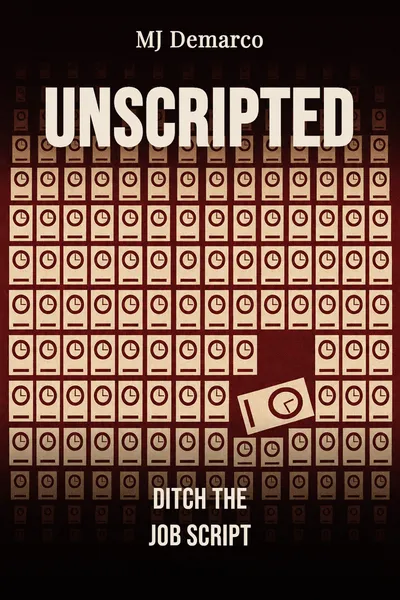
UNSCRIPTED
Ditch the job script
Description
Somewhere around the age of five, most of us receive a set of instructions we never asked for. Study hard, get good grades, land a stable job, save a slice of every paycheck, invest it in an index fund, and wait. Wait forty years. Then, around sixty-five, if the market cooperates and your knees hold out, you get your life back. MJ DeMarco calls this bundle of instructions the Script — capital S — and in UNSCRIPTED he treats it the way a mechanic treats a car that keeps breaking down: not as bad luck, but as a design flaw nobody flagged.
DeMarco isn't writing as a professor or a life coach. He's writing as a guy who spent his twenties broke, living with his mother, driving a limousine, before he built and sold an internet company and retired young. His earlier book, The Millionaire Fastlane, made the case against slow-and-steady wealth. UNSCRIPTED, published in 2017, goes further — it argues that the problem isn't just financial. It's that we've outsourced the authorship of our own lives to a story written by people who profit when we follow it.
The book is loud, occasionally abrasive, and unapologetically motivational. But underneath the exclamation points sits a genuinely uncomfortable claim: that the safest-sounding path — the job, the pension, the retirement date — is quietly the riskiest, because it hands your time to someone else and gives you money back at a rate that rarely buys freedom. What DeMarco wants isn't a raise. It's ownership.
The question we’re asking : What exactly is the Script we've all been handed, and what does DeMarco offer in its place?What we’ll see : How a man who drove limos came to see the safe path as the risky one, and what building instead of borrowing actually looks like.
Table of contents
01 Chapter 1 — The script we never chose
DeMarco's central image is theatrical. A script is something an actor recites — lines written by someone else, performed on cue, night after night. The Script, in his telling, is the life plan we absorb before we're old enough to question it. Go to school. Get the degree. Find the job. Marry, mortgage, commute, contribute to the 401(k). Repeat until retirement. Nobody sat you down and pitched this plan. You inherited it, the way you inherited an accent, and by the time you notice it running your days, it feels less like a choice than like gravity.
What makes the Script sticky, he argues, is that it isn't obviously wrong. Every individual instruction sounds sensible. Save money — sure. Get an education — of course. Diversify your investments — who would argue? The trouble is the whole, not the parts. Followed faithfully, the Script produces a person who spends the best decades of their life trading hours for a paycheck, deferring nearly all enjoyment to a distant finish line they may not reach in good health, or reach at all.

02 Chapter 2 — The math that was never in your favor
The engine of the Script is a single transaction: time for money. You show up, you give hours, you receive wages. DeMarco's most cutting observation is that this trade is capped on both ends. There are only so many hours in a week, and your employer decides what each hour is worth. Work harder and you might earn more, but you can't clone yourself, and you can't work the twenty-fifth hour. Your income is chained to your presence, and your presence is finite.
He's especially skeptical of the slow-wealth gospel — the idea that compounding a modest salary over forty years builds fortune. The problem isn't that compounding is fake; it's that the timeline is brutal. To retire comfortably on savings alone, most people need decades of discipline and a market that behaves. DeMarco does the arithmetic that financial advisors gloss over: at a normal savings rate, the number that actually buys freedom arrives, if it arrives, right around the age when you're too old to spend it the way you dreamed at thirty.
03 Chapter 3 — Businesses that work while you sleep
DeMarco's answer to the time-for-money trap is what he calls the unscripted path: building a business, but a specific kind. Not a job you own — that's just self-employment with a worse boss. He's dismissive of the freelancer who quits the office only to work eighty-hour weeks trading their own hours at a slightly better rate. That's still the treadmill. What he wants is a system that keeps producing value after you step away, so that income detaches from the clock.
The book is practical about how. He leans on what he'd earlier framed as commandments for a real business: it has to scale, and it has to be built on need rather than want. Solve a genuine problem for enough people, and the enterprise can grow beyond the limits of your own two hands. A software product, a book, a marketplace, a brand — these can serve a customer at three in the morning while you're asleep. That, for DeMarco, is the whole point. Value should keep flowing when your attention isn't on it.
04 Chapter 4 — The freedom nobody hands you
Strip away the motivational packaging and DeMarco is really writing about time — the one resource none of us can manufacture more of. His whole argument turns on a quiet asymmetry: money is recoverable, hours are not. You can lose a fortune and rebuild it, but the Tuesday you spent in a meeting you resented is gone permanently. The Script, in this light, isn't just a bad financial plan. It's a scheme for spending the irreplaceable thing to accumulate the replaceable one, and calling that responsible.
This is why he keeps returning to the language of authorship. To be unscripted is to hold the pen — to decide what your days contain rather than accept a template optimized for someone else's stability. It's a claim that sits at the heart of a lot of modern restlessness, the same instinct behind people leaving corporate roles, building side projects, or simply asking why the default life looks the way it does. DeMarco just states it more bluntly than most: the default was authored, and you can author something else.
05 Conclusion
The limo driver living with his mother is the figure DeMarco keeps in view, because he was that figure. His way out wasn't luck or a better job — it was refusing the story that a better job was the answer at all. UNSCRIPTED asks its reader to make the same refusal: to look at the earn-save-wait sequence, recognize it as a script rather than a law, and consider that the safest-feeling life might quietly be the one that costs the most.
Related books