Twilight of the Idols
Philosophy with a hammer
Description
In the late summer of 1888, in a rented room in Sils-Maria, in the Swiss Alps, Friedrich Nietzsche wrote a short, furious book in a matter of days. He gave it a title that mocked Wagner's grand opera Twilight of the Gods, then subtitled it, in his own words, "how to philosophize with a hammer." He was forty-three, mostly ignored, in fragile health, and about to enter the last productive months before the breakdown that would end his working life in January 1889. The book he dashed off was meant as a quick, portable summary of his whole outlook — a way in for readers who had never opened him before.
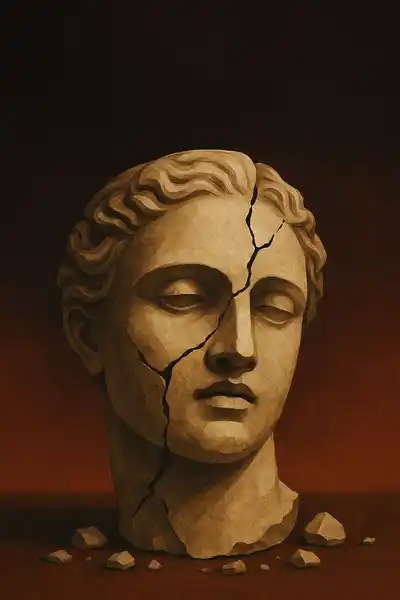
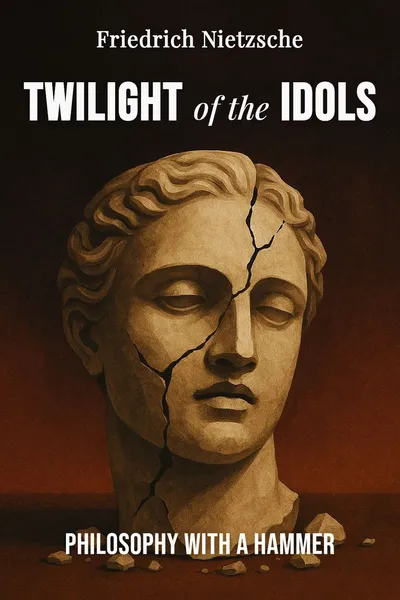
The hammer in the title is not a wrecking tool. Nietzsche compares it to the little mallet a doctor uses to tap an idol and listen for the hollow sound inside. The idols he means are the values we inherit and never question: reason, morality, God, free will, the notion that the visible world is a mere shadow of some truer one. He wants to sound them out, one by one, and hear which ones ring false. What looks eternal, he suspects, is often just old.
That suspicion is what makes the book still land. It is not a system, and it does not ask to be believed. It is closer to a friend who has stopped taking the furniture of Western thought for granted and wants to show us the seams — where a conviction came from, whose interests it served, what kind of person needed to believe it. The idols answer back with a hollow note, and the last one he taps is the oldest.
The question we’re asking : What does it mean to "philosophize with a hammer," and why does the oldest idol Nietzsche taps turn out to be Socrates?What we’ll see : How a small, late book takes apart the values the West had treated as beyond question — and traces the whole habit back to a single figure.
Table of contents
01 Chapter 1 — The book written in a week
Twilight of the Idols was composed in an astonishing rush. Nietzsche drafted most of it in the first weeks of September 1888 and had it ready for the printer by the end of that month, though it only appeared early the following year. He described it to friends as a resting point between larger works, a book you could read in an afternoon that still contained the core of everything he thought. The speed shows in the form: it is a chain of aphorisms, essays, and one-line strikes rather than a continuous argument.
He opens with a section of maxims he called "Arrows and Epigrams" — short, sharpened lines meant to wound before you can defend yourself. "What does not kill me makes me stronger" comes from here, one of the most quoted sentences he ever wrote, and one whose original setting is grimmer and drier than the motivational poster version. Around it sit dozens of others, each a little blow: against philosophers who mistake their own tiredness for wisdom, against moralists who dress up resentment as virtue.

02 Chapter 2 — How an idol is made
The central move of the book is genealogical. Nietzsche does not ask whether a value is true; he asks where it came from and what it was for. Take the long philosophical habit of treating the changing, physical world as an illusion and some unchanging "real" world as the truth behind it. In a compact section he calls "'Reason' in Philosophy," he argues that philosophers made an idol of permanence out of sheer discomfort with becoming. They could not bear that things pass, so they invented a realm where nothing does, and then called the passing world a lie.
Their instrument for this, he says, is language itself. Because our grammar puts a subject behind every verb — the lightning that flashes, as if the flash were separate from the lightning — we come to believe there must be a doer behind every deed, a soul behind every act, a God behind the world. "I am afraid we are not getting rid of God," he writes, "because we still believe in grammar." The idol, on this reading, is baked into the way we speak before we ever start to think.
03 Chapter 3 — The four great errors
The book's most systematic stretch is a section he numbers as "The Four Great Errors," and it is where the hammer does its most careful work. The errors are the mental reflexes he thinks let the idols keep standing, and he treats them almost as habits of a nervous mind rather than as arguments to be refuted.
The first is confusing cause and effect. We notice that healthy, long-lived people tend to eat and live in a certain way, and conclude that living that way produces the health — when, Nietzsche suggests, the vitality came first and the disciplined life was its expression, not its cause. The second is the invention of false causes: when something happens to us, especially something frightening, we reach for a familiar explanation that soothes us — a spirit, a sin, a divine will — because any explanation feels better than none. We prefer a known cause, even a wrong one, to the open dread of not knowing.
04 Chapter 4 — The problem with Socrates
Behind all the idols, Nietzsche places one figure, and he puts him almost at the front of the book, in a section titled "The Problem of Socrates." Socrates is where the trouble starts — the moment the West decides that thinking clearly matters more than living well, that the unexamined life is not worth living, that reason should sit in judgment over instinct. To most of the tradition, that turn is the birth of philosophy itself. To Nietzsche it is the first great symptom, the point where a confident culture began to distrust itself and reach for reasons the way a sick man reaches for a cure.
He reads Socrates less through his arguments than through his person. Here was an ugly, low-born Athenian who, by his own account, seethed with dangerous appetites — and who answered them not by mastering them in the old aristocratic way but by turning reason into a tyrant over them. Dialectic, the relentless demand to give grounds for everything, Nietzsche treats as a weapon of the resentful: a way for the clever outsider to trip up the noble and confident, who had never needed to justify their instincts and could not do it on command. Making everyone reason was a way of dragging everyone down to the terrain where the sick had the advantage.
05 Conclusion
Twilight of the Idols was one of the last things Nietzsche finished. Within months of sending it off, in Turin in January 1889, he collapsed into the mental illness from which he never recovered, and he spent his remaining eleven years unable to write, cared for first by his mother and then his sister. The book he had called a short summary of his whole philosophy became, by accident, something close to a testament — the compact statement of a mind at the height of its powers just before they went out.
Related books