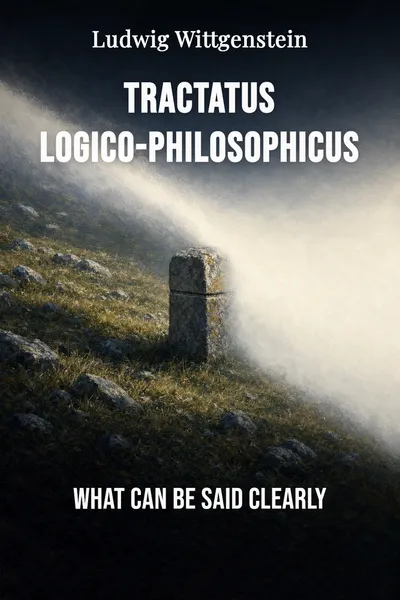
Tractatus Logico-Philosophicus
What can be said clearly
Description
In August 1918, a young Austrian on leave from the front handed his uncle a manuscript of some seventy pages. Ludwig Wittgenstein had drafted much of it in notebooks he carried through the trenches of the First World War, first fighting for Austria-Hungary, later a prisoner of the Italians in a camp near Monte Cassino. The pages were not a diary of the war. They were a set of numbered propositions about logic, language, and the shape of the world — written in a prose so compressed that each sentence seemed to have been polished until nothing could be removed. He believed he had solved the problems of philosophy, and that once the book was understood, there would be little left for anyone to do.
The book appeared in German in 1921 and in English in 1922, under a Latin title suggested by G. E. Moore: Tractatus Logico-Philosophicus. It ran to fewer than eighty pages. Its propositions were numbered like a decimal tree — 1, 1.1, 1.11 — so that the whole thing read as a single crystalline structure, each thought hanging beneath a larger one. Bertrand Russell wrote an introduction; Wittgenstein thought Russell had misunderstood him. And then, having settled philosophy to his own satisfaction, Wittgenstein left it, to teach schoolchildren in rural Austria.
It became one of the most influential works of the century, read closely by the logical positivists of Vienna even as its author kept his distance from them. What makes it strange is that a book obsessed with what language can precisely state ends by insisting that its own deepest concerns lie beyond stating. The famous last line — roughly, what we cannot speak about we must pass over in silence — is not a defeat. It is the point.
The question we’re asking : How can a book devoted to the clarity of language end by drawing a border around everything that matters most, and calling for silence beyond it?What we’ll see : How a wartime manuscript built a theory of how words touch the world, and why its author thought the result was less a doctrine than a ladder to be thrown away.
Table of contents
01 Chapter 1 — A soldier writing philosophy in the trenches
Wittgenstein came to philosophy sideways. Born in 1889 into one of the wealthiest families in Vienna, he had trained as an engineer, working on aeronautics in Manchester before questions about the foundations of mathematics pulled him toward logic. In 1911 he arrived unannounced at Cambridge to study with Bertrand Russell, who quickly decided this intense young man was the most impressive student he had ever encountered — and, before long, an equal. Russell later said that knowing Wittgenstein was one of the great intellectual adventures of his life.
When war broke out in 1914, Wittgenstein enlisted in the Austro-Hungarian army, though his wealth would easily have kept him out of the fighting. He asked to be sent to the front. He served on an artillery ship, then in an observation post under fire, and the notebooks he filled during these years mix technical logical work with private reflections on death, meaning, and how a person should live. He seems to have wanted the danger. Facing it, he thought, was part of becoming the kind of person who could see clearly.

02 Chapter 2 — The world is everything that is the case
The book opens with a line that sounds almost like a riddle: the world is everything that is the case. Not everything that exists, note — everything that is the case. Wittgenstein means that the world is not fundamentally a collection of things but a collection of facts. A chair and a floor are things; the chair standing on the floor is a fact. The world, on this view, is the totality of facts, the way things actually stand, and this small shift — from things to facts — sets up everything that follows.
Facts, in turn, are built out of what he calls states of affairs: combinations of simple objects hooked together. The objects are the fixed furniture of reality, the same across every possible way the world could be; what varies is how they combine. Reality is the objects arranged one way rather than another. This is a picture of the world as something articulated, jointed, capable of being carved into elements and their configurations — and it is designed to line up, piece for piece, with the structure of language.
03 Chapter 3 — The picture theory and the limits of the sayable
At the heart of the book is what came to be called the picture theory of meaning. A proposition, Wittgenstein argues, is a picture of reality — not a visual image, but a logical one. The way a map's marks stand for towns and roads, or the way toy cars in a courtroom model can stand for a real collision, a sentence's elements stand for objects, and the arrangement of the sentence claims that the objects are arranged the same way. A proposition shows a possible state of affairs, and it is true if the world is arranged as the picture has it, false if it is not.
For a picture to depict anything, it has to share something with what it depicts. That shared thing is logical form. But here the theory turns on itself in a way Wittgenstein found unavoidable. A picture can show its logical form, but it cannot depict that form the way it depicts a fact — it cannot step outside itself to picture the very relation that lets it picture at all. What makes representation possible cannot itself be represented. It shows itself in every meaningful sentence but can never be one of the things a sentence states.
04 Chapter 4 — What the ladder was for
Near the very end, Wittgenstein does something that has puzzled and delighted readers ever since. He says that anyone who has understood him will recognize his own propositions as nonsense — that the reader must, so to speak, climb up through them and then throw the ladder away. Having used the book to see the world rightly, one is meant to discard the book. It is one of the strangest gestures in philosophy: a work that undercuts its own claim to say anything, and treats that self-cancellation as success rather than failure.
This is where the Tractatus steps beyond a theory of logic into a stance on what thinking can and cannot reach. If the border of language is also the border of what can be stated as knowledge, then the traditional ambition of philosophy — to build doctrines about reality, the soul, the good — was misconceived from the start. Philosophy is not a body of teachings alongside the sciences. It is an activity, a kind of clarification, whose job is to mark the limit from the inside and to keep the sayable free of confusion. It draws the line; it does not colonize what lies past it.
05 Conclusion
The soldier who handed over his manuscript in 1918 believed he had finished philosophy, and for a while he acted as though he had. He gave away his inherited fortune, taught in Austrian village schools, designed a house in Vienna for his sister, worked as a gardener. He would return to Cambridge in 1929 and eventually turn against much of the Tractatus, spending his later years dismantling the picture of language it had built — the book we now call the Philosophical Investigations grew out of that quarrel with his younger self. He died in 1951, and that second work appeared only after his death.
Related books