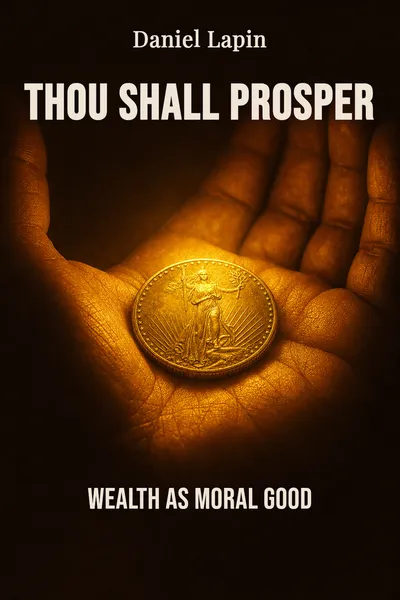
Thou Shall Prosper
Wealth as moral good
Description
Somewhere in the back of most of our minds sits a quiet suspicion about money: that the more of it someone has, the more likely they are to have done something a little shabby to get it. We inherited this without quite choosing it. The rich man and the eye of the needle, the robber baron, the sense that a fortune is a thing to be explained away rather than celebrated. Rabbi Daniel Lapin, an Orthodox rabbi who has spent decades thinking and speaking about commerce, noticed that this suspicion runs deep in Western culture — and that one community, historically, seemed strangely immune to it.
His book Thou Shall Prosper, first published in 2002, is his attempt to explain that immunity and to bottle it. Lapin's claim is blunt and, to a lot of readers, faintly scandalous: making money honestly is not a moral compromise you tolerate on the way to doing good. It is itself a moral act. To earn a living by serving other people, he argues, is one of the most dignified things a person can do. Jewish tradition, in his reading, never carried the reflexive discomfort with wealth that so much of Christendom absorbed — and that difference, he thinks, is worth studying by anyone, of any faith or none.
What follows is not a get-rich scheme, though it wears the costume of one. It is closer to a theology of the marketplace: an argument that how we feel about money quietly governs how we behave around it, and that centuries of accumulated Jewish thinking offer a template for feeling about it differently.
The question we’re asking : Can the pursuit of wealth be a genuinely moral undertaking, and what would it mean to treat it that way?What we’ll see : How one tradition reframed commerce as service, and turned that reframing into a set of everyday habits.
Table of contents
01Chapter 1 — The shame that never made sense
Lapin starts with an observation about mood. In much of Western culture, he says, wealth arrives wrapped in a low-grade guilt. We admire the self-made success and, in nearly the same breath, wonder what corners got cut. Popular stories reward the poor and suspect the prosperous; the villain, more often than not, is the one with the largest bank account. This isn't a considered philosophy so much as an inherited reflex, and Lapin's first move is to make us notice that we're carrying it at all.
He traces a good deal of the reflex to a particular strand of Christian thought — an old current that treated commerce as spiritually dangerous, lending as suspect, and material success as something to apologize for. None of this, he is careful to say, is the whole of Christianity, and much of it has softened. But the residue lingers in the culture at large, even among people who have never opened a religious text. The idea that money and virtue pull in opposite directions is simply in the water.

02Chapter 2 — Money is a certificate of service
The pivot of the book is a single reframing, and everything else hangs off it. Money, Lapin argues, is not a pile of stuff you extract from the world. It is a receipt. Each dollar in your possession is, in principle, evidence that you did something another human being valued enough to pay for. Honestly earned wealth is therefore a running tally of the times you served your fellow human — a certificate of service, in his phrase. Seen this way, a large fortune is not a hoard. It is proof of having helped a great many people.
This is why he treats business as fundamentally cooperative rather than predatory. A transaction that both sides enter freely leaves both better off, or one of them would have walked away. The baker and the customer each end the exchange happier than they began; nothing was taken. Lapin leans hard on this everyday miracle, because it undercuts the zero-sum picture — the sense that if you have more, someone else must have less — that fuels so much of the moral suspicion around wealth.
03Chapter 3 — The habits of people who make wealth
Having reframed the goal, Lapin turns to conduct, and here the book reads like a manual of dispositions rather than tactics. He is less interested in spreadsheets than in character, because he believes wealth follows from a settled way of being in the world. The recurring theme is relationship. Money moves between people, so the person who cultivates trust, keeps their word and builds a wide network of genuine connections is positioning themselves where opportunity actually lives. Commerce, for Lapin, is a deeply social act, and loneliness is bad for business as well as for the soul.
Several of his prescriptions carry an unmistakably Jewish accent. He praises the discipline of continuous study — the habit, drawn from a tradition that reveres learning, of always reading, questioning and sharpening the mind. He commends a rhythm of work and genuine rest, invoking the logic of the Sabbath: that stepping away restores the person who then returns to labor with clearer eyes. He argues for planning far beyond one's own lifetime, thinking in generations rather than quarters, the way a tradition that has survived millennia learns to do.
04Chapter 4 — The believers who count the exceptions
Step back from the specific advice and a larger claim comes into view. Lapin is really arguing that a community's economic behavior is downstream of its metaphysics — that what a culture believes about money in its bones will shape, over generations, how its members actually act around it. This is why he spends so long on feeling and framing before he ever gets to conduct. A people who quietly regards wealth as suspect will, on average, pursue it more timidly, apologize for it more often and pass that ambivalence to its children. A people who regards honest prosperity as a blessing will lean into it with fewer inner brakes.
This is the load-bearing idea beneath the book's more provocative passages, including Lapin's frank discussion of Jewish economic success across history. His explanation is not genetic and not conspiratorial; it is cultural and theological. A tradition that honored literacy, that treated commerce as respectable, that thought in long horizons and prized community bonds was, he argues, unusually well configured for the modern economy — and it got that way by believing certain things about God and money that most of its neighbors did not.
05Conclusion
We began with the reflexive suspicion that wealth is a little shameful, the sense that a fortune wants explaining. Lapin's whole enterprise is an attempt to dissolve that reflex and replace it with something close to gratitude. If money is a certificate of service, then the honestly prosperous person has nothing to apologize for and, in a sense, a great deal to be proud of — they have spent their life being useful to others, and the bank statement is merely the ledger of that usefulness.
Related books