The World in a Grain
The world runs on sand
Description
Pick up your phone. The screen you're looking at started as sand — melted, purified, and drawn into glass so flat it registers a single fingertip. The chip inside it started as sand too, refined into silicon so pure that impurities are measured in parts per billion. Now look out the window. The concrete on the building across the street, the asphalt on the road, the plate glass in the storefront: all of it is sand, bound and baked and poured. We live inside sand and barely notice it, the way we don't notice the air until it's gone.
Vince Beiser, an investigative journalist, spent years following this humble material around the world for his 2018 book The World in a Grain. What he found is that sand is not the endless, worthless stuff of childhood beaches. It is the most-used solid substance on the planet — after water and air, the natural resource we consume more of than any other, more even than oil. Roughly fifty billion tons of it are dug up every year to feed the concrete, glass, and silicon that modern life is built from. And the strange, uncomfortable punchline is that we are beginning to run short of the right kind.
That sentence sounds absurd. Sand covers the Sahara, lines every coast, fills every hourglass. How could a planet this dusty possibly run low? The answer turns out to be specific, physical, and increasingly violent — and it reaches from the skyline of Dubai to the riverbeds of India, where people have died over the stuff.
The question we’re asking : How did the most ordinary substance on Earth become the invisible foundation of modern civilization — and how are we running out of it?What we’ll see : We follow sand from the beach to the skyscraper, the microchip and the fatal riverbed, and see what our hunger for it is quietly costing.
Table of contents
01 Chapter 1 — The commodity nobody counts
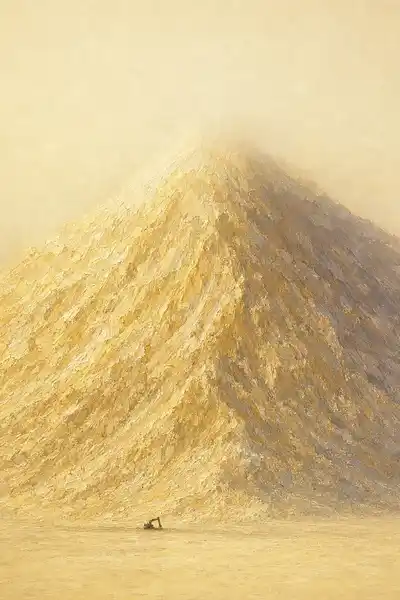
Sand is what economists call a low-value, high-volume commodity. A ton of it sells for a few dollars, which means it barely registers as a business — nobody speculates on sand futures, no country goes to war over it in the headlines. And yet by weight it is the second most extracted material on Earth after water. Beiser's figure, drawn from UN and industry estimates, is on the order of fifty billion tons a year: enough to build a wall thirty meters high and thirty meters wide wrapped all the way around the equator. We move more sand than we move coal, iron, or oil.
The reason is concrete. Concrete is essentially sand and gravel glued together with cement, and concrete is the literal foundation of the modern built world — every building, every road, every dam, bridge, runway, and parking lot. It is the most widely used manufactured material in human history. China alone, during its building boom, poured more concrete in a handful of recent years than the United States poured across the entire twentieth century. Behind every one of those numbers is a mountain of sand that had to be dug out of somewhere.

02 Chapter 2 — What glass and concrete are really made of
Not all sand is created equal, and this is the hinge the whole book turns on. Desert sand — the vast dunes of the Sahara or the Arabian Peninsula — is almost useless for building. Wind-blown over millions of years, its grains are rounded smooth, like tiny ball bearings, so they won't lock together in concrete. The sand that works is angular: grains with rough edges that grip. That kind comes mostly from riverbeds, lakes, floodplains, and the seabed. Which is why Dubai, a city rising out of one of the largest deserts on Earth, has had to import sand from Australia to build its towers. A country made of sand, buying sand.
Glass is a purer obsession still. Ordinary window glass is mostly silica sand melted at extreme heat, and the clearer and stronger you want the glass, the purer the sand must be. Beiser traces the lineage from the stained-glass windows of Chartres to the flawless flat glass of a modern facade to the optics ground for the Hubble Space Telescope. The Gorilla Glass on a smartphone is a chemically toughened descendant of the same craft. Each step demanded sand of higher and higher quality, mined from a shrinking number of deposits pure enough to deliver it.
03 Chapter 3 — The sand mafias
When a cheap, heavy material becomes suddenly scarce and valuable, the economics get ugly fast. Beiser's most jarring reporting takes him to India, where the demand for construction sand has outstripped legal supply and created a black market run by what the local press openly calls the sand mafia. Criminal networks strip riverbeds by night, bribe officials, and control access to the material a booming country needs to build. People who get in the way — journalists, activists, honest police officers, government inspectors — have been beaten, and some have been killed. Hundreds of deaths have been linked to sand-mining conflicts across the country.
The violence is not confined to India. Beiser documents illegal extraction and its attendant corruption across the developing world, from Southeast Asia to Africa. In some cases entire small islands in Indonesia have reportedly vanished, dredged away for sand shipped to Singapore, which has expanded its own landmass by more than twenty percent over decades using imported and reclaimed sand. Whole beaches have been carted off overnight in Morocco and the Caribbean, leaving nothing but bare rock where a coastline used to be. Sand theft, it turns out, is a real and lucrative crime.
04 Chapter 4 — When the beaches run out
Step back from the crime and the concrete, and the deeper subject of Beiser's book comes into focus: what it means for a civilization to run short of its most basic building material, and to have never quite admitted the material mattered. We have spent a century behaving as though sand were free, infinite, and consequence-free — the definition of a thing beneath notice. That assumption is now colliding with physical limits, and the collision is reshaping coastlines, rivers, and ecosystems that a few dollars a ton never accounted for.
The environmental bill is coming due most visibly at the water's edge. Dredging riverbeds lowers water tables, undermines bridges, and destroys the habitats of fish and river life. Stripping beaches removes the natural buffer that protects coastlines from storms and rising seas — so as the climate makes those storms worse, we are quietly dismantling the very defenses we most need. And beaches themselves, the thing sand most obviously is, are eroding worldwide, in part because the sand that once replenished them is trapped behind dams or hauled off to make cement. We are consuming the shore to build the city that the shore protects.
05 Conclusion
Hold the phone again. The glass, the silicon, the smooth grey case that feels so far from any beach — all of it began as sand, dug and dredged and refined from a resource we assumed would always be there. Beiser's achievement in The World in a Grain is to take the most overlooked substance on Earth and show that the entire architecture of modern life, from the pyramids to the skyscraper to the microchip, has been quietly resting on it the whole time. We shelter in sand, connect through it, see the world on screens made of it.
Related books