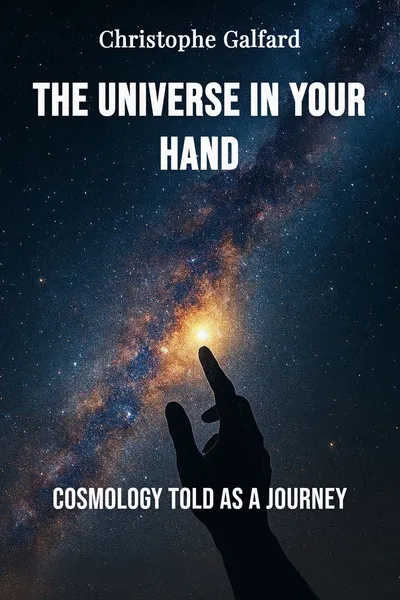
The Universe in Your Hand
Cosmology told as a journey
Description
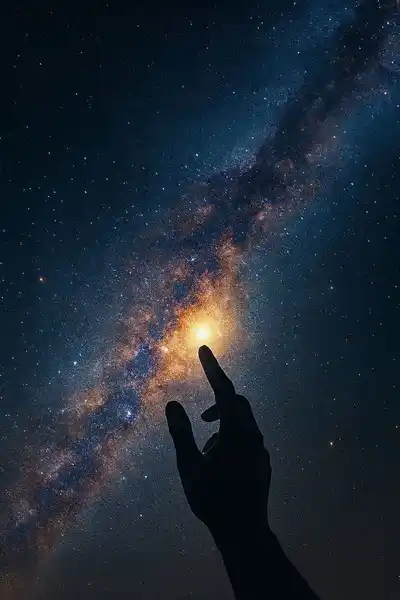
Christophe Galfard opens his book with an instruction that sounds like a party trick: hold out your hand, palm up, and imagine the whole universe sitting in it. Then he does something almost no physicist bothers to do. He drops the equations. Galfard spent years at Cambridge working under Stephen Hawking, co-writing a children's book with him, and he came out of it with an unusual conviction — that the deepest ideas in modern cosmology can be told entirely in pictures and sensations, without a single line of algebra. So he wrote a book that reads like a voyage. We are the traveler, and he is the guide sitting beside us as the ground falls away.
The wager is bold, and it is easy to be skeptical of it. Popular science tends to gesture at the hard parts and then retreat to metaphor at the exact moment the metaphor stops working. Galfard does the opposite. He pushes the journey all the way — past the Moon, past the dying Sun, out of the galaxy, back to the first fraction of a second after the beginning, and down into the strange grammar of the very small. And he keeps insisting, gently, that we can follow. Not because it is simplified, but because the human imagination turns out to be a surprisingly good instrument for holding these things.
What makes the exercise land is that it never pretends the story is finished. The further out we travel, the more Galfard lets the certainties thin out, until we arrive somewhere unexpected: a clear-eyed account of everything cosmology cannot yet explain. The voyage is real, but so is the edge of the map.
The question we’re asking : Can the biggest ideas in cosmology actually be felt rather than calculated — and where does that journey leave us?What we’ll see : A guided voyage outward and backward through space and time, and the honest cliff-edge it arrives at.
Table of contents
01 Chapter 1 — Leaving the ground behind
Galfard begins where we already stand, then removes the floor. In the opening stretch of the book we are asked to imagine leaving Earth, rising until continents shrink to smudges and the atmosphere becomes a thin blue skin we had never noticed protecting us. The tone is deliberately ordinary — a friend narrating a shared ascent — and that ordinariness is the method. He wants the reader to feel scale before understanding it, because a number like a hundred and fifty million kilometres to the Sun means nothing until you have watched the Sun fail to get any closer no matter how far you fly.
The Moon comes and goes. The Sun, as we approach it, stops being a light in the sky and becomes what it is: an enormous, roaring furnace fusing hydrogen into helium, converting a slice of its own mass into the light that reaches your skin on a summer afternoon. Galfard lingers on the fact that this furnace is not eternal. In roughly five billion years it will swell into a red giant, most likely swallowing Mercury and Venus and scorching whatever is left of Earth, before collapsing into a slowly cooling ember. The Sun we take for permanent is a phase.

02 Chapter 2 — When light stops telling the truth
Deeper into the voyage, Galfard turns to the strangest passenger on the trip: light, and the fact that it takes time to arrive. This is where the book does its most patient work. When we look at the Sun, we see it as it was eight minutes ago. Look at a nearby star and you see years into the past; look at a distant galaxy and you are staring at light that left before the Earth existed. To see far, in Galfard's telling, is to see backward. The night sky is not a snapshot of now. It is a museum of different nows, layered on top of each other.
He uses this to smuggle in relativity without ever calling it homework. Nothing outruns light, and light's finite speed knits space and time into a single fabric. Galfard has us imagine approaching that speed and watching time itself go strange — clocks slowing, distances compressing — not as paradox but as the honest behaviour of a universe that has a top speed. The point is not to memorise the rules. It is to feel that space and time bend, that they respond to mass and motion, that the smooth stage we assumed was fixed is actually elastic.
03 Chapter 3 — The four forces and the first fractions of a second
The most audacious leg of the journey sends us not further out but further back — to the beginning. Galfard rewinds the expanding universe like a film. Galaxies rush together, space shrinks, everything grows denser and hotter, until we arrive at a moment when all of what exists was compressed almost beyond imagining. He is careful here in a way pop science rarely is: he does not claim to explain the very first instant. He starts a hair after it, when the universe was already unthinkably hot, and follows it forward as it cools.
In those first fractions of a second, the story is governed by the four fundamental forces — gravity, electromagnetism, and the two nuclear forces that operate only inside atoms, one binding their cores together, the other governing certain kinds of decay. Galfard's ambition is to show these not as a list but as characters in a cooling drama. As the young universe expands and its temperature drops, particles that could not survive the heat begin to form and hold. Matter condenses out of pure energy. The recipe of everything we are is written in these opening moments.
04 Chapter 4 — What the equations refuse to close
Step back from the whole voyage and something striking emerges from Galfard's book: for all its confidence, it is honest about how little the confidence covers. The journey out and back is real, the physics is load-bearing, and yet the moment we tally what actually fills the universe, the ground gives way again. Everything we have travelled through — stars, galaxies, the furnace of the Sun, our own bodies — turns out to be a thin minority of what is out there. The ordinary matter that the whole story was built around is a small fraction of the total.
The rest is named, but naming is not the same as knowing. There is dark matter, an invisible mass that betrays itself only by its gravity, holding galaxies together that would otherwise fly apart. Galfard is candid that we do not know what it is; we know it is there because the visible universe moves as if it is. And there is something stranger still: dark energy, a pressure woven into space that is pushing the universe apart faster and faster. The expansion is not slowing under gravity, as everyone once assumed. It is accelerating, driven by something we can measure and cannot explain.
05 Conclusion
The book ends where it began, with the hand held out — but the hand now holds something heavier. We have flown past a dying Sun, watched light arrive from the deep past, rewound the universe to its first hot instant, and descended into a quantum world that trades solidity for probability. Galfard never once asks us to solve an equation, and the journey holds together anyway, which was always the point: the ideas of modern cosmology can be carried by imagination if someone is willing to walk beside you the whole way.
Related books