
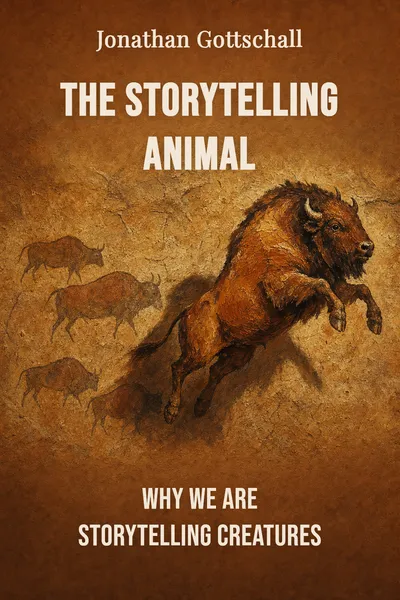
The Storytelling Animal
Why we are storytelling creatures
Description
Put a preschooler in an empty room with nothing but a cardboard box, and within a minute the box is a boat, a cave, a spaceship under attack. Nobody taught the child to do this. Jonathan Gottschall, a literary scholar who got tired of studying stories the way other people study fossils, opens his 2012 book The Storytelling Animal with exactly this scene: his own daughters, spinning elaborate dramas out of thin air, populated by orphans, monsters, and lost mothers. He noticed something odd. Children's make-believe is almost never sunny. It's full of trouble — kidnappings, catastrophes, things going wrong. The kids weren't playing at happiness. They were rehearsing disaster.
That observation sends Gottschall looking, and what he finds is that the habit never stops. We spend our waking hours consuming fiction — novels, films, gossip, ads, the running commentary in our own heads — and then we sleep, and the brain keeps at it, staging dreams nobody asked for. A species this soaked in narrative ought to have paid an evolutionary price for it. Storytelling costs time, energy, attention. Natural selection is not sentimental about waste. So either stories are a spectacular accident, or they do something for us we badly need.
Gottschall pulls from evolutionary biology, neuroscience, psychology, and his own field of literary study to argue for the second option. Story, he says, is not the icing on the human cake. It's closer to the flour. It's how we practice, how we bind together, how we understand a self that would otherwise be a chaos of impulses. The book is short and unashamedly readable, which is itself part of the argument: a book about why humans crave narrative had better be a good story.
The question we’re asking : If storytelling costs so much time and energy, why did a survival machine like the human brain evolve to crave it?What we’ll see : How a species addicted to make-believe uses fiction to rehearse, to bond, and to become someone at all.
Table of contents
01Chapter 1 — The mind that will not sit still
The first thing Gottschall wants us to feel is how relentless the habit is. We tend to picture the storytelling mind as something switched on at bedtime or in a cinema, and switched off the rest of the day. Not so. He borrows a striking estimate from the psychologist Eric Klinger's work: a large chunk of our waking life is spent not on the task in front of us but on daydreams, fantasies, small private movies about arguments we might win or futures we might have. We are lost in reverie for hours a day and barely notice. The default state of the human mind, left to itself, is to drift into story.
Then there's the child, who makes the point unmissable. Gottschall was struck that his daughters' pretend worlds ran overwhelmingly on trouble. Kids don't play at a nice calm afternoon; they play at the house being on fire, the baby being stolen, the wolf at the door. Play looks like fun, but its content is fear and conflict and things to be survived. That pattern, repeated across cultures and generations, is a clue rather than a coincidence.

02Chapter 2 — The trouble the brain rehearses at night
If daydreams are the mind wandering off during the day, dreams are the strangest evidence in the whole book, and Gottschall treats them as the extreme case of the storytelling brain. We spend years of our lives, cumulatively, watching narratives we didn't write, can't control, and mostly forget. The brain, even shut off from the world, refuses to stop generating plot. Whatever storytelling is for, it's built so deep that we do it unconscious.
And here too, the content is trouble. Gottschall leans on the dream research of the psychologist Antti Revonsuo, whose threat-simulation theory holds that dreams are disproportionately about danger: being chased, falling, losing a loved one, being unable to run. Pleasant dreams exist, but the nightmare is the house style. If dreams were random noise, we'd expect them to be as often boring as terrifying. Instead the sleeping brain keeps staging emergencies, as if rehearsing responses to the exact threats our ancestors faced.
03Chapter 3 — The story we tell ourselves is us
The most unsettling turn in the book is when Gottschall points the lens at the reader's own life. We assume that at least the story of who we are is reliable — that memory is a recording and the self a stable narrator. He spends a chapter dismantling that comfort. Memory, the research he cites keeps showing, is not playback. It's reconstruction, assembled fresh each time, edited to fit the plot we've settled on. We don't so much remember our lives as re-narrate them, and the narration quietly favors coherence over truth.
He draws on the work of psychologists like Jonathan Haidt and Michael Gazzaniga to describe an inner spin doctor. Gazzaniga's split-brain experiments are the vivid case: when the brain acts for reasons it can't access, it does not shrug and admit ignorance. It invents a reason on the spot, confidently, and believes it. There is a part of us whose full-time job is manufacturing a plausible narrative of the self, stitching our scattered actions into a character who makes sense. We are, each of us, an unreliable narrator convinced of our own reliability.
04Chapter 4 — What a fiction-drenched species does next
Step back from the individual dreamer and the private life-story, and Gottschall's argument scales up to something civilizational. If a whole species runs on narrative, then narrative is one of the strongest forces acting on human collectives — not a decoration on culture but part of its engine. Stories are how large groups of strangers come to share values, fears, and enemies. That's neutral machinery, and Gottschall is careful to show it cutting both ways.
On the constructive side, he treats fiction as a kind of moral gymnasium. When we inhabit a character, we practice empathy: we feel from inside a life not our own, and the research he cites suggests heavy fiction readers show measurably better social understanding. Story is how a culture rehearses its ethics, over and over, in the safe simulator of the imagined. It's plausibly why nearly every society converges on tales that reward cooperation and punish the cheat — narrative quietly teaching the rules that let groups hold together.
05Conclusion
We began with a child turning a cardboard box into a spaceship, and it's worth returning there, because Gottschall never really leaves that room. Everything the book covers — the daydreaming adult, the dreaming sleeper, the self quietly rewriting its own past, the nation swept up by a myth — is the same impulse the four-year-old shows with the box. The human mind, given nothing, will manufacture trouble, characters, and plot, and then live inside it as though it mattered. It does matter. That is the whole point.