The Social Animal
Why we follow the crowd
Description
In 1972, a social psychologist at the University of Texas named Elliot Aronson published a slim book with an unusually blunt title: The Social Animal. He had trained under Leon Festinger, worked in the shadow of Kurt Lewin's legacy, and spent years running the kind of experiments that seemed, on paper, almost too simple to matter — a group of students staring at lines, a volunteer flipping switches, a room slowly filling with smoke. The book gathered those experiments and asked one question of them all: what actually makes people do what they do? Aronson's answer was not the comforting one. Most of the time, he argued, the person matters less than the room they happen to be standing in.
The book borrowed its title from Aristotle, who had called man a social animal more than two thousand years earlier, and it kept that ancient frame while filling it with modern evidence. Aronson wanted to explain conformity, obedience, prejudice, propaganda, attraction, cruelty — the whole range of things we do because other people are watching, or because we cannot bear how a situation makes us feel about ourselves. He was not writing to flatter the reader. He was writing to show that the behaviors we condemn in others live comfortably inside all of us, waiting for the right circumstances.
What made the book endure through edition after edition was not any single finding but the way it refused to let us off the hook. We like to believe that good people do good things and bad people do bad things, and that we would have behaved differently. Aronson spent three hundred pages quietly dismantling that belief, one study at a time, and then handed it back to us changed.
The question we’re asking : What does social psychology reveal about why we conform, obey, and rationalize — and why do we so badly want to believe it wouldn't apply to us?What we’ll see : How a handful of famous experiments led Aronson to relocate the causes of human behavior from character to circumstance.
Table of contents
01Chapter 1 — The stranger who looked at the smoke and did nothing
Aronson opens not with a theory but with a scene, because that is how he thinks the discipline earns its keep. A man collapses on a busy sidewalk. Dozens of people walk past. We assume the crowd is callous, that a city hardens hearts. Then the experiments arrive and complicate the story. In the studies Aronson recounts, the more bystanders present, the less likely any single one is to help — not because they care less, but because responsibility spreads thin across a group, and each person reads the calm of the others as a signal that nothing is wrong.
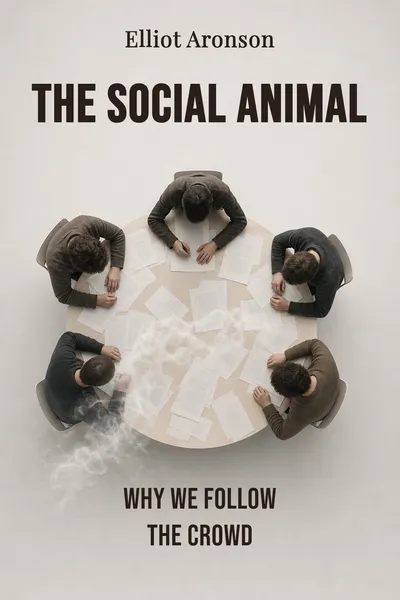
One of his favorite demonstrations put a participant alone in a room to fill out a questionnaire while smoke began seeping under the door. Alone, most people got up and reported it quickly. Placed with two others who had been instructed to sit still and keep writing, the same kind of person often stayed put, glancing at the impassive faces around them, until the room grew hazy. They were not cowards. They were reading the situation the only way social animals know how — by watching everyone else and assuming the group knew something they did not.

02Chapter 2 — Asch, Milgram, and the length of a line
The heart of the book is conformity and obedience, and Aronson tells the two stories that made the field famous. Solomon Asch's experiments in the early 1950s were almost comically plain. A participant sat with a group and was asked which of three lines matched a reference line. The answer was obvious. But the others in the room, all confederates, calmly gave the same wrong answer. Facing that unanimous wall, a striking share of real participants abandoned the evidence of their own eyes and agreed with the group. Not because they were confused about the lines. Because standing alone against everyone felt worse than being wrong.
Aronson lingers on what Asch found in the variations, because that is where the mechanism shows itself. Break the unanimity — give the participant just one ally who tells the truth — and conformity collapses. It was never the majority's numbers that did the work so much as its perfect agreement. One dissenting voice was enough to remind people that reality was still an option. The line was always the same length. What changed was how safe it felt to say so.
03Chapter 3 — The dissonance we cannot live with
If conformity and obedience explain why we bend to others, Aronson needs a second engine to explain why we then convince ourselves we were right to bend. That engine is cognitive dissonance, the theory of his mentor Leon Festinger, and it is the idea the book returns to most often. The claim is simple and unsettling: holding two clashing thoughts at once is uncomfortable, and we are relentless at reducing that discomfort — usually by changing whatever is easiest to change, which is rarely our behavior and often our beliefs.
Aronson's own contribution sharpened the theory around the self. Dissonance bites hardest, he argued, when a piece of behavior threatens our image of ourselves as decent, competent, sensible people. Someone who suffers to join a group decides the group must be worth it. Someone who has just done another person a favor comes to like them more, having reasoned backward from the deed to the affection. Someone who cheats convinces themselves that everyone cheats. The mind does not tolerate the gap between what we did and who we think we are; it closes the gap by revising the story.
04Chapter 4 — A discipline built on the situation, not the person
Step back from the individual studies and a single claim organizes the whole book. Social psychology, as Aronson practices it, is the science of the situation. Where common sense reaches for character — he helped because he is kind, she obeyed because she is weak — the discipline reaches for circumstance, and keeps finding that circumstance explains more than we would ever guess. Aronson gives this instinct a name he borrows from Lewin: the tendency to overattribute behavior to personality and underrate the power of the setting is itself one of the mind's most reliable errors.
This is why the book keeps its Aristotelian title. We are social animals not as a poetic flourish but as a mechanism. What others do, expect, and permit is not background noise to our decisions; it is often the loudest input we receive. The same person is honest in one room and complicit in another, generous under one arrangement of eyes and indifferent under another. Aronson is not saying we have no self. He is saying the self is more porous, more responsive to the people around it, than the flattering story we tell about our own consistency.
05Conclusion
Aronson began with a man collapsing on a sidewalk and a stranger who did nothing, and by the end the stranger is no longer a puzzle or a villain. He is us, standing in a particular room, reading the faces around us, absorbing the calm of a crowd that has quietly agreed nothing is wrong. The experiments he gathered — Asch's lines, Milgram's switches, the smoke under the door, the endless small labor of reducing our own dissonance — all point the same direction. Behavior lives less inside the person than in the arrangement of people around them.
Related books