The Sleepwalkers
Europe walking into 1914
Description
On June 28, 1914, in Sarajevo, a nineteen-year-old named Gavrilo Princip fired two shots into an open car and killed Archduke Franz Ferdinand, heir to the Austro-Hungarian throne, along with his wife Sophie. The assassination had almost not happened. An earlier bomb thrown that morning had missed. The archduke's driver, later in the day, took a wrong turn, stopped to reverse, and by chance rolled to a halt a few feet from Princip, who had given up and wandered off to a delicatessen. The murder that would help pull all of Europe into war was, in its final act, a matter of a stalled engine on a street corner.
Six weeks later, five great powers were at war, and within a few years roughly nine million soldiers would be dead. The distance between a botched roadside ambush and the collapse of a continent is the puzzle at the heart of Christopher Clark's 2012 book. For a century, the standard account had a defendant: Germany, its militarism, its ambition, its blank check to Vienna. Clark, a Cambridge historian of Prussia and Germany, set out to describe not who was guilty but how it happened — the meetings, the telegrams, the men who signed things they did not fully grasp.
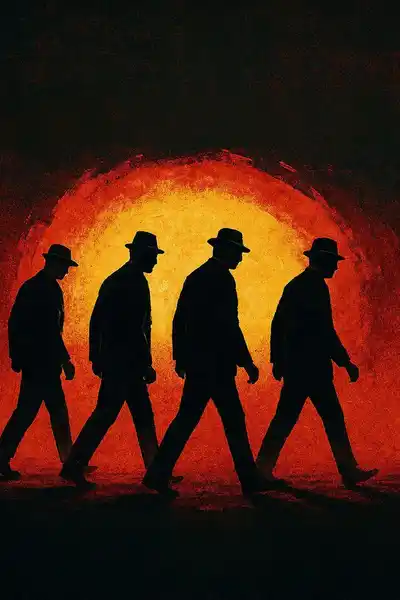
His title is his argument in two words. The statesmen of 1914, he writes, were sleepwalkers: watchful but unseeing, rational within their own frames, blind to the shared catastrophe they were assembling one reasonable step at a time. It is an unsettling way to read a disaster we thought we understood — because it takes away the villain and hands us something harder to hold.
The question we’re asking : How does a continent that nobody quite decided to destroy end up destroying itself in six weeks?What we’ll see : We follow the crisis as a chain of small, defensible choices, and watch the search for a single culprit dissolve into something more troubling.
Table of contents
01Chapter 1 — The empty seat in the archduke's car
Clark opens not with grand causes but with the crime itself, and he insists on its contingency. The plot was amateurish. The conspirators, backed by shadowy figures inside Serbian military intelligence, were young, tubercular, half-committed. The morning's first attempt failed. Franz Ferdinand, shaken but unhurt, chose to visit the wounded in hospital, and it was on that improvised detour that the wrong turn delivered him to Princip. Remove any one link — the driver's error, the archduke's stubbornness, the loaded pistol still in Princip's pocket — and the twentieth century tilts elsewhere.
But Clark's interest in the accident is not to reduce the war to bad luck. It is to force a question the older histories skipped: why did the murder of one man, however senior, become a reason to mobilize armies across a continent? Assassinations were not rare in that Europe. Kings, empresses, and presidents had been killed in the preceding decades without triggering general war. What made Sarajevo different was not the bullet but the world it landed in.

02Chapter 2 — A continent primed to misread each other
Before the telegrams start flying, Clark widens the lens to the system the crisis fell into, because the July decisions only make sense against it. Europe by 1914 had sorted itself into two armed blocs: Germany and Austria-Hungary on one side, France and Russia on the other, with Britain attached to the second by understanding rather than treaty. These alliances were meant to keep the peace by balancing power. What they actually did was link every quarrel to every other, so that a dispute over Serbia could reach, by a chain of obligations, all the way to the North Sea.
Underneath the alliances ran deeper currents. France had never reconciled itself to the loss of Alsace and Lorraine in 1871 and had spent decades and rubles courting Russia. Russia, humiliated by Japan in 1905 and by Austria's annexation of Bosnia in 1908, was determined not to back down again in the Balkans, where it cast itself as protector of the Slavs. Germany felt encircled and feared a Russia growing stronger by the year. Each power's caution looked, from across the border, like aggression; each defensive move invited a defensive countermove.
03Chapter 3 — Six weeks, a dozen men, no brakes
Then Clark slows down and takes July almost day by day, and the effect is claustrophobic. Vienna wanted to punish Serbia but moved slowly, partly because the harvest had sent soldiers home, partly because it needed to be sure of Berlin. On July 5 and 6, Germany gave its now-infamous assurance of support — the blank check — believing, or telling itself, that firmness would keep the crisis local and frighten Russia into standing aside. That miscalculation is central, but Clark refuses to make it the sole hinge.
The Austrian ultimatum to Serbia, delivered on July 23, was deliberately harsh, designed to be rejected. Serbia's reply, drafted with Russian encouragement, was conciliatory in tone and evasive in substance — enough to look reasonable to outsiders, not enough to satisfy Vienna. Meanwhile the French president and prime minister were literally at sea, on a state visit to Russia, where they appear to have reinforced Russian resolve at the worst possible moment, then spent days sailing home out of easy contact.
04Chapter 4 — Blame is a story, and stories have authors
Step back from the telegrams and Clark's larger provocation comes into view. For a century, the July crisis had been treated as a courtroom, with historians as prosecutors hunting the guilty party. The Treaty of Versailles wrote German war guilt into international law in 1919. Later scholarship, especially the influential Fritz Fischer thesis of the 1960s, argued that Germany had willed the war as an instrument of expansion. Clark does not deny German responsibility, but he questions the whole habit of framing 1914 as a case to be solved rather than a process to be understood.
His method is the argument. By reconstructing the crisis from the inside of each capital, he shows how every actor had reasons that were plausible in their own terms, and how catastrophe emerged not from one malign intention but from the interaction of many defensible ones. This is why the sleepwalker image matters. Sleepwalkers are not innocent and not quite guilty; they are present, moving, consequential, and unaware. To insist on a single villain, Clark suggests, is to impose a tidiness the evidence does not support — to prefer a satisfying story over an accurate one.
05Conclusion
The image that opens the book — a stalled car, a wrong turn, a boy with a pistol who had given up — is where Clark's whole method takes its shape. That accident could have gone another way. What could not easily have gone another way was the response, because the response ran through structures that had been assembling for decades: alliances that linked every quarrel, plans that rewarded speed over deliberation, capitals that read one another through fear. The bullet was contingent. The machinery around it was not.
Related books