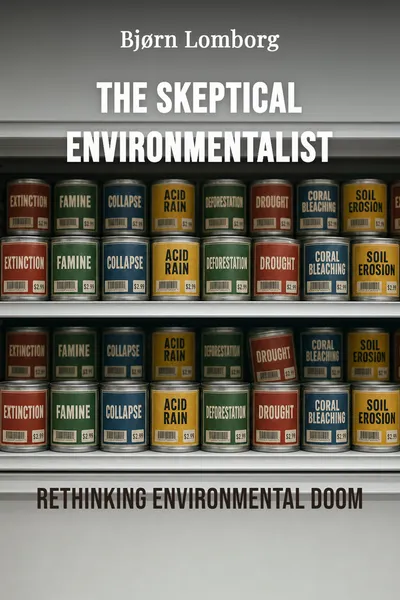
The Skeptical Environmentalist
Rethinking environmental doom
Description
In 1997, a Danish statistics professor named Bjørn Lomborg picked up a copy of Wired magazine and read an interview with the economist Julian Simon, who claimed that most of what we believe about the environment falling apart was simply wrong. Lomborg, by his own account a card-carrying Greenpeace type, set out with a group of students to prove Simon wrong using the raw data. What he found unsettled him enough to reverse course. Four years later, in 2001, Cambridge University Press published the result: a five-hundred-page brick called The Skeptical Environmentalist, stuffed with almost three thousand footnotes.
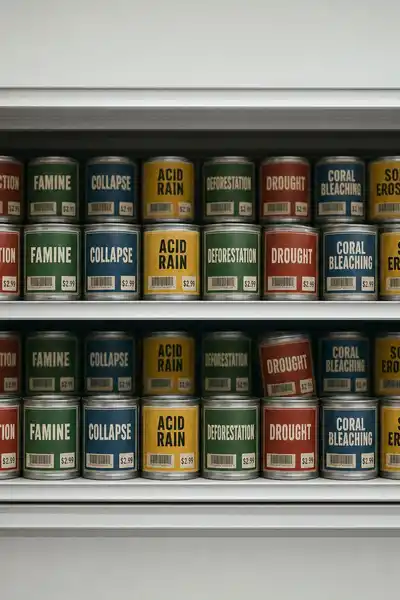
The book landed like a provocation, because that is more or less what it was. Lomborg did not deny that forests get cut or that the climate is warming. His claim was stranger and harder to swallow: that on most measures we actually track — life expectancy, food per person, clean water, air quality in rich cities — things had been getting better, not worse, and that the story we tell ourselves about imminent collapse was built on selective figures, worst-case scenarios quoted as fact, and a media appetite for bad news. He called this bundle of received wisdom "the Litany."
The response was ferocious. Scientific American devoted an issue to attacking him; a Danish scientific-honesty committee briefly ruled against him before the ruling was itself overturned. Whatever one makes of the man, the book poses a question that refuses to go away, and it sits underneath every climate argument we still have today.
The question we’re asking : If the planet's problems are real but smaller than we're told, how should we decide where to spend the limited money we have?What we’ll see : How one contrarian statistician read the environmental data against the headlines — and what his arithmetic did to the way we argue about the future.
Table of contents
01 Chapter 1 — The Litany, and the man who counted it
Lomborg begins with a portrait of a mood. Open a newspaper, he says, and the environment arrives pre-packaged in a single register: forests vanishing, species dying by the thousand, oceans emptying, the air thickening, resources running out, everything trending toward catastrophe. He gives this shared background story a name — the Litany — and his whole project is to test it line by line against the numbers that the same institutions publish.
His starting move is deliberately unglamorous. Rather than argue about values, he goes to the long-run data collected by the UN, the FAO, the World Bank, and national statistical agencies, and asks a plain question: are we, as a species, better or worse off than before? On the headline measures of human welfare, his answer is better. Global life expectancy roughly doubled over the twentieth century. The share of people going hungry fell even as population climbed. Access to clean drinking water widened. In developed cities, air pollution — the soot and smoke that actually killed people in London in the 1950s — had been falling for decades.

02 Chapter 2 — The numbers behind the headlines
To make the case concrete, Lomborg walks through the big-ticket fears one at a time, and the pattern repeats. Take resource depletion, the classic doom of the 1970s, when the Club of Rome's models predicted we would run out of oil and metals within a generation. We did not. Known reserves of oil were larger at the end of the century than at the start, because higher prices funded new exploration and better extraction, and because scarcity pushes substitution. Simon's old wager against the doomsayers — that raw-material prices would fall, not rise — had quietly been won.
Food told a similar story. The neo-Malthusian prediction that population would outstrip the harvest kept failing, because yields rose faster than mouths. Deforestation, Lomborg argues, was real but wildly overstated: the planet had lost roughly twenty percent of its forest cover across all of recorded history, not the runaway annual collapse implied by campaign literature, and temperate forests in the rich world were actually expanding. Species loss, the figure most often quoted at fifty thousand extinctions a year, he traces back to a single 1979 estimate by Norman Myers that had, he says, hardened into a citation with no firm data underneath it.
03 Chapter 3 — What a dollar can actually buy
The heart of the book is not a denial but a question about priorities, and it turns on a word most environmental debate avoids: cost. Every dollar spent on one problem is a dollar not spent on another. Lomborg insists that this is not cynicism but arithmetic — the unavoidable logic of a world where good intentions vastly outrun available money. The right question, he argues, is never simply "is this problem real?" but "what is the most good this money can do?"
His signature example is the Kyoto Protocol, then the great hope of climate diplomacy. Run the numbers, Lomborg says, and Kyoto would cost tens of billions of dollars a year while merely postponing the projected warming by about six years by the end of the century — a huge bill for a barely measurable delay. Set that against what the same sums could achieve elsewhere: clean water and sanitation for everyone on earth, he estimated, would cost a fraction of that annually and would save millions of lives now, not marginally adjust a temperature curve decades out.
04 Chapter 4 — When measurement becomes a moral position
Step back from the reefs and the reserves, and Lomborg's real subject comes into view — not the environment at all, but how a society decides. His deeper wager is that refusing to measure trade-offs is itself a decision, and one with consequences we simply choose not to look at. When we fund the emotionally loudest cause rather than the most effective one, the people who would have been helped by the road not taken do not disappear; they are just invisible in the accounting, because no one added them up.
This is why the book provoked such fury, and why the fury partly misses it. Critics heard a man telling us the planet was fine and stop worrying. What he was actually doing was insisting that worry be rationed by evidence, that catastrophe be a claim you can check rather than a mood you inhabit. The disagreement is less about facts than about who gets to hold the pen when the trade-offs are written down — the campaigner, who trusts urgency, or the statistician, who trusts the ledger.
05 Conclusion
The book that began with a Wired interview ended by turning its author into one of the most argued-about figures in environmental debate — celebrated by economists, denounced by ecologists, and rarely read as carefully as it was condemned. Lomborg never claimed the planet had no problems. He claimed that our sense of proportion had drifted, that the Litany had replaced the ledger, and that a movement built on urgency had grown allergic to the boring discipline of counting.
Related books