The Seven Mysteries of Life
How all life connects
Description
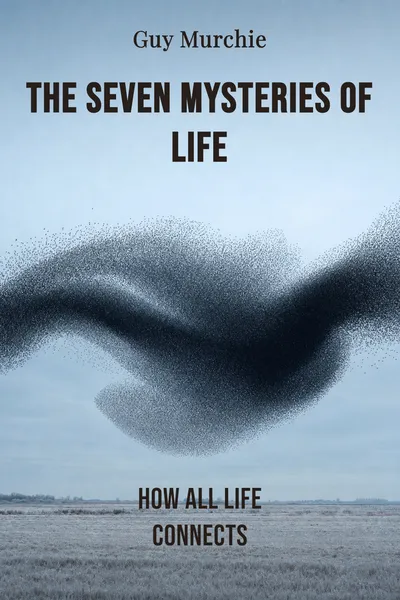
Somewhere in the middle of the twentieth century, a former war correspondent named Guy Murchie set out to answer a question most people never bother to ask out loud: what is life, actually, and where does it end? He had already written about the sea and the sky with the eye of a man who flew planes and sailed boats for a living. But this new project was different in scale. It took him roughly seventeen years, and when it was done, in 1978, it came out as a single enormous book called The Seven Mysteries of Life, some seven hundred pages long, subtitled an exploration in science and philosophy.
The strange thing about the book is how hard it is to file. It moves, sometimes inside a single paragraph, from the mating habits of insects to the geometry of snowflakes, from the migration of birds to the mathematics of odds, from cell division to the question of whether a planet might be alive. A biologist would call parts of it biology. A physicist would recognize the physics. A theologian would find the last chapters uncomfortably close to home. Murchie refused to choose, and that refusal is the whole point.
What holds the sprawl together is a conviction he keeps circling back to: that the divisions we draw between fields, and between kinds of things, are conveniences we invented, not seams in the world itself. Life, in his telling, is not a category with a fence around it. It bleeds into rock, into weather, into number, into whatever comes after. And that is where the book gets both its wonder and its risk.
The question we’re asking : What did Murchie see when he stopped treating biology, physics, and philosophy as separate rooms?What we’ll see : A seventeen-year attempt to describe life as one continuous fabric, and what that costs and reveals.
Table of contents
01 Chapter 1 — The seventeen-year walk toward one question
Murchie did not come to this book as an academic. Born in 1907, he spent decades as a journalist and an aviator, crossing oceans, navigating by the stars, writing dispatches from the Second World War. His earlier books, Song of the Sky and Music of the Spheres, were already the work of someone who wanted to understand everything at once. The Seven Mysteries of Life reads like the culmination of that appetite, the place where a lifetime of noticing finally gets organized around a single ambition.
The ambition, stated plainly, was to take the measure of "all life in all worlds." Not life on Earth, not human life, not even life as biology defines it, but the whole phenomenon, wherever and however it might occur. That framing tells us something about the man. He assumed from the start that whatever life is, it is not confined to this planet and probably not confined to carbon, and that to understand it here we would have to understand it as a general feature of the universe rather than a local accident.

02 Chapter 2 — The blur where the living and the dead trade places
The first place Murchie goes after the boundary between life and non-life, which turns out to be far softer than the schoolbook version. We are taught that living things breathe, grow, and reproduce, and that rocks do none of these. Murchie spends page after page dissolving that neatness. A virus sits on the fence, crystalline and inert until it finds a host, then suddenly busy. A crystal grows and heals its own flaws in a way that looks unnervingly like biology. He is not being mystical here; he is pointing at cases the definitions were never built to handle.
Then he turns the same lens on the human body and finds the boundary just as porous. The atoms in our bones were forged in stars and will one day be soil, water, air, and the bodies of other creatures. The self we experience as continuous is, at the level of matter, a standing wave, a pattern that persists while its material contents are swapped out constantly. What we call a living thing, in this view, is less a possession of certain atoms than a shape that certain atoms are passing through. The mineral world is not the opposite of the living one; it is its supply and its destination.
03 Chapter 3 — Interdependence goes further than sympathy
If the first move is to soften the boundary of life, the second is to show how thoroughly living things are woven into one another. Interdependence is one of Murchie's seven mysteries, and he means something more radical than the familiar idea that everything is connected. He means that many things we treat as individuals are better understood as communities, and that many things we treat as communities behave like individuals.
His favorite examples are the social insects. A single bee is nearly helpless and nearly meaningless on its own; the hive is where the real organism lives, thinking with thousands of bodies, regulating its own temperature, making collective decisions no bee could make alone. Murchie asks, seriously, whether the hive is not the true unit of bee life, with individual bees playing the role of cells. Once you accept that framing for bees, it becomes harder to refuse it elsewhere. Our own bodies are colonies of cells, and those cells carry the descendants of once-independent bacteria in their machinery.
04 Chapter 4 — The mysteries were never meant to be solved
Step back from the particulars and Murchie's real subject comes into view, and it is not sharks or snowflakes or bees. It is the way we know things. The book is a sustained argument against the habit of carving the world into separate disciplines and mistaking those divisions for reality. Biology, physics, sociology, mathematics: to Murchie these are not different countries but different windows onto one landscape, and the landscape is continuous whether or not our windows are.
This is why he insists on calling them mysteries rather than problems. A problem is something you dispatch and forget. A mystery is something you live alongside, that keeps opening as you approach it. When Murchie names the abstract nature of the universe, interdependence, the omnipresence of life, the polarity principle, transcendence, the germ of mind, and the divinity of being, he is not handing us a checklist of riddles awaiting answers. He is naming the places where the fabric is thickest, where one field runs into the next with no visible seam.
05 Conclusion
Guy Murchie spent the better part of two decades assembling this book, and when it appeared it drew the kind of praise that outlasts fashions. The poet May Sarton called it a good book to take to a desert island as a sole companion, so rich is it in knowledge and insight, and the phrase fits because the book is less an argument you win than a companion you keep. It rewards a reader who is willing to wander with it, to follow a thought from a beehive to a galaxy and trust that the detour is the destination.
Related books