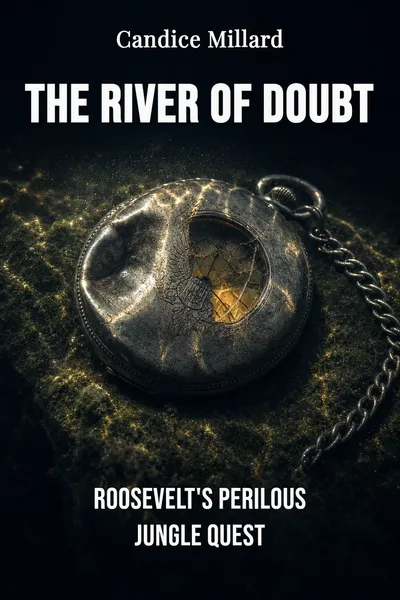
The River of Doubt
Roosevelt's perilous jungle quest
Description
In October 1913, a former president of the United States stood on a dock in New York with his bags packed for South America. Theodore Roosevelt was fifty-four, overweight, half-blind in one eye, and freshly beaten. The year before, he had split the Republican Party, run as a third-party candidate under the Progressive banner, taken a bullet in the chest during a Milwaukee speech — and lost. The defeat had gutted him. So he did what he had always done when the walls closed in: he went looking for something wild enough to knock the sadness out of him. A lecture tour of Argentina and Brazil was the official reason. It was not the real one.
In Rio, a plan that had been a genteel museum-collecting expedition mutated, almost casually, into something else. The Brazilian government offered Roosevelt the chance to map an unexplored tributary of the Amazon, a black-water river so unknown that it appeared on no map. Its name told you everything the authorities knew about it: the Rio da Dúvida, the River of Doubt. Nobody could say where it went, how long it ran, or what lived along its banks. Roosevelt, who could not resist a blank space, said yes almost before anyone had finished explaining the danger.
What followed was two months of near-annihilation — starvation, drowning, malaria, murder, and rapids no boat was built to survive. Candice Millard's account reconstructs that descent hour by hour, and in doing so tells two stories at once: the adventure of a river that did everything it could to kill the men on it, and the portrait of a man who had spent his whole life insisting that hardship was the point.
The question we’re asking : Why would a former president stake his life on a river no one had mapped — and what did that river do to the men who trusted it?What we’ll see : A defeated politician, a crew of mismatched men, and a black-water river in the heart of the Amazon that turned an expedition into a fight for survival.
Table of contents
01 Chapter 1 — A defeated president looking for a hard trip
Roosevelt did not travel to recover. He travelled to be tested. Millard is precise about the psychology here: from boyhood, a sickly asthmatic willing his own body into strength, he had built a personal creed around what he called the strenuous life. When his first wife and his mother died on the same day in 1884, he had fled to the Dakota Badlands to work cattle and freeze and exhaust himself back into equilibrium. The pattern held for thirty years. Grief, defeat, restlessness — all of it got answered the same way, by hurling himself at something physically brutal until the noise in his head went quiet.
The 1912 election was the worst defeat of his life, and it arrived just as he was aging out of the body that had always saved him. The Amazon offer landed on exactly that wound. He was warned, repeatedly, that a man his age and condition had no business on an uncharted Amazonian river. He heard the warnings as an invitation. The trip's American organizers had imagined a comfortable riverine tour with a naturalist or two; Roosevelt quietly rewrote it into a genuine descent of an unknown waterway, the kind of thing that made serious explorers hesitate.

02 Chapter 2 — The men who went into the unknown
The party that pushed off in February 1914 was smaller and stranger than the one that had left the coast. There was Roosevelt and his twenty-four-year-old son Kermit, who had come along partly to keep an eye on his father and was carrying his own private weight — he was engaged, desperate to get home and marry, and every delay tightened him further. There was Rondon and his Brazilian soldiers. There was George Cherrie, a seasoned American naturalist who had survived plenty of expeditions and privately doubted this one. And there was a doctor, José Antônio Cajazeira, whose skills would matter more than anyone wanted to admit.
At the bottom of the hierarchy were the camaradas — the Brazilian paddlers and porters who did the actual labor of moving heavy dugout canoes down an impossible river. Millard gives them the weight the original expedition largely denied them. They were the ones who hauled, dragged, and portaged, who went hungriest, and who would die in the largest numbers. Among them moved a man named Julio, whose growing desperation would become one of the darkest threads of the whole story.
03 Chapter 3 — The river that nearly killed them all
The River of Doubt did not ease them in. It threw rapids at them almost from the start — long, violent stretches where the canoes had to be unloaded and dragged through the forest along the bank, a process that could cost days to advance a few miles. Each portage burned calories they did not have and exposed them to a jungle that Millard describes as a closed economy of predators, parasites, and poisons, all of it competing, all of it hungry. Piranha, candiru, ants, wasps, and disease-bearing insects turned every camp into a low, constant siege.
The canoes began to go. Some were smashed against rocks, some sank, and rebuilding them from felled trees consumed still more time and strength. Food ran to almost nothing. The men were reduced to fractions of what a body needs, and their strength drained visibly. Then the river started collecting lives. A camarada named Simplício drowned when his canoe was pulled into a rapid. Sickness spread. Cherrie and the doctor watched the whole party thin toward collapse.
04 Chapter 4 — What the wilderness measures in a man
Strip away the rapids and the fever, and what Millard has really written is a portrait of a temperament pushed to its absolute limit. Roosevelt had preached the strenuous life to a nation for decades — the conviction that comfort softens a man and only struggle proves him. The River of Doubt is where the doctrine met its bill. The same appetite for hardship that had made him a great and reckless public figure was exactly what nearly killed him and several men around him, and he knew it. The trip was, in a real sense, the belief tested against a river that did not care about beliefs.
What the ordeal exposed was less a hero than a man at the end of a particular kind of strength. The Roosevelt who begged to be left to die was not performing; he genuinely calculated that his body had become a threat to the others and offered to remove it. That he was overruled by his own son inverts the entire dynamic of his life. For once the great self-reliant man survived because someone refused to let him go — the strenuous ideal saved, at the last, by ordinary human loyalty.
05 Conclusion
The expedition emerged from the jungle in late April 1914, gaunt and depleted, and Roosevelt gave a triumphant account of it to skeptical geographers back home — the black-water river was real, roughly four hundred miles of it, and now it was on the map. But the man who stepped off the boat was not the man who had boarded it in New York. He had left pounds of himself in the Amazon, along with a chronic fever and an injury that never fully healed, and those losses trailed him for the rest of his shortened life.
Related books