
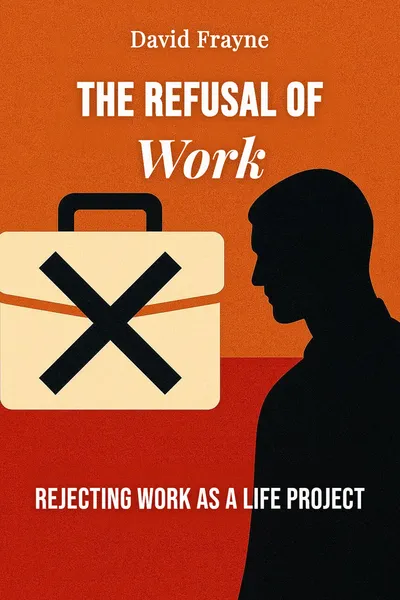
The Refusal of Work
Rejecting work as a life project
Description
When we meet someone new, the first real question — after the name — is almost always the same: so, what do you do? We mean the job. We take it for granted that the answer tells us something essential, that a person's work is the shortest route to who they are. The British sociologist David Frayne noticed how strange that reflex is, and built a book around it. The Refusal of Work, published in 2015, starts from a simple observation: paid employment has quietly colonised nearly everything we call a life, and almost nobody finds this odd anymore.
Frayne wasn't writing a motivational manifesto or a four-day-week policy pitch. He spent time with people who had deliberately scaled their jobs down to a sliver, or walked away entirely — not retirees, not the idle rich, but ordinary workers who concluded that the deal on offer wasn't worth it. He wanted to know what they saw, what it cost them, and what their choices exposed about the rest of us who stayed. Their stories are less triumphant than you'd expect, and more unsettling.
Behind the interviews sits an older argument, one Frayne traces through a line of thinkers who kept asking why we organise our days around labour the way we do. The work ethic feels like common sense, like gravity. Frayne's wager is that it's nothing of the kind — that it was built, relatively recently, and that seeing the seams changes what we think is possible.
The question we’re asking : Why does paid work hold such total authority over how we live, and what does it take to genuinely step out from under it?What we’ll see : How a sociologist's conversations with people who quit became a dismantling of the work ethic we treat as nature.
Table of contents
01 Chapter 1 — The job that eats the rest
Frayne's starting point is less about hours than about reach. The job is no longer a thing we do for a set stretch of the day and then leave behind. It sets the rhythm of our sleep, shapes where we live, decides which friendships survive, and supplies the vocabulary we use to measure whether a life is going well. Even leisure gets recruited: we rest to be productive, we network over drinks, we treat holidays as recovery time so we can go back and perform. Work has become, in Frayne's phrase, the central organising principle of modern life — and it holds that place without ever having to argue for it.
He draws on earlier critics to sharpen the point. The French sociologist André Gorz, writing in the 1980s, argued that waged work had become the one activity through which a person could claim social existence at all. To not have a job was to be, in some sense, no one. Herbert Marcuse had made a related case decades earlier: that advanced societies keep people busy producing and consuming things they don't particularly need, and call the whole arrangement freedom. Frayne takes these threads and tests them against the present, where the smartphone has dissolved the last barrier between the office and the kitchen table.

02 Chapter 2 — A moral invention we mistook for nature
To make refusal thinkable, Frayne first has to show that the work ethic is a historical thing and not a permanent feature of the human condition. For most of recorded history, work was regarded as a curse or a burden to be escaped, not a calling that gave life meaning. The idea that labour is virtuous, that idleness is a moral failing, that a person's worth can be read off their diligence — this is comparatively recent, and Frayne follows the familiar genealogy back through the Protestant reformers and into industrial capitalism, where the moral and the economic fused.
What interests him is how thoroughly the invention took. The work ethic survived the very conditions that produced it. We no longer need everyone labouring constantly; productivity has climbed for over a century, and a smaller quantity of work could in principle supply what a society needs. John Maynard Keynes famously predicted in 1930 that his grandchildren might work around fifteen hours a week. The productivity gains arrived more or less as he expected. The leisure did not. Instead, the hours stayed long and new forms of work multiplied to absorb the slack.
03 Chapter 3 — The people who stepped off
The heart of the book is Frayne's time with people who had actually reduced or refused work. Some had cut their hours dramatically, taking the pay cut on purpose. Others had quit outright, living frugally on very little, piecing together an existence that put their own projects and relationships ahead of a career. They were not, for the most part, dropouts in any romantic sense. They were thoughtful people who had done the arithmetic of their own lives and decided the trade was a bad one.
What they gained is the part most sympathetic readers want to hear. Time, first of all — unhurried, unscheduled time, the kind that lets a person read, make things, walk, think, be present to other people without the clock running underneath. Several described a return of curiosity, a slow rediscovery of appetites the job had flattened. The dulled imagination Frayne diagnosed in the first chapters began, for them, to wake up. They talked about feeling more like themselves, about days that belonged to them.
04 Chapter 4 — What refusal actually asks
If there is a conclusion Frayne wants his readers to resist, it's the one that turns refusal into a personal lifestyle choice — the brave individual who downsizes, quits the rat race, finds themselves. The lives he documents are genuinely admirable, but they're also a trap if we read them only as inspiration. The whole point of his analysis is that these people had to pay privately for a problem that is public. They absorbed the isolation, the insecurity, and the judgment alone, because the society around them offered no shared way of living with less work. Individual escape, in his account, is a symptom of collective failure, not a solution to it.
What a serious refusal of work would require, then, is not more people opting out but a change in the arrangements that make opting out so costly. Frayne is sympathetic to measures that would spread free time more fairly — shorter working weeks as a norm rather than a privilege, and some form of guaranteed income that would unhook basic security from a full-time job. The aim isn't the abolition of work but the end of its monopoly: a world where contributing to society and earning the right to exist are no longer the same transaction.
05 Conclusion
Frayne started from that opening question — so, what do you do? — and the people he met had answered it the hardest way, by subtracting the job and seeing what remained. What remained was time and curiosity, but also a loneliness that none of them had quite anticipated. They had escaped the work ethic only to find that it had quietly been holding up everything else: their routines, their friendships, their place in the social order. The escape was real, and it was never free.
Related books











