The Public and Its Problems
What makes a public real
Description
In 1926, John Dewey stood at the University of Virginia and gave a set of lectures with an unusually blunt premise: nobody had ever properly said what a public actually is. Political theory had spent centuries deriving the state from first principles — natural rights, a social contract, the will of God, the logic of sovereignty. Dewey, then in his late sixties and already the most influential philosopher in America, thought all of that was reasoning backward. The lectures became a short, dense book the following year, and it has been argued over ever since.
His method was the reversal that ran through everything he wrote. Instead of starting with a grand definition of the state and asking how citizens fit into it, he started with something small and observable: people do things, and those things spill over onto other people who had no part in the doing. Sometimes the spillover is trivial. Sometimes it reaches so far, and lasts so long, that the people affected have to organize themselves to deal with it. Out of that, and only out of that, does a public appear.
The book landed in a decade when American democracy felt, to many observers, exhausted — voter turnout falling, machine politics entrenched, the sheer scale of industrial society making the old town-meeting ideal look quaint. Dewey took the diagnosis seriously without accepting the despair. He wanted to know what a public is made of, why it seemed to have gone quiet, and whether human intelligence could reassemble it.
The question we’re asking : When we talk about "the public" and "the state," what are we actually pointing at — and can it be rebuilt once it fades?What we’ll see : How Dewey builds the state up from ordinary consequences rather than down from first principles, and where that leaves democracy in a crowded, distracted age.
Table of contents
01Chapter 1 — A public is a by-product, not a founding contract
Dewey begins by refusing to begin where everyone else does. He will not open with the nature of the state, the essence of authority, or the rights of man. Those, he argues, are a priori constructions — definitions handed down first, with the facts arranged afterward to fit. His own procedure is the opposite. Look at what human beings do, trace the effects of what they do, and let the concepts emerge from the pattern. It is a posteriori reasoning, and he treats it as the only honest kind for a subject this practical.
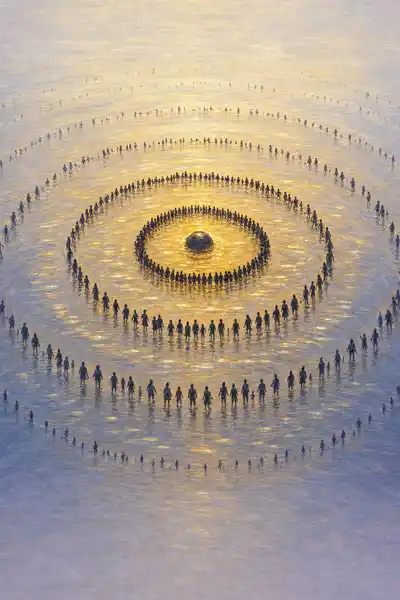
The pattern he finds is simple to state. Every action has consequences. Some consequences fall only on the people directly involved in the transaction — two friends talking, a shopkeeper and a customer settling a bill. Dewey calls these private, and he is careful to note that private does not mean unimportant or selfish; it just means contained. Other consequences reach beyond the people who produced them, touching third parties who never chose to be involved. When those indirect consequences are extensive enough, and lasting enough, to need caring for, the people affected acquire a shared interest in controlling them.

02Chapter 2 — From scattered public to organized state
A public, in this raw form, is diffuse. It is everyone touched by a certain spread of consequences, but it has no voice, no hands, no way of acting as a unit. To do anything about the effects that constitute it, the public has to organize — and organizing means selecting some people to look after the shared interest on everyone's behalf. Those chosen representatives are officials. The public, once it has equipped itself with officials to regulate the consequences that concern it, becomes a state.
This is Dewey's deflation of a word that usually arrives wrapped in reverence. The state is not sovereign will incarnate, not the march of Spirit through history, not a party to a contract older than memory. It is the public organized, through officials, to protect and regulate the far-reaching consequences of conduct. Government is simply the set of agencies and offices through which that organized care is carried out. He strips the capital letters off both.
03Chapter 3 — Why the public went missing
If a public organizes itself around the consequences it can perceive and care about, then a public can also fail to organize — and this is the crisis at the heart of the book. Dewey looks at the America of his day and sees a public that cannot find itself. The machinery of democracy is all present: elections, parties, ballots, a free press. Yet the sense that citizens grasp what affects them and act on it collectively has thinned to the point of eclipse. He calls the condition, memorably, the eclipse of the public.
The cause is the sheer scale and complexity of modern industrial life. The inherited forms of democratic self-government — the New England town meeting above all — were built for a face-to-face community where a person could see the consequences of local action and gather with neighbors to manage them. Steam, electricity, the railroad, the corporation, and the printing press flung consequences across a continent. The effects that constitute publics now travel too far and too fast for the old local instruments to catch. People are swept up in vast systems whose workings they cannot trace, let alone control.
04Chapter 4 — The community that has to be found before it can govern
Here the book widens without leaving its subject. The problem of the public, Dewey argues, is at bottom the problem of turning a Great Society — a mass of people linked by machinery, commerce, and consequence — into a Great Community, a body whose members actually know their interdependence and act on it. The mechanical ties already exist; goods and effects circulate everywhere. What is missing is the shared perception, the communication that would let people recognize the associated life they are already living.
This is why he places communication at the very center. Democracy, for Dewey, is not finally a set of institutions — ballots and legislatures are its outward apparatus, not its substance. It is a way of associated living, an idea of community life itself, in which people freely share their experience and consult about the consequences that bind them. A public becomes real when it can converse with itself: when the far-flung effects of conduct can be traced, named, and debated by the very people they touch. Without that circulation of meaning, the machinery runs empty.
05Conclusion
Dewey had begun with the smallest observable thing — an action that spills onto a bystander — and built all the way up to the state, then watched that state's public go dark under the weight of modern scale. The arc holds together because he never let the concepts float free of the consequences that produce them. A public is real when the people affected by conduct can perceive that they are affected and organize to manage it; it fades when the effects outrun the means of perceiving them. The state rises and falls with that capacity, not with any eternal principle.
Related books