The Population Bomb
The prophecy that never came true
Description
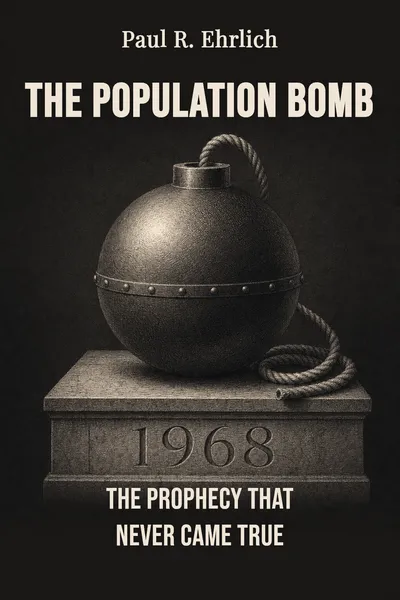
In 1968, a Stanford biologist named Paul Ehrlich published a slim paperback with a title that did most of the work: The Population Bomb. It opened with a sentence that has followed him for the rest of his life — "The battle to feed all of humanity is over." Not slowing, not at risk. Over. In the 1970s and 1980s, the book warned, hundreds of millions of people would starve to death, and no crash program launched then could prevent it. The famines were baked in. Ehrlich wrote the book with his wife, Anne, though the publisher put only his name on the cover, and it sold something like two million copies. He became a fixture on television, a regular guest of Johnny Carson, the calm voice explaining that the planet had too many people and not enough food.
The dates came. The dates went. The mass famines Ehrlich forecast for the 1970s did not arrive on anything like the scale he described. Global food production rose faster than population through the decades that were supposed to break it. India, which the book had all but written off, became a grain exporter. The world added billions of people and, on average, fed them better than before. The bomb, in the terms Ehrlich had set, did not go off.
So we have a best-seller built on a forecast, and a forecast that missed. That is the easy part. The harder part is what the book got right underneath the thing it got wrong, and why a prediction this public, this dated, this confident, could be so far off and still shape how a generation thought about the future.
The question we’re asking : How could a book this influential be this wrong about the one thing it staked everything on — and what was it actually seeing?What we’ll see : We follow the forecast from the certainty of its opening line to the harvests that undid it, and to what the miss leaves standing.
Table of contents
01 Chapter 1 — A prediction with a date on it
The Population Bomb was not a subtle book, and it did not want to be. Ehrlich had spent his career studying butterflies and the way populations of living things grow until something — food, space, disease — stops them. He looked at the human population doing what he had watched insect populations do, and he did the arithmetic. The world held about 3.5 billion people in 1968 and was adding them at a rate that would double the total in roughly thirty-five years. The book asked a simple question with a terrifying answer: what happens when a curve like that meets a food supply that cannot keep up?
His answer was famine, and he was willing to put a timetable on it. The opening pages describe the 1970s as the decade when the world would "undergo famines" and "hundreds of millions of people are going to starve to death." He offered scenarios — he called them that, not predictions, though the distinction was lost on almost everyone — in which the 1970s brought food riots, collapsing nations, and death tolls in the hundreds of millions. India was the recurring example, a country he judged simply incapable of feeding its projected population.

02 Chapter 2 — The math that felt like destiny
The reasoning behind the bomb was old and, on its own terms, hard to argue with. In 1798 the English clergyman Thomas Malthus had noticed that populations tend to grow geometrically — 2, 4, 8, 16 — while food supply grows arithmetically, by slow addition. Two curves like that can only cross one way. Sooner or later the mouths outrun the harvest, and the gap closes through what Malthus bluntly called the positive checks: hunger, disease, war. Ehrlich was, in essence, Malthus with a Stanford lab and a television slot, restating a two-hundred-year-old worry with modern population figures behind it.
The figures were genuinely alarming. Global population growth had accelerated through the twentieth century, peaking around two percent a year — a pace at which a total doubles inside a single lifetime. Death rates had fallen fast, thanks to sanitation and medicine, while birth rates in much of the world had not yet followed. That gap is what produces a population explosion, and it was real. Ehrlich did not invent the numbers. He read them the way a population biologist reads any species approaching the limits of its habitat: as a curve heading for a wall.
03 Chapter 3 — When the famine didn't come
Even as Ehrlich wrote, the ceiling he assumed was being lifted. Through the 1960s an American agronomist named Norman Borlaug had been breeding wheat varieties that were shorter, stronger, and dramatically more productive, and pairing them with fertilizer and irrigation. The package spread across Mexico, then India and Pakistan, in what came to be called the Green Revolution. Wheat yields in India roughly doubled within years. The country that Ehrlich had marked as hopeless brought in record harvests in the late 1960s and 1970s, and by the mid-1980s was exporting grain. Borlaug would later receive the Nobel Peace Prize, credited with helping avert the very famines the bomb had declared inevitable.
The larger pattern held everywhere the book had said it could not. World population did roughly double after 1968, exactly as feared — but food production grew faster. The share of humanity that was chronically hungry fell, decade over decade, even as the absolute number of people climbed into the billions. There were terrible famines in those years, in Bangladesh, in the Sahel, in Ethiopia. But they came from war, politics, and failed distribution, not from a planet that had simply run out of food. The global harvest never hit the wall.
04 Chapter 4 — A frightened book about a real number
It would be neat to file The Population Bomb under false alarms and move on. The neatness is the trap. The book was wrong in the way that matters most for a forecast — the specific, dated disaster did not happen — and the wrongness had a specific cause. Ehrlich took a real trend, drew it straight, and assumed the one variable that could bend it, human capacity to grow food and to change behavior, would stay flat. Almost every doomsday forecast that misses, misses in exactly that shape: a true present, a fixed assumption, and a future extrapolated in a rigid line.
What makes the book worth keeping is that the number underneath it was not imaginary. The population did surge. It strained water, soil, forests, and climate in ways we are still paying for, even if the strain arrived as slow environmental damage rather than the sudden famines Ehrlich named. His deeper claim — that a finite planet cannot support unlimited human demand — is not the part that failed. What failed was the deadline, and the arithmetic that treated the future as already written.
05 Conclusion
The battle to feed humanity, Ehrlich announced in 1968, was already lost. It wasn't. The decade he circled for mass famine instead saw the largest gains in food production in history, and the country he had given up on fed itself and then some. The bomb he described did not detonate on schedule, and the schedule was the whole point — a prediction with a date is a prediction you can check, and this one failed the check.
Related books