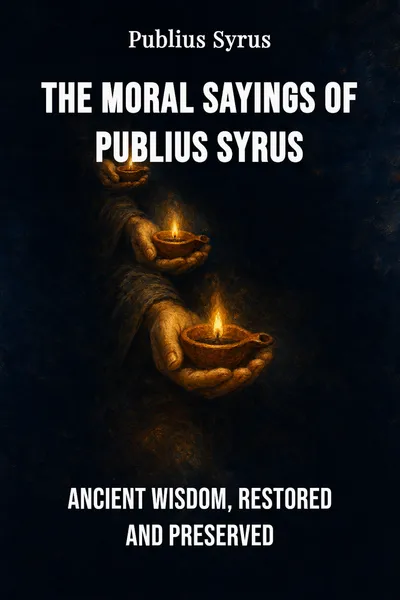
The Moral Sayings of Publius Syrus
Ancient wisdom, restored and preserved
Description
Sometime in the first century BCE, a man arrived in Rome as a slave. He came, according to the tradition, from Syria — his name, Publius Syrus, carries the origin like a label. He was clever enough that his owner had him educated and then freed him, and clever enough after that to make a living on the stage, writing and performing mimes, the rough, popular theater Romans crowded into. He was good at it. Good enough, the story goes, that Julius Caesar once awarded him a prize over his rivals. The plays themselves are gone. What survived is stranger: a collection of single lines, each one a self-contained piece of advice or observation, pulled out of the mimes because Romans found them worth remembering.
That collection is what comes down to us as the Sentences, or in the English edition, The Moral Sayings of Publius Syrus. It is not a book he sat down to write. It is a book assembled from him — favorite lines copied out, taught to schoolchildren, padded over the centuries with sayings from other hands, until the whole thing became a compact anthology of practical wisdom in verse. "A rolling stone gathers no moss" is not in it, but the register is close: short, portable truths a person could carry around.
The edition many readers encounter today is itself a small act of rescue — a facsimile of an older printing, reproduced with its age still on it, because someone decided the lines were worth keeping in circulation. The book's whole life has been like that. It exists because people kept choosing to save it, one copy at a time.
The question we’re asking : How does a book of one-line sayings, drawn from lost plays by a freed slave, survive two thousand years and keep getting reprinted?What we’ll see : We follow the maxims from the Roman stage to the modern reprint — the man, the lines, the long chain of hands that kept them alive.
Table of contents
01Chapter 1 — A slave who wrote in one line what others took a page to say
What we know about Publius Syrus is thin, and most of it comes from later Roman writers who admired him rather than from anything he left behind. He was born, probably, in Syria or somewhere in the Roman East, brought to Italy as a slave in the middle of the first century BCE. His master, impressed by the young man's wit, educated him and eventually granted him freedom — the standard path by which a talented enslaved person could become a Roman citizen with a name of his own.
He made that name on the stage, writing mimes. The mime in Rome was not the silent art the word suggests to us now. It was spoken, bawdy, improvisational, closer to broad comedy than to anything refined, and it was hugely popular with ordinary audiences. Publius Syrus was a performer as well as an author, and by the reign of Julius Caesar he had a reputation. The often-repeated story is that Caesar staged a competition among the mime writers of the day and gave Publius the prize, defeating even the celebrated Decimus Laberius. Whether the detail is exact or polished by retelling, it fixes his standing: he was the best at what he did.

02Chapter 2 — The maxims themselves, and the man behind them
Read a page of the Sentences and the appeal is immediate. Each entry is one line, usually a single sentence, and it earns its place by being both true and tight. "A good reputation is more valuable than money." "We should look to the mind, not to the outward appearance." "He gives twice who gives promptly." That last one — bis dat qui cito dat — is still quoted, often by people who have no idea a first-century mime writer put it into a Roman comedy. The form is the whole point. Publius did not argue toward a conclusion; he handed you the conclusion, compressed, and let you unpack it yourself.
The subjects are the durable ones. Money and what it can and cannot buy. The unreliability of fortune. The difference between how a thing looks and how it is. The obligations of friendship and the risks of trusting the wrong person. What to do with anger, with power, with grief. The tone is worldly rather than pious — this is not a philosopher's system but the accumulated street sense of someone who watched a great many people behave badly and a few behave well. There is a coolness to it, a refusal to flatter. "Powerful is the empire of habit." "You should hammer your iron when it is glowing hot."
03Chapter 3 — How a handful of lines survived two thousand years
The survival of the Sentences is a small case study in how anything ancient reaches us at all. The plays died because nobody was assigned to keep them. The maxims lived because they became useful. In the schools of the later Roman Empire, students learned to read and write partly by copying moral sentences, and a collection of short, edifying, memorizable lines was ideal for the purpose. A child practicing letters could copy "Anger reveals what wisdom conceals" and absorb a lesson in the same stroke. Utility, not literary prestige, kept the text alive.
That usefulness carried it through the medieval centuries, when monasteries and cathedral schools continued to teach Latin from exactly these kinds of florilegia — gatherings of choice sayings. Publius Syrus, sometimes attached to the name of Seneca, circulated in manuscript, copied and recopied, absorbing additions and losing lines along the way. There was no single authoritative version; there was a living tradition of a book that everyone agreed was worth having and nobody guarded very strictly. Its survival was not the preservation of a masterpiece under glass but the constant re-use of a working tool.
04Chapter 4 — Why an old book keeps getting reprinted
The modern edition of The Moral Sayings of Publius Syrus that a reader is likely to hold is a facsimile — a photographic reproduction of an earlier printing, put back into circulation with its imperfections intact. There may be marks on the pages, old notations, a bit of marginalia, the occasional flawed leaf. The publisher does not hide these; they are part of what the object is. And that fact, more than any single maxim, is where the story of the book comes to rest. The Sentences has always traveled this way, as a copy of a copy, each version bearing the traces of the hands that made it.
There is something fitting in preserving a book of maxims about fortune and impermanence in an edition that visibly shows its own wear. The lines themselves keep insisting that things do not last, that reputation outlives wealth, that the wise plan for change. The physical book, scuffed and reproduced, quietly demonstrates the point. What Publius understood on the Roman stage — that a thought survives when it is small enough to carry and true enough to repeat — is exactly the mechanism by which his own words are still here.
05Conclusion
A freed slave wrote lines for a rough popular theater, won a prize from Caesar, and then watched his plays disappear the way most popular entertainment disappears. What remained was the smaller thing — the sentences a person could carry in memory. Those outlasted the mimes, the theaters, the language they were written in, and the empire that produced them, because at each stage they were exactly compact enough to copy, teach, and quote again.
Related books