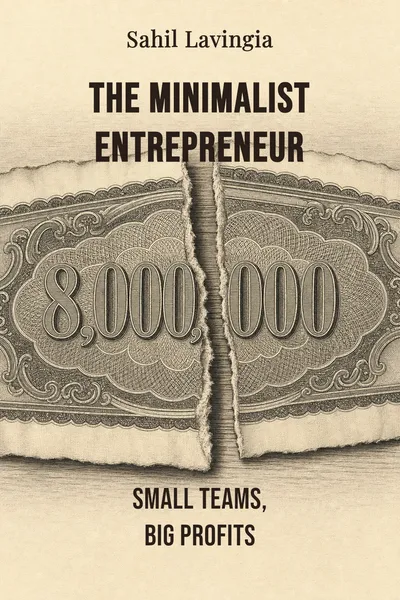
The Minimalist Entrepreneur
Small teams, big profits
Description
In 2011, Sahil Lavingia left an early job at Pinterest, where he had been employee number two and held options that would eventually have been worth a fortune, to build his own company. He was nineteen. The idea was simple enough to fit in a sentence: a way for creators to sell things directly to their audience without a middleman taking a cut. He called it Gumroad. Within a year he had raised more than eight million dollars from some of the best-known investors in Silicon Valley, and the plan was the one everybody in that world shared. Grow fast, raise more, become enormous.
It did not happen. Growth stalled short of the numbers a venture-backed company needs to justify its next round. In 2015 Lavingia failed to raise more money, laid off most of his team, and spent the following years watching the business shrink to something he ran with a handful of people, then almost alone. By the conventional scorecard of the industry he had come up in, this was failure. And yet Gumroad kept paying creators, kept turning a profit, kept existing. Lavingia eventually wrote a book about what that decade taught him, and the lesson ran directly against everything he had been told at the start.
The book is called The Minimalist Entrepreneur, and it is less a memoir than a quiet argument with an entire way of building companies. It asks whether the venture-scale, burn-cash, win-everything model is the only path, or merely the loudest one — and whether a business that stays small on purpose might be the more durable choice.
The question we’re asking : Can a business built to stay small out-live one built to get huge fast?What we’ll see : How a founder who did everything by the book unlearned it, and what he now tells people who want to start something without betting the house.
Table of contents
01 Chapter 1 — The unicorn that refused to die
The startup playbook Lavingia followed in his early twenties is the one most people picture when they hear the word entrepreneur. Raise money from venture capitalists, hire quickly, spend aggressively to capture a market, and worry about profit much later — ideally after an acquisition or a public offering has made everyone rich. The model has a brutal internal logic. A venture fund needs a few enormous wins to cover its many losses, so it steers every company toward the same swing-for-the-fences bet. Anything that merely works, that merely makes money and serves its customers well, counts as a disappointment.
Gumroad hit that wall directly. The company was useful, creators liked it, money flowed through it — but it wasn't growing at the exponential rate its next funding round required. In 2015 the term sheet Lavingia expected never arrived. He describes the aftermath with unusual candor: the layoffs, the shrinking, the sense that he had let down the people who believed in him and himself most of all. For a while he treated the whole thing as a wound.

02 Chapter 2 — Community before code
The most counterintuitive advice in the book is about sequence. The instinct of most technical founders is to build first — to disappear for months, ship a polished product, and then go looking for people who want it. Lavingia argues for something close to the reverse. Start with a community, a group of people who share a problem you also have, and build in the open where they can watch and weigh in. The product emerges from the relationship rather than the other way around.
This isn't a marketing trick dressed up as philosophy. His point is that the hardest part of any small business is not writing the software or making the thing; it's knowing that anyone actually wants it before you've spent your savings finding out. Serving a community you already belong to solves that problem at the root. You feel the need yourself, you hear it from people you talk with every day, and the first customers are often the same people who told you what to build. The market research and the audience turn out to be the same set of humans.
03 Chapter 3 — Profit is a feature, not an afterthought
In the standard startup story, profit is something you get to eventually, once you've captured enough of the market to charge what you like. Money is meant to be burned in the meantime — spent on hiring, on acquisition, on outrunning competitors. Lavingia flips the order. In the minimalist model, profitability is not the reward at the end; it's the thing that keeps you alive long enough to have a story at all. A business that makes more than it spends can survive a bad month, a stalled quarter, a founder who needs a break. A business burning through someone else's cash cannot.
The practical consequence is a preference for staying small. Small teams are cheaper, faster, and easier to keep aligned with the people they serve. Lavingia points to his own years running Gumroad with almost no staff — a distributed handful of people, sometimes just himself — as proof that a company doesn't need hundreds of employees to matter to its customers. Every hire, in his accounting, is a new fixed cost and a new mouth that the business must feed before it feeds you. Restraint on that front buys independence.
04 Chapter 4 — The other end of the founder story
Stepping back, the argument in The Minimalist Entrepreneur is really about who gets to build a company at all. For roughly two decades, the venture model didn't just fund startups; it defined the word. To be an entrepreneur was to raise, scale, and exit, and anyone whose ambition topped out at a good, durable, medium-sized business was politely regarded as someone who hadn't dreamed big enough. Lavingia's book is an attempt to reopen a door that model had quietly closed.
The reopening matters because the venture path is narrow by design. A fund can back only companies that might return the entire fund many times over, which rules out the overwhelming majority of viable business ideas — the ones that would make a decent living for a founder and serve a real community, but would never grow into a billion-dollar outcome. By insisting that this second kind of company is legitimate, even admirable, Lavingia is arguing for a much larger population of people who could reasonably call themselves founders. Not just the ones with a connection to Sand Hill Road.
05 Conclusion
The company that Silicon Valley wrote off in 2015 was still there years later, still profitable, still sending money to the creators who used it. Lavingia had spent the intervening time not rebuilding the rocket ship he was supposed to build, but learning to value the modest, working thing he actually had. The book he wrote out of that experience turns a private disappointment into a general case: that a business kept small and close to its customers can outlast one designed to get big fast, precisely because it never depended on the next round of someone else's money to breathe.
Related books