The Lower Depths of Antiquity
Rome seen from the bottom
Description
We tend to picture ancient Rome from the top down. The forum, the Senate, the aqueducts, the villas with their mosaic floors and their libraries. The Rome that survives in stone and in Latin literature is a Rome of men who owned things — land, slaves, words. It is the Rome that got to write itself down, and it has been very good at convincing everyone since that it was the whole city. Catherine Salles wrote a book against that picture, not by denying it but by walking around behind it.
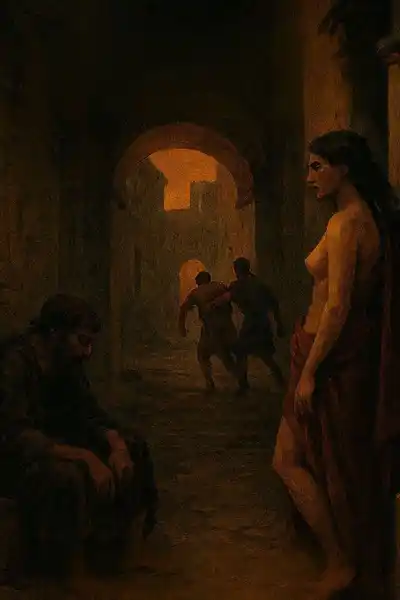
Her subject is the crowd the marble leaves out. The dockworkers and prostitutes, the gladiators and grave-diggers, the fortune-tellers, the beggars, the people packed into wooden tenements that burned and collapsed with grim regularity. Rome at its height held perhaps a million people, and the great majority of them lived close to nothing. They left almost no letters, no memoirs, no monuments they paid for themselves. What they left, mostly, is what other people said about them — usually with a wrinkled nose.
So Salles does something odd for an ancient historian. She reads the elite sources against their own grain, mining satire, insults, court speeches and graffiti for the world they were trying to sneer past. The result is a Rome that smells of smoke, sweat and cheap wine, a city where survival was a full-time occupation. It is a portrait built almost entirely from the reactions of people who found the poor distasteful — and that, in the end, is the deepest thing the book is about.
The question we’re asking : What did the vast majority of Romans — the ones who never made it into the official story — actually live like?What we’ll see : A city rebuilt from below: its cramped lodgings, its despised trades, and the awkward fact that everything we know about it comes from people who looked down on it.
Table of contents
01 Chapter 1 — The city the marble hides
The Rome most of us carry around is a museum Rome — columns, togas, the calm geometry of ruins bleached white by time. Salles begins by dismantling that image, because the living city was nothing like it. At its peak, under the early emperors, Rome may have housed close to a million people crammed into a space that could not comfortably hold them. It was loud, filthy, and dangerous in ways the surviving architecture cannot convey, and the people who made it work were overwhelmingly poor.
The scale of that poverty is easy to miss because it was so normal. A large share of the population depended on the grain dole, the free or subsidized wheat that the state handed out to keep the city fed and quiet. Salles is careful here: the dole was not charity in any modern sense, it was crowd management. A hungry Rome was a rioting Rome, and emperors knew it. Bread and circuses was not a cynical slogan invented by moralists after the fact — it was, more or less, urban policy.

02 Chapter 2 — Where the poor actually slept
Housing is where the gap between the two Romes becomes physical. The wealthy lived in the domus, the private house built around courtyards, the kind of dwelling that leaves handsome floor plans for archaeologists. Almost nobody else did. The rest of Rome lived in the insula, the multi-story apartment block that packed families into rented rooms stacked one on top of another, often above shops and workshops at ground level.
These buildings were, by every account we have, precarious. Built fast and cheap, they leaned, cracked, and burned. Fire was the constant terror of a city lit by oil lamps and heated by open flames, in structures made partly of wood. Collapse was almost as common. Salles gathers the complaints scattered through Roman writers — Juvenal grumbling about the tenement that groans and threatens to fall, the propped-up walls, the landlord who patches a gaping crack and tells the tenants to sleep soundly while the roof sags over their heads.
03 Chapter 3 — The trades nobody wanted to name
To survive, the Roman poor did whatever the city needed and the respectable would not touch. Salles walks through this economy of despised labor with a kind of forensic patience, because it is precisely the work that elite writers treated as beneath discussion. There were dockworkers hauling grain up from the port, muleteers, tanners whose stink kept them at the city's edge, launderers who bleached cloth with urine collected in public jars. None of it was dignified, all of it was essential.
Then there were the trades that carried a moral stain on top of the physical one. Prostitution was everywhere, cheap and visible, worked mostly by slaves and the desperate poor, taxed by the state and scorned by the same men who used it. Gladiators occupied a strange rung: adored in the arena, legally and socially degraded outside it, their blood entertainment and their persons property. Actors and performers sat under a similar shadow. To be applauded by Rome was not the same as being respected by it.
04 Chapter 4 — A history written by the wrong people
Step back from the tenements and the trades and a larger problem comes into focus, one that Salles's whole book is quietly built around. Almost everything we know about the Roman poor comes from people who were not poor and did not like them. The lower depths of antiquity survive as a reflection in an unfriendly mirror. This is not a minor caveat; it shapes the entire picture, and honesty about it is part of the book's method.
Consider who was doing the writing. Juvenal, Martial, Petronius, Cicero — men of education and status, writing satire, epigram, fiction and courtroom rhetoric. When they mention the poor, they do so to disgust, to amuse, or to score a point. A slum appears because it is a good joke; a prostitute appears because she makes an insult land; a freedman's vulgarity appears because his new money is funny to old money. The poor are never the audience and almost never the point. They are texture.
05 Conclusion
Salles ends more or less where she began, with the crowd that built and fed and entertained Rome and then vanished from its official memory. The insulae burned and were rebuilt; the dockworkers and diviners and gladiators died and left nothing but the odd inscription and a lifetime of other men's jokes. Their city was the real one, in the sense that most Romans lived in it, and it is the one that left the faintest trace. What survives is the version its own upper crust chose to keep.
Related books