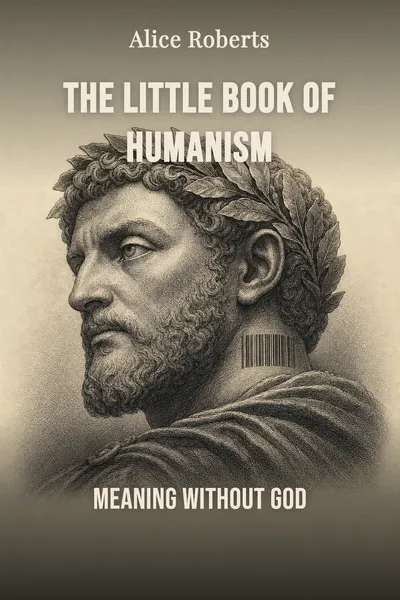
The Little Book of Humanism
Meaning without God
Description
In 2020, a scientist and a philosopher published a small, handsomely made book that reads less like an argument than like a commonplace book — the kind people used to keep, copying out passages that struck them. Alice Roberts, an anatomist and broadcaster known for her work on human evolution, and Andrew Copson, who runs Humanists UK, had gathered a few hundred fragments: lines from Marcus Aurelius and George Eliot, from Einstein and from a nineteenth-century freethinker most readers have never heard of. Each fragment sits with a short piece of commentary. The whole thing fits in a coat pocket.
The book has a plain enough purpose. It sets out to show that a good life — meaningful, decent, even joyful — does not require a god to underwrite it. That claim tends to arrive in public wrapped in argument, in the combative register of the New Atheist bestsellers of the 2000s. The Little Book of Humanism does something quieter. It does not spend its pages attacking belief. It assembles, instead, the positive case: what humanists across two thousand years have actually said about how to live, why to be kind, and what to do about the fact that we die.
Which raises the interesting part. If you strip out God, plenty of people assume what remains is a void — no source for morality, no comfort in grief, no reason to get out of bed. Roberts and Copson are betting the opposite: that the materials for all of it were there the whole time, scattered across the writing of people who never called themselves humanists because the word had not yet been coined for what they were doing.
The question we’re asking : Where does a meaningful, ethical life come from once the divine scaffolding is removed?What we’ll see : How an anthology of the nonreligious quietly reconstructs purpose, morality, and mortality from human materials alone.
Table of contents
01 Chapter 1 — Two thousand years of the same conversation
The first thing the book does is stretch the timeline. Humanism, in the popular imagination, is a modern invention — a product of the Enlightenment at the earliest, or of the twentieth century's declining churches. Roberts and Copson keep reaching further back. They quote Confucius on treating others as you would wish to be treated, centuries before the Gospels. They quote the Roman poet Lucretius, writing around 50 BCE, on death as nothing to fear because there will be no one left to fear it. The through-line they trace is not a movement with a founder. It is a recurring human instinct, surfacing independently in cultures that never met.
What holds these scattered voices together is a shared starting point rather than a shared creed. Each of them begins from the world as it actually appears — no revelation, no afterlife assumed — and asks what follows. The Greek and Roman Stoics ask it. The thinkers of the Indian Cārvāka school, materialists who rejected the authority of scripture, ask it. Renaissance scholars rediscovering the classical texts ask it again. The book is careful not to claim all these people for a single team, but the family resemblance is unmistakable once it is laid side by side.

02 Chapter 2 — Being good without being told to
The hardest question humanism faces is the one the book confronts directly: without divine command, where does morality get its grip? The suspicion runs deep that goodness needs enforcement from above — that people behave only because someone is watching and keeping score. The passages Roberts and Copson choose take that suspicion apart from several directions at once, and none of them relies on a rule handed down.
The oldest answer is the plainest. We are social animals, and we suffer when others suffer and flourish alongside them; kindness is not imposed on human nature but grows out of it. The book leans on the eighteenth-century Scottish philosophers here — Hume, and especially Adam Smith, whose account of moral sympathy grounds conscience in our capacity to imagine ourselves in another's place. Morality, on this view, is not obedience. It is a skill of attention, learned and refined, the way we learn to read another person's face.
03 Chapter 3 — The one life, and how to face its end
The passages many readers will return to are the ones about death, because this is where the absence of religion is supposed to hurt most. No reunion, no eternal reward, no larger plan — just the end. The book does not pretend this is easy, and it earns its comfort precisely by not flinching. Its central move is old, and it comes from Epicurus by way of Lucretius: the state of being dead is not something that happens to you, because there is no you left for it to happen to. Fearing it is like dreading the endless stretch of time before you were born, which troubles no one.
From that starting point the emphasis shifts, gently, from death to life. If this is the only one we get, the value of the time is not diminished but concentrated. The book quotes writers who find in mortality not despair but a sharpened attention — the sense that a finite thing is more precious than an infinite one, not less. A holiday matters because it ends. The reasoning is quiet and it does real work, turning what looks like a deprivation into a reason to pay attention.
04 Chapter 4 — A quiet tradition finally names itself
Step back from the individual passages and a larger claim comes into view — one the book makes by its form as much as its content. What Roberts and Copson have assembled is evidence that humanism is not a modern reaction to religion's decline but a coherent moral tradition that has always existed, running underneath the official histories, largely unnamed. Naming it, and gathering it in one place, changes how it can be seen. A scatter of individual freethinkers becomes a lineage.
This matters more than it might seem. Traditions do practical work. They give people a sense that their way of living has weight and precedent, a vocabulary for the big moments, a set of ancestors to think alongside. Organized religions have always had this, and it is part of what makes them durable through grief and crisis. The nonreligious, by contrast, have often lived without it — holding perfectly good values while feeling, in the hardest moments, that they were improvising alone. The book's real project is to hand that missing inheritance back.
05 Conclusion
The book that started as a pocket-sized commonplace collection ends up doing something larger than its size suggests. By setting Confucius beside Einstein and Lucretius beside a grieving parent's words, Roberts and Copson quietly demonstrate what argument alone struggles to prove: that purpose, decency, and even consolation have human sources, available to anyone, older than any single faith. The void people fear when the divine scaffolding comes down turns out to have been furnished all along.
Related books