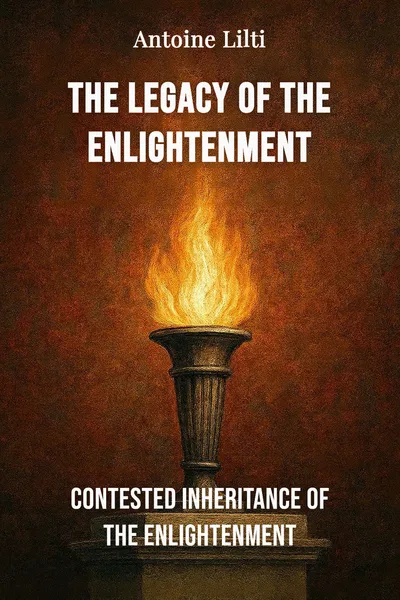
The Legacy of the Enlightenment
Contested inheritance of the Enlightenment
Description
Every few years, someone announces that the Enlightenment is either our salvation or the root of everything that has gone wrong. On one side, writers defend the eighteenth century as the moment reason, tolerance and human rights were born, the fragile achievement we have to protect from populists and fanatics. On the other, critics trace a straight line from Voltaire and Kant to colonial violence, scientific racism and the arrogance of a West convinced it owned the future. Both camps speak as if the Enlightenment were a single thing with a single message, handed down intact, waiting for us to accept or reject it.
The French historian Antoine Lilti finds this whole framing suspect. In his book on the Enlightenment's legacy, he argues that the quarrel tells us far more about us than about the eighteenth century. The thinkers we lump together under one banner disagreed with each other, hedged their own ideas, and would barely recognize the tidy doctrine we attribute to them. Diderot was not Kant; Rousseau spent his career picking fights with the people we now file beside him. The coherence is something we added later, mostly so we would have something clean to be for or against.
Lilti's move is to stop treating the Enlightenment as a finished inheritance and start watching how it was assembled, retouched and fought over across two centuries. The interesting story is not what the philosophes meant, but what successive generations needed them to have meant. Once we look at it that way, the familiar debate loses its footing, and something more unsettling comes into view.
The question we’re asking : Why do we keep fighting over the Enlightenment as if its meaning were settled, when the eighteenth century itself was anything but?What we’ll see : How a messy, self-doubting century was turned into a tradition — and why both its defenders and its prosecutors are arguing about a thing they partly invented.
Table of contents
01Chapter 1 — A quarrel that never quite ends
The argument has a long memory. Lilti points out that almost from the moment the eighteenth century closed, people were already quarreling over what it had been. The French Revolution turned the philosophes into either the fathers of liberty or the arsonists of civilization, depending on which side of the Terror you stood. Edmund Burke blamed abstract reason for the guillotine; revolutionaries claimed the same thinkers as founding saints. The Enlightenment was contested before it had even acquired its name as a single period.
That pattern has held ever since. In the twentieth century, Theodor Adorno and Max Horkheimer, writing in exile during the Second World War, argued that the Enlightenment's worship of reason and control carried within it the seeds of domination — that the same instrumental rationality that promised liberation could organize a death camp. Their Dialectic of Enlightenment became a founding text for everyone who wanted to read Auschwitz as the dark endpoint of eighteenth-century rationalism rather than its betrayal.

02Chapter 2 — Progress had its critics from the start
The most durable caricature is that the Enlightenment believed, naively and uniformly, in progress — in reason marching forward, dragging humanity toward happiness. Lilti spends considerable effort dismantling this. Faith in progress existed, certainly, and Condorcet gave it its grandest expression while hiding from the Revolution that would kill him. But it was never the consensus. The century was at least as full of doubt about progress as it was of confidence in it, and often the doubt came from the same pens.
Rousseau is the obvious case. One of the most celebrated figures of the age built his fame by arguing that the sciences and arts had corrupted rather than improved humanity, that civilization was a fall and not an ascent. He was not a marginal crank; he was a star, read and debated across Europe. That the Enlightenment produced its own most eloquent critic from the inside tells us the movement was never the self-satisfied cult of reason its opponents describe.
03Chapter 3 — The invention of a tradition
If the Enlightenment was so divided, where did the unified version come from? Lilti's answer is that it was largely built after the fact. The idea of a coherent movement called 'the Enlightenment,' with a doctrine and a direction, was assembled by later readers who needed an ancestor. Each era chose its philosophes, edited out the inconvenient ones, and presented the result as a faithful inheritance rather than a reconstruction.
The nineteenth century turned the period into the prehistory of its own politics, liberal or republican depending on the country. In France, the Third Republic made Voltaire and Rousseau into secular saints of the schoolroom, their busts installed to teach children the values of the nation. The messy, aristocratic, often contradictory world of the salons became a clean lineage of reason and citizenship. What had been a conversation became a catechism.
04Chapter 4 — What we do when we claim an inheritance
Step back and Lilti's real subject comes into focus: not the eighteenth century itself, but the strange fact that a historical period became a permanent reference point for deciding who we are. We do not treat many epochs this way. No one builds their identity around being for or against the Renaissance. But the Enlightenment has become the name we give to an argument about modernity — about reason, rights, universalism — and so every modern quarrel tends to reroute itself through the eighteenth century, as if settling what Kant or Diderot really meant could settle what we should do.
This is why the inheritance is genuinely contested rather than simply misunderstood. An inheritance is not a fact to be established; it is a claim to be made. When defenders invoke the Enlightenment to protect human rights, and critics invoke it to indict colonial reason, they are not making rival errors about the past. They are doing the same thing — choosing which strands of a tangled history to carry forward and which to disown. The eighteenth century supplies raw material for both gestures because it genuinely contained both.
05Conclusion
The quarrel we started with — Enlightenment as salvation or as original sin — turns out to rest on a shared assumption that Lilti patiently dissolves. Both sides believe there is a single, recoverable Enlightenment whose true meaning would, once established, decide the case. There is not. There is an eighteenth century full of brilliant, contradictory people who argued with each other and with themselves, and there are two hundred years of readers who assembled those arguments into the tradition we now fight over.
Related books