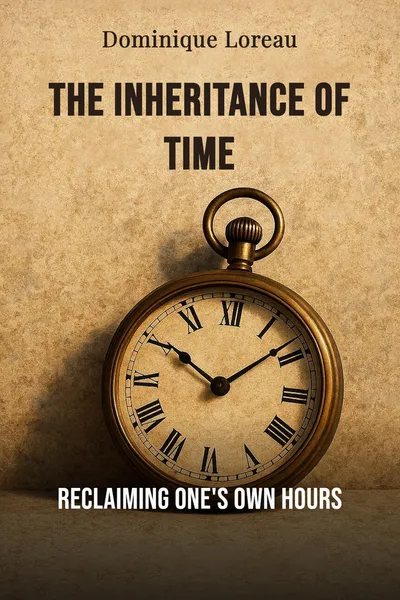
The Inheritance of Time
Reclaiming one's own hours
Description
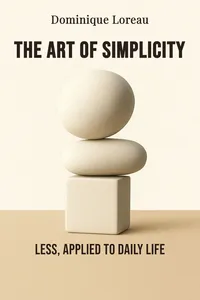
Dominique Loreau has spent decades in Japan, and she writes about ordinary things the way a Zen monk sweeps a courtyard — slowly, deliberately, as if the sweeping itself were the point. She built her reputation on books about owning less: fewer objects, fewer clothes, a quieter interior. In The Inheritance of Time, she turns the same attention toward something we cannot stack on a shelf or give to a charity shop. She asks what we actually do with the hours we are given, and why so few of us feel we own them.
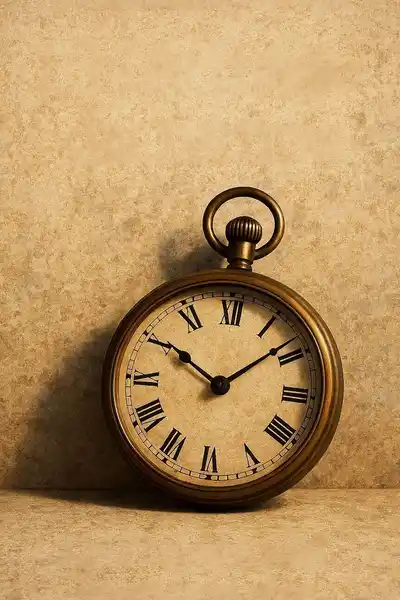
The word in her title does a lot of work. We tend to think of an inheritance as money or a house, something transferred at a death, something we receive and then spend. Loreau treats time this way on purpose. Each of us arrives with a stock of hours whose total we will never know, and almost none of us keeps the books. We let the hours drain through notifications, obligations, half-chosen commitments and the vague sense that we are always behind. The estate is enormous, and we manage it like absentees.
Her proposal is not another productivity system, and it is not a call to do more in less time. It runs the other way. If time is an inheritance, the task is not to optimize it but to reclaim it — to notice where it goes, to refuse what quietly steals it, and to decide, for once, what the hours are for. That reframing is simple to state and surprisingly hard to live, which is exactly why she wrote a whole book around it.
The question we’re asking : What changes when we stop treating time as something we spend and start treating it as something we inherit and own?What we’ll see : How one writer turns the oldest complaint — there's never enough time — into a question of possession, and what she suggests we do about it.
Table of contents
01Chapter 1 — The one thing nobody leaves us in a will
Loreau opens from a quiet observation rather than a statistic. We spend our lives acquiring — degrees, salaries, square meters, relationships — and we rarely notice that all of it is bought with the same currency, which is time. Money can be earned back; a lost afternoon cannot. Yet we guard the bank account and leave the hours unwatched. The paradox she keeps returning to is that the most precious thing we have is the one we treat most carelessly, precisely because it arrives for free and keeps arriving, day after day, until it doesn't.
Calling time an inheritance is her way of making it visible. An inheritance has a size, even if we can't see the figure. It can be squandered or husbanded. It carries a faint obligation: someone, or something, handed it over, and there is a question of what we make of it. Loreau isn't religious about this, and she isn't morbid. She simply wants us to feel the weight of a finite estate, because a stock you can run out of is one you start to pay attention to.

02Chapter 2 — The clutter is not only on the shelves
Loreau made her name telling readers to own fewer things, and she brings that instinct straight into time. A cluttered home and a cluttered schedule, in her view, come from the same reflex: the inability to say no, the fear of missing out, the belief that more is always safer than less. We accumulate commitments the way we accumulate objects — picking them up because they seemed useful, keeping them because discarding feels wasteful, until the shelf and the week are both full of things we never really chose.
The remedy she proposes for time is the one she proposed for possessions: subtraction. Before asking how to fit more in, ask what can come out. She invites us to look at the standing obligations, the recurring meetings, the memberships, the habitual favors, the social events attended out of guilt rather than desire, and to treat each one as an object we might donate. Does it earn its place? If not, it goes. The point is not an empty calendar but a deliberate one, where what remains is there because we put it there.
03Chapter 3 — Slowness as a discipline, not a mood
If the first half of the book is about clearing space, the second is about how to inhabit it. Here Loreau draws openly on the years she has lived in Japan and on the aesthetic of attention she found there. Slowness, for her, is not laziness and not a spa-day mood. It is a discipline — a trained capacity to do one thing at a time and to be fully present while doing it. The tea is drunk, not gulped between emails. The walk is walked, not used as a backdrop for a podcast and a phone call.
She is suspicious of the way we have turned every spare moment into something to be filled. The queue becomes screen time, the meal becomes multitasking, the commute becomes a race through audio. Loreau asks what we are so afraid of in a few minutes of nothing. Her answer is that we have lost the habit of being with ourselves, and that reclaiming time is partly reclaiming the ability to sit inside an ordinary moment without reaching for an escape from it.
04Chapter 4 — A life measured in hours, not years
Step back from the practices and a quieter argument comes into view. Loreau is asking us to change the unit in which we count a life. We are used to measuring it in years — how many we've had, how many we hope remain — a frame so vast it stays abstract. Years don't press on us. An ordinary Tuesday feels infinitely renewable. But a life is not really lived in years; it is lived in hours, and the hours are countable, finite, and already being drawn down whether or not we are watching.
Seen this way, her whole project is less about calendars and more about ownership. To inherit something is to be responsible for it, and responsibility implies a choice between stewardship and neglect. Most of us, Loreau suggests, are neglectful heirs — not through malice but through inattention, letting the estate run itself according to habits and expectations we never consciously approved. Reclaiming time is the moment the heir finally reads the will and decides to take charge of what was always theirs.
05Conclusion
The book ends where it began, with the small act of paying attention. Loreau doesn't promise more time; no one can. She promises a different relationship to the time we have — one in which the hours are counted, the clutter is cleared, and the moments that remain are inhabited slowly enough to be felt. Her practices are deliberately undramatic: an hour kept, an invitation declined, a meal eaten without a screen, a task done one at a time. The modesty is the method. She trusts that a reclaimed inheritance is rebuilt in installments, the same way it was lost.
Related books