The Humanure Handbook
Waste into gold: the composting method
Description
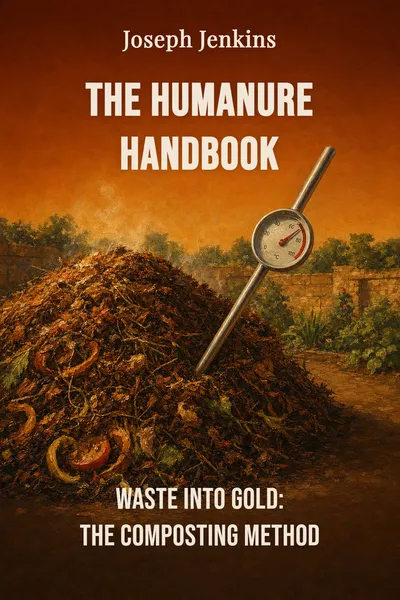
In 1995, a builder and roofer from western Pennsylvania named Joseph Jenkins self-published a book with a title most people would rather not read aloud on the bus. He had been composting his family's own waste for years, in a sawdust bucket and an outdoor bin, and he had grown tired of being treated as a curiosity or a crank. So he did what a stubborn person with a master's thesis and a printing budget does: he wrote everything down — the biology, the temperatures, the pathogen die-off curves, the exact way to build a bin out of scrap pallets — and dared the reader to find the flaw.
The book, "The Humanure Handbook," went on to sell hundreds of thousands of copies across several editions and get translated into more than a dozen languages. That is a strange fate for a manual about poop. But Jenkins was not really writing a plumbing guide. He was picking a fight with an assumption so deep most of us never notice we hold it: that human excrement is waste, a hazard, a thing whose only sensible destination is a pipe leading somewhere we don't have to think about.
His counter-claim is blunt and, once you sit with it, oddly hard to argue against. Nothing in nature is thrown away — everything a living thing produces becomes food for something else. The problem, in Jenkins's telling, isn't the material. It's what we decided to do with it, and the enormous machinery we built to keep doing it.
The question we’re asking : Why do we treat human waste as something to flush away and fear, when Jenkins insists it can safely become soil?What we’ll see : How one self-published builder turned a taboo into a careful argument about biology, sanitation, and the difference between waste and a resource.
Table of contents
01 Chapter 1 — The word nobody wants to say
Jenkins coined a word because the existing ones failed him. "Sewage" and "sludge" carry the assumption of a problem to be disposed of; "night soil" carries centuries of disease and stigma. He wanted a term for human excrement treated as an organic resource, the way we say "manure" for the output of a cow without flinching. So: humanure. Manure of human origin, destined not for a pipe but for a compost pile. The word does real work in the book — it lets us talk about the thing without automatically reaching for the language of contamination.
The reflex he's fighting is recent. For most of human history, and still across much of the world, human waste returned to the land as fertilizer, sometimes carefully, sometimes dangerously. What changed things in the industrialized world was the flush toilet and the sewer, a nineteenth-century response to genuine urban horrors — cholera, typhoid, cities drowning in filth. The fix worked, and it worked so well that it hardened into common sense: the good toilet is the one that makes the material vanish.

02 Chapter 2 — What actually happens in the pile
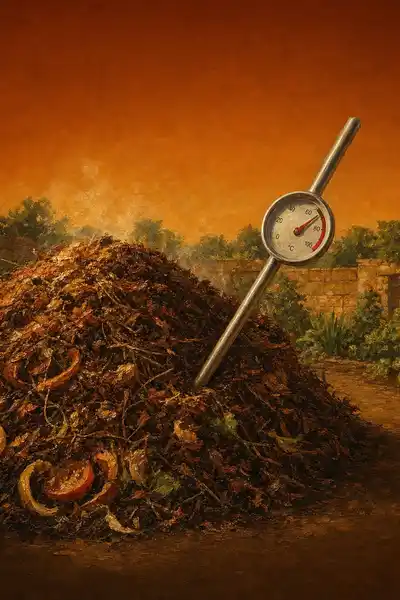
The heart of the book is not ideology but biology, and Jenkins is careful here because this is where the argument lives or dies. Composting is not rot. Rotting is what happens when organic matter breaks down without oxygen, slowly and stinkingly. Composting is aerobic — it recruits an enormous, invisible workforce of bacteria and fungi that consume organic material, and in doing so generate heat. That heat is the whole game.
In a well-built pile, the population of thermophilic, or heat-loving, microorganisms drives the internal temperature up, often into the range of 50 to 70 degrees Celsius. Human pathogens — the bacteria, viruses, and parasite eggs that make waste dangerous — are adapted to live at body temperature, not in a furnace. Sustained heat kills them. Jenkins leans on decades of research showing that time and temperature together render finished compost safe, and he treats the numbers as the answer to the safety objection rather than waving it away.
03 Chapter 3 — The bucket, the bin, and the balance
For all its biology, the book is at bottom a builder's manual, and Jenkins is happiest with a diagram. The system he champions is almost comically simple, which is part of the point. At the indoor end sits what he calls a sawdust toilet: a five-gallon bucket inside a wooden box with a standard toilet seat, and a supply of sawdust beside it. Every deposit gets a generous handful of cover material on top. That cover is not decoration — it seals odor, absorbs moisture, and starts the carbon-nitrogen balance that the compost pile will finish.
No water, no pipes, no electricity, no expensive proprietary fixture. When the bucket is full, it's carried out and emptied onto the compost pile, then rinsed and returned. Jenkins spends real pages on the unglamorous details — how many buckets a household needs, how to keep the toilet clean, why a tight-fitting lid and enough cover material mean the indoor unit doesn't smell. He's aware that this is the part where readers wince, and he answers the wince with logistics rather than argument.
04 Chapter 4 — Sanitation is a story we told ourselves
Step back from the buckets and a larger claim comes into focus, which is what makes Jenkins's book more than a novelty. The flush toilet, he argues, didn't just solve a sanitation crisis. It rewrote our entire relationship to a natural cycle, and it did so in a way we've come to mistake for the only possibility. We treat "waste and clean water go down separate from the food that grows in soil" as a fact of civilized life. Jenkins insists it's a design choice — one with a beginning, a cost, and alternatives.
The cost is easiest to see in the accounting. A resource loop that ran for millennia, in which the nutrients a body takes from food return to the soil that grows more food, was cut and replaced with a linear system: extract fertilizer, eat, flush the nutrients into water, treat the water at expense, and buy more fertilizer. Jenkins doesn't frame humanure composting as a lifestyle quirk but as the restoration of a loop that industrial sanitation broke without quite meaning to.
05 Conclusion
Jenkins never quite drops the builder's plainness, and that's the book's charm. He returns, again and again, to the bucket and the sawdust and the year-long wait — the ordinary discipline of turning something we fear into dark, sweet-smelling soil. The finished compost, spread on a garden or an orchard, is the proof he keeps pointing to: no trace of its origin, no hazard when made correctly, just fertility that would otherwise have been flushed into a river and paid for twice.
Related books