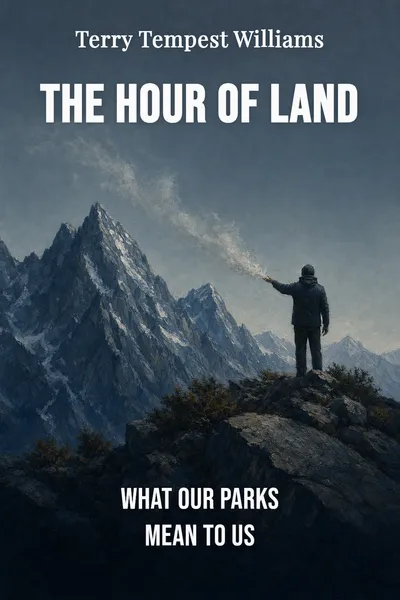
The Hour of Land
What our parks mean to us
Description
In 2016 the National Park Service turned one hundred, and Terry Tempest Williams marked the anniversary not with a guidebook but with a confession. The Hour of Land opens on Grand Teton, where her family scattered her mother's ashes, and moves through eleven more places — Yellowstone, Acadia, Big Bend, Gettysburg, the Gulf Islands, César Chávez in California. Each one is a park she has walked, argued with, grieved in. The book carries black-and-white images from photographers like Sally Mann, Lee Friedlander, and Sebastião Salgado, but the through-line is Williams herself, a Utah writer who cannot look at a protected landscape without also seeing the people who fought over it.
She calls the parks "breathing spaces" — public lungs in a country that keeps paving over its open ground. Close to three hundred million visits a year suggests she is not alone in needing them. And yet the book refuses the postcard. Williams writes about oil rigs on the horizon of Theodore Roosevelt National Park, about the Deepwater Horizon spill fouling the Gulf Islands, about a battlefield where the ground itself remembers a slaughter. The America in these portraits is beautiful and compromised at once.
So The Hour of Land sits at an odd angle to the celebration it was written for. It honors the parks while asking whether we deserve them, whether we understand what we are keeping, whether a centennial is a birthday or a warning. The book is part memoir, part natural history, part argument — and it never quite lets one mode settle before another cuts in.
The question we’re asking : What do national parks actually hold for us, once we stop treating them as scenery?What we’ll see : A writer's restless, personal tour of twelve American landscapes, and the argument buried inside the love letter.
Table of contents
01 Chapter 1 — Twelve parks, one restless love
The structure of the book is deceptively simple: twelve chapters, twelve parks, chosen not to represent the system evenly but to represent Williams's own relationship to it. She could have written the obvious ones and stopped. Instead the list wanders — Grand Teton, where the grief begins, then Theodore Roosevelt in North Dakota, Acadia in Maine, Gettysburg in Pennsylvania, Effigy Mounds in Iowa, Big Bend on the Texas–Mexico border, Canyonlands in her home state of Utah, Glacier in Montana, Alcatraz in San Francisco Bay, the Gulf Islands off the coast of Mississippi and Florida, and Gettysburg's darker cousins in the roster of American memory. Each is a case, not a scene.
What holds the twelve together is not geography but a refusal to keep the personal and the political apart. In Grand Teton, the death of her mother and the survival of the land press against each other on the same page. In Big Bend, the desert quiet is inseparable from the fence and the politics of the border it runs beside. Williams does not visit a park and then, afterward, consider its issues. The issues are already there when she arrives, in the light on the rock.

02 Chapter 2 — The Terry-Tempest-Williams way of seeing
Williams came to this book as the author of Refuge and When Women Were Birds, memoirs that braid family, faith, and the natural world until the seams disappear. She writes about land the way some writers write about people — attentively, unevenly, with the willingness to be wounded. Her sentences are lyrical without being decorative; she reaches for the exact bird, the exact geological term, and then lets the fact do emotional work. The prose is a large part of why the parks feel alive rather than catalogued.
Her method is to stand somewhere long enough to be changed by it. In Canyonlands she writes about the disorienting scale of erosion, deep time made visible, and how it shrinks human urgency to something bearable. At Effigy Mounds she attends to the Indigenous earthworks and the uneasy fact that a national monument now protects what a settling nation once nearly erased. She is always aware that she is a guest, and that the ground under her feet has older claims than the Park Service's.
03 Chapter 3 — Where the wild meets the human hand
The claim at the center of the book is that a national park is not wilderness. It is a landscape with its own long evolutionary history that we have shaped into "something of our own making" — a boundary drawn, a road built, a story told about what belongs inside the line. Williams keeps returning to this intersection of humanity and wildness, because it is where the parks are most honest about themselves. They are wild places managed by a bureaucracy, funded by a Congress, visited by millions, and threatened by the same economy that pays for them.
She does not flinch from the threats. Theodore Roosevelt National Park sits amid the North Dakota oil boom, its horizon lit by gas flares and its quiet cut by truck traffic. The Gulf Islands appear in the aftermath of the 2010 Deepwater Horizon blowout, oil in the marsh grass, a park absorbing an industrial catastrophe it did nothing to cause. Glacier is losing the glaciers that named it. In each case the park is not a refuge from the wider world but a place where the wider world's consequences arrive first and stay longest.
04 Chapter 4 — What a park keeps that nothing else can
Step back from the twelve portraits and a larger argument comes into focus, the one the centennial was supposed to celebrate but rarely names out loud. National parks are among the last genuinely common things left in American life — ground that belongs to everyone and therefore to no one in particular, held in trust across generations rather than owned, sold, and consumed. In a culture organized around private property and paywalls, that is nearly a radical arrangement, and Williams treats it as one.
This is why she calls them breathing spaces and means it in more than a physical sense. A park is a place where the market's logic is suspended, where a citizen with no wealth has the same standing as one with a great deal, where the point is not to extract value but to be present. The three hundred million annual visits, in her reading, are not a tourism statistic. They are evidence of a hunger the rest of the economy cannot feed — for silence, for scale, for a relationship to land that is not transactional.
05 Conclusion
The book ends where it began, in the register of grief and attention that Williams brings to everything she loves. She scattered her mother's ashes in Grand Teton and spent twelve chapters learning that the land holds our losses the way it holds our histories — patiently, without asking permission, on a timescale that dwarfs our own. The parks outlast the arguments about them, which is exactly why the arguments matter now.
Related books