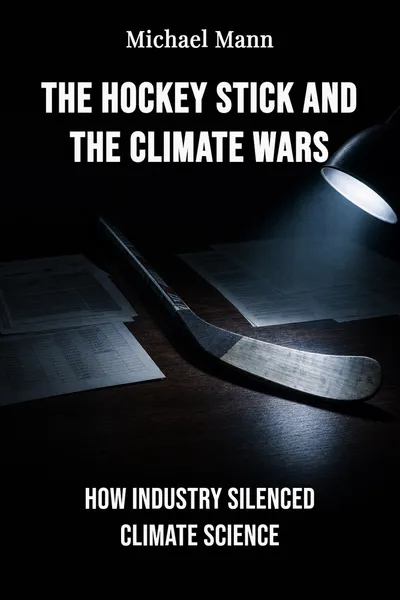
The Hockey Stick and the Climate Wars
How industry silenced climate science
Description
In 1998, a young climate scientist named Michael Mann published a reconstruction of Northern Hemisphere temperatures stretching back six centuries, later extended to a thousand years. The line it produced was mostly flat for most of that span — the long handle — and then, in the twentieth century, it bent sharply upward. The blade. A colleague, the geoscientist Jerry Mahlman, looked at it and called it a hockey stick, and the name stuck. It was, on its face, an ordinary piece of paleoclimate research, built from tree rings, ice cores and coral, published in a technical journal that almost nobody outside the field reads.
Two years later it appeared in the summary report of the Intergovernmental Panel on Climate Change, reproduced where policymakers and journalists would actually see it. And that was the problem. A graph that a person could grasp in a single glance — temperatures steady for centuries, then spiking exactly as industrial societies began burning coal and oil — was far more dangerous to certain interests than any equation buried in a paper. You did not need a PhD to read it. You only needed eyes.
What followed was not a scientific debate in any recognizable sense. It was a campaign — congressional subpoenas, hostile op-eds, hacked emails, death threats, an investigation launched by a state attorney general. Mann, who had set out to study the deep past of the climate, found himself the target of one of the most sustained assaults ever waged on a working scientist. He told the story himself, from the inside, in a book that reads less like a memoir than a field report from a war he never chose to fight.
The question we’re asking : What happens when a single scientific graph becomes too legible, too persuasive, and too inconvenient to be left alone?What we’ll see : How a routine reconstruction of the past became a lightning rod, and what its author learned about the machinery built to discredit it.
Table of contents
01 Chapter 1 — A curve that fit on a single page
The science behind the Hockey Stick is less dramatic than its reputation. Thermometers only give us reliable global records back to about 1850, which is not long enough to know whether recent warming is unusual. So Mann and his colleagues Raymond Bradley and Malcolm Hughes turned to proxies — natural archives that record temperature indirectly. Tree rings grow wider in warm years. Corals and ice layers and lake sediments carry their own signatures. Stitch enough of these together, calibrate them against the modern instrumental record, and you can estimate temperatures for centuries before anyone was measuring them.
The result, published across two papers in 1998 and 1999, was a reconstruction that stayed roughly level through the medieval period and the so-called Little Ice Age, then climbed steeply in the past hundred years. The recent warmth, the data suggested, had no clear precedent in the previous millennium. It was careful work, hedged with the honest uncertainty bands that define good science — the estimates for older centuries were fuzzier, and Mann and his co-authors said so plainly.

02 Chapter 2 — The manufactured controversy
The attack, when it came, borrowed a playbook that was decades old. The tobacco industry had shown the way: you do not need to disprove a scientific finding to neutralize it, you only need to manufacture the appearance of doubt. Keep the question looking open, and policy stalls indefinitely. Mann came to see the assault on his work as a direct descendant of that strategy, funded and coordinated by interests with a great deal of money riding on the continued burning of fossil fuels.
The technical case against the Hockey Stick was led by two figures outside mainstream climate science — a mining executive named Stephen McIntyre and an economist, Ross McKitrick. In papers published in the early 2000s, they argued that Mann's statistical methods were flawed and that his conventions could produce hockey-stick shapes from random noise. Their critique was seized on instantly and amplified far beyond what the specialist community thought it warranted. Subsequent reconstructions by independent teams, using different data and different methods, kept producing the same basic shape.
03 Chapter 3 — When the emails were stolen
In November 2009, weeks before a major climate summit in Copenhagen, someone hacked a server at the University of East Anglia in England and released thousands of private emails between climate scientists, Mann among them. The timing was not accidental. The affair was branded Climategate almost immediately, and phrases lifted from the correspondence were paraded through the press as supposed proof that scientists had been cooking the books all along.
The most notorious was a line from the British scientist Phil Jones about using a trick to hide the decline. Read in context, trick meant a clever technique — the everyday shorthand scientists use — and the decline referred to a known quirk in certain tree-ring data after 1960, a technical wrinkle already discussed openly in the literature. Stripped of that context and repeated endlessly, the words sounded like a confession. That was the design. A private word, weaponized in public, does not need to be understood to do damage.
04 Chapter 4 — Science as a contact sport
Step back from the graph and the individual controversies, and the Hockey Stick episode reveals something larger about how organized doubt is engineered. The pattern is repeatable, almost industrial. Find the most legible, most persuasive piece of evidence in a field. Attack it not on its merits — that battle is usually already lost — but as a symbol, so that discrediting one image seems to discredit the whole edifice. Fund a small number of contrarian voices and amplify them until they appear to represent a genuine scientific split. Reach past the journals into the machinery of politics, subpoenas, hearings, hacked correspondence, until the scientist spends more time defending than researching.
05 Conclusion
The graph itself survived every assault. In the years after the East Anglia hack, reconstruction after reconstruction — using new proxies, new statistics, independent teams — reproduced the same essential shape Mann had drawn in 1999. A long, near-level handle and a sharp modern blade. The scientific verdict was never seriously in doubt; a 2013 IPCC report extended and strengthened the picture. What was contested was not the past temperature of the planet but whether the public would be allowed to see it clearly.
Related books