

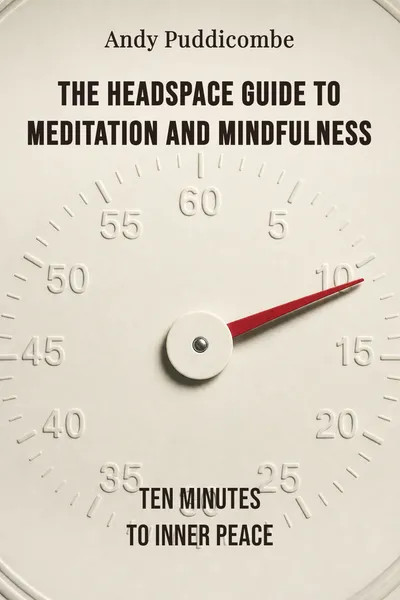
The Headspace Guide to Meditation and Mindfulness
Ten minutes to inner peace
Description
Andy Puddicombe spent most of his twenties as a Buddhist monk. He had started studying sports science at university, then left it behind after a series of losses in his personal life pushed him toward something quieter, and over roughly ten years he trained in monasteries across Nepal, India, Burma, Thailand, Russia and beyond. He learned to sit with his own mind for hours at a time. Then he did something most monks don't: he disrobed, moved back to a world of deadlines and rent, and set out to translate what he'd learned into language that would make sense to someone who had never sat cross-legged in their life.
The result, eventually, was Headspace — the app millions now open on the train — and, before that, the book that laid out its method. Puddicombe's wager is deceptively small. Not a retreat, not a philosophy degree, not incense and robes. Ten minutes a day. That's the whole pitch, and it sounds almost too modest to matter. Yet the claim behind it is large: that ten daily minutes of a specific kind of attention can loosen the grip of stress, blunt the low hum of tiredness, and open a steadier, more spacious relationship with our own experience.
What's easy to miss is how much unlearning that requires. Most of us think we already know what meditation is — emptying the mind, forcing calm, achieving some blissed-out blank. Puddicombe spends much of the book dismantling exactly those assumptions, because they're the reason people try it once, fail, and quit. The interesting part is what he puts in their place.
The question we’re asking : Can ten minutes a day of doing, in a sense, nothing actually change how we feel — and what is that nothing?What we’ll see : How a former monk turns a monastic discipline into a plain, daily habit, and why the point was never to stop the thoughts.
Table of contents
01Chapter 1 — The monk who walked away
Puddicombe tells his own story without much drama, which is part of why it lands. In his late teens, a run of difficult events — including friends killed in an accident and the strain that followed — left him looking for a way to make sense of a mind that wouldn't settle. He had already dabbled in meditation as a boy; now he took it seriously. He stopped his studies and travelled to Asia to train, moving between traditions and teachers over about a decade, eventually taking full monastic ordination in the Tibetan Buddhist tradition.
Monastic training, in his telling, is not the serene picture we imagine. It is repetitive, uncomfortable, sometimes tedious, and it confronts you relentlessly with your own restlessness. He describes sitting for long stretches and watching his mind produce an endless stream of plans, judgments and worries — the same stream, he insists, that runs through everyone. The monastery didn't hand him a quiet mind. It taught him a different way of being with a noisy one.

02Chapter 2 — Meditation isn't what we think it is
The biggest obstacle, Puddicombe argues, is our idea of success. We sit down expecting to empty the mind, and within seconds it fills with a shopping list, an old argument, a flash of anxiety. We conclude we're bad at it and give up. But emptying the mind was never the goal — and treating it as one guarantees frustration. The mind produces thoughts the way the body produces heartbeats. Trying to force it silent is like trying to still a glass of muddy water by stirring it harder.
His favourite image is a busy road. Sitting to meditate, he says, is like sitting on the verge watching traffic pass. The thoughts are the cars. Most of us don't just watch — we run into the road, chase a particularly shiny car, get caught up in where it's going, and only notice minutes later that we've been dragged off somewhere. Meditation isn't stopping the traffic. It's learning to sit on the verge a little longer, noticing the cars without leaping after every one.
03Chapter 3 — Ten minutes, and the blue sky underneath
The core technique the book teaches is deliberately simple, and Puddicombe calls it, plainly, Take10 — ten minutes, once a day. Sit somewhere you won't be disturbed, back reasonably upright, hands resting. Take a few deep breaths, then let the breath return to its natural rhythm and simply notice it. When you find you've drifted into thought, note it without irritation and return to the breath. That's the entire mechanism. Its power is in the repetition, not in any complexity.
He surrounds this centre with small, concrete instructions that stop beginners from floundering. Before focusing on the breath, take a moment to notice the body in the chair, the sounds in the room, the general sense of how you feel — a brief check-in rather than a plunge into concentration. He suggests gently counting breaths, one to ten and back, as a rail to hold when the mind is especially loud. And he warns against the two classic traps: white-knuckle effort on one side, drowsy vagueness on the other. The sweet spot is relaxed alertness.
04Chapter 4 — Living the practice off the cushion
The ten minutes, Puddicombe is careful to say, are not the real destination. They're a training ground. The genuine aim is to change how we meet the other fifteen hours of the waking day — the emails, the traffic, the difficult conversation, the child who won't sleep. What the formal sitting rehearses is a single move: noticing where the mind has gone, and coming back. Off the cushion, that same move is what lets us catch a spiral of worry before it swallows an afternoon.
This is why he devotes a large part of the book to integration, to what he calls mindfulness in daily life. He offers exercises attached to ordinary activities — eating, walking, running, even falling asleep — where the task is simply to be present to what's actually happening rather than lost in commentary about it. Eating a meal while genuinely tasting it. Walking while feeling the feet meet the ground. The activities are unremarkable; the shift is in the quality of attention we bring to them.
05Conclusion
The book ends more or less where the monk's journey began: with the recognition that a mind can't be forced into peace, only given the conditions to find its own. Puddicombe's whole method is an attempt to make those conditions portable — small enough to fit into a commute, plain enough to survive without robes or belief. Take10 is the seed, the natural breath the anchor, the busy road and the blue sky the two images meant to keep us from the mistakes that make most people quit. Nothing in it is complicated, and that is deliberate.