
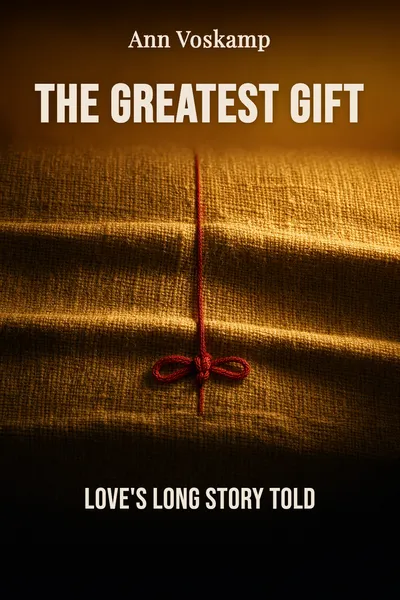
The Greatest Gift
Love's long story told
Description
Every December arrives with the same quiet ambush. The lights go up, the lists get longer, and somewhere between the wrapping paper and the school concerts, the thing the season was supposedly about slips out of reach. Ann Voskamp opens The Greatest Gift, her Advent devotional published in 2013, from inside exactly that pressure. She writes as someone who has felt Christmas turn into one more thing to manage — a countdown of obligations rather than a countdown of wonder — and who suspects most of us have felt it too. The book is her attempt to interrupt that momentum, day by day, for the twenty-five days leading to Christmas.
Her move is unexpected. Instead of starting at the manger, she starts much earlier, in the opening pages of Genesis, and treats the nativity not as a standalone scene but as the last chapter of a story that has been running for a very long time. Each day of the devotional plants itself in a different corner of Scripture — a garden, an ark, a barren woman, a shepherd boy, a line of flawed ancestors — and follows a single thread through them all. The birth in Bethlehem, in her telling, is where that thread finally ties off.
What emerges is less a set of holiday reflections than a sustained argument about how to read a whole tradition. Voskamp is asking her readers to stand back far enough to see the shape of the thing, and the shape she finds is not a lesson to be earned but something handed over freely. The season, she insists, was never meant to be performed.
The question we’re asking : What does it change to read the Christmas story as the ending of a story that started in the very first pages of Scripture?What we’ll see : How Voskamp turns the frenzy of the season into an invitation to slow down and trace one long thread of grace to a manger.
Table of contents
01Chapter 1 — The rush that swallows the season
Voskamp does not begin by scolding anyone for being busy. She begins by naming the busyness as something almost involuntary, a current that carries people along whether they want it to or not. The weeks before Christmas, in her description, become a strange inversion: the season built to celebrate a gift turns into the most exhausting stretch of the year, measured in errands and expectations. She writes from the middle of a working farm and a full house, so the frazzle she describes is not theoretical. It is the sink full of dishes, the calendar with no white space, the sense of running toward a day that keeps threatening to arrive before we are ready for it.
The diagnosis underneath all this is that we have confused preparation with production. We prepare for Christmas the way we prepare for a deadline — by doing more, buying more, achieving more — and the doing crowds out the very thing we were preparing to receive. Voskamp keeps returning to the image of hands that are too full to be given anything. If the point of the season is a gift, then grasping and striving are exactly the wrong posture. You cannot receive with clenched fists.

02Chapter 2 — A family tree with more shadow than light
Having slowed the reader down, Voskamp then does something many Christmas books avoid: she goes back to the beginning and walks the long way forward. Her structure follows the ancestry of Jesus, the genealogy that opens the Gospel of Matthew, and she takes each name in that lineage as a doorway into an older story. This is where the devotional reveals its real ambition. She is not decorating the nativity; she is building the road that leads to it, brick by brick, across centuries of Scripture.
What strikes her most about that road is how unlovely much of it is. The family line running toward Bethlehem is not a procession of saints. It includes deceivers, exiles, a prostitute, an adulterous king, foreigners, and the barren and the broken. Voskamp lingers deliberately on these figures rather than tidying them away. Jacob the trickster, Tamar, Rahab, Ruth the outsider, David and his catastrophic failures — she treats each as evidence rather than embarrassment. The genealogy of the coming gift is, by any ordinary measure, a genealogy of mess.
03Chapter 3 — Advent as the discipline of slowing down
The daily form of the book is not incidental to its meaning; it is the meaning practiced. Voskamp treats Advent as a discipline, in the old sense of a repeated practice that reshapes a person over time. Twenty-five days is long enough to change a habit of attention. Read one entry, sit with one passage, carry one question through the day — and the cumulative effect is a slow retuning of how a person moves through the season. The book asks less for agreement than for repetition.
Her prose does a lot of this work. Voskamp writes in a lyrical, unhurried style — sentences that circle an image, break it open, hold it up to the light. Some readers find this style luminous and others find it dense, but its function is consistent: it refuses to let you skim. You cannot speed-read a Voskamp paragraph and get anything from it. The writing itself enforces the slowness the book is arguing for, so that the how of reading becomes a rehearsal for the how of living the season.
04Chapter 4 — Grace as the shape of the whole story
Step back from the daily readings and one claim organizes everything else in the book: that grace, not achievement, is the grammar the entire story is written in. This is what lets Voskamp connect a garden in Genesis to a manger in Bethlehem without the seams showing. She is reading the whole of Scripture through a single lens, and the lens is gift — something given to those who could not earn it, extended across a long line of people who mostly got it wrong. The nativity is not the first act of grace in her telling; it is the fullest.
That reading has consequences beyond the season. If the deepest thing running through the story is a gift, then the human posture that fits the story is reception, not performance. This is why the busyness Voskamp diagnosed in the opening pages matters so much to her. It is not merely tiring; it is a category error. It approaches a gift as though it were a goal, striving toward something that was only ever meant to be received. The whole book is an attempt to correct that posture, and the correction is theological before it is practical.
05Conclusion
The Greatest Gift ends where the calendar does, at Christmas morning, but Voskamp has spent twenty-five days making sure the manger no longer looks like a beginning. It looks like an ending — the last knot in a thread pulled all the way back to the first garden, through a line of people no one would have chosen, toward a gift no one could have earned. The book closes the loop it opened: the reader who began overwhelmed by the season is invited to arrive, finally, with hands unclenched and eyes adjusted to a longer story.