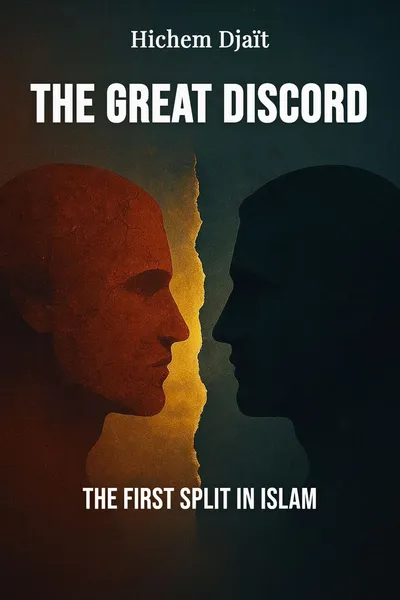
The Great Discord
The first split in Islam
Description
In the summer of 656, a crowd of provincial soldiers and disgruntled Muslims besieged the house of the third caliph, Uthman ibn Affan, in Medina. He was an old man by then, a companion of the Prophet, one of the first converts. For days he refused to raise arms against fellow believers. On a June afternoon, the rebels broke in and killed him while he sat reading the Quran. His blood, according to the accounts, fell across the open pages. The murder of a caliph inside the Prophet's own city, less than a quarter-century after Muhammad's death, was something the young community had no way to absorb.
The historian Hichem Djait spent much of his career reconstructing what came next: the years of civil war that Muslim tradition calls the Great Discord, or fitna. It was not a border war or a dynastic quarrel that history could quietly file away. It was the community turning on itself over the single question it had never resolved — who had the right to lead after the Prophet, and on what grounds. The answers people gave in those few years would still be dividing believers fourteen centuries later.
Djait's method is careful, almost forensic. He works through contradictory chronicles written generations after the events, sifting the legend from what likely happened, refusing both the pious version and the cynical one. What emerges is not a story of villains and saints but of sincere people caught in a situation none of them could master, making choices that would freeze into doctrine long after they were dead.
The question we’re asking : How did a dispute over succession, in a single generation, become the fracture that still runs through the Muslim world?What we’ll see : A besieged caliph, a divided community, a battle that solved nothing, and a wound tradition never learned to close.
Table of contents
01Chapter 1 — A murder in Medina
To understand why Uthman's death detonated the community, we have to see how young that community still was. Muhammad had died in 632, only twenty-four years earlier. The men now fighting had prayed behind him, memorized his words, fought at his side. There was no settled theory of the state, no rulebook for succession. The first three caliphs — Abu Bakr, Umar, then Uthman — had each come to power by a different improvised procedure, and the improvisation had held only because the men were respected and the conquests were spectacular. Under Uthman, the improvisation began to fail.
Uthman belonged to the Umayyad clan, the Meccan aristocracy that had fought Muhammad longest before converting late. As caliph he appointed relatives to the rich new governorships — Egypt, Iraq, Syria. To his enemies this looked like the old Meccan elite quietly recapturing a movement that had once humbled them. Djait is cautious here: he shows that the charges of nepotism were partly fair and partly the resentment of soldiers who felt the spoils of empire slipping from their hands. Grievance and principle were tangled from the start, and they would stay tangled.

02Chapter 2 — The community picks a side
Into this vacuum stepped Ali ibn Abi Talib — the Prophet's cousin, married to his daughter Fatima, among the very first believers. Many in Medina turned to him as the obvious successor, the man closest to Muhammad by blood and by early loyalty. Ali accepted, and became the fourth caliph. But he took power over a body already split, and with Uthman's blood still unaccounted for. His first act could not be reconciliation, because half the community wanted the killers punished and Ali could not, or would not, deliver them.
The demand for vengeance became the wedge. In Mecca, two senior companions, Talha and Zubayr, joined by Aisha, the Prophet's widow, gathered an army and marched on Basra, insisting Ali either avenge Uthman or step aside. The result was the Battle of the Camel, near Basra in late 656 — named for the camel Aisha rode at the center of the fighting. It was the first time Muslims met Muslims on an open battlefield, both sides invoking the same God and the same Prophet. Ali won. Talha and Zubayr died. But a line had been crossed that no victory could uncross.
03Chapter 3 — The arbitration that decided nothing
The two armies met in 657 at Siffin, on the plain beside the Euphrates. For weeks they skirmished and negotiated, both reluctant to unleash a full slaughter of believers on believers. When the fighting finally turned decisively against Muawiya, his lieutenant Amr ibn al-As proposed a gesture as shrewd as it was audacious: Syrian soldiers raised pages of the Quran on their lances and called for the dispute to be settled by the word of God rather than the sword. It was a tactical masterstroke dressed as piety, and it worked.
Ali's army fractured over how to respond. Many of his own men, exhausted and moved by the sight of scripture on the spears, pressed him to accept arbitration. Ali suspected the trap but could not hold his coalition together against it. He agreed to submit the quarrel to two human arbitrators. And the moment he did, a faction of his hardest supporters turned on him in fury, arguing that judgment belonged to God alone and that Ali had betrayed the faith by letting men arbitrate what only God could decide. These were the Kharijites — the first sect to break away, and soon Ali's deadliest enemies.
04Chapter 4 — A wound that never closed
The fitna did not end when Ali died; it hardened into memory, and memory into doctrine. Around the figure of Ali and his descendants grew the conviction that authority in Islam should have stayed within the Prophet's family — that Ali had been the rightful heir all along and the community had wronged him. This became the party of Ali, the shiat Ali, from which the word Shia descends. Against it stood the position that legitimacy rested with the consensus of the community and its established leaders, whatever their lineage — the outlook that would crystallize as Sunni. The split was not born of theology. It was born of this succession war, and theology grew up afterward to explain and defend positions that men had already taken with their lives.
Djait's point is that the events of a single generation became a permanent grammar. The martyrdom of Ali's son Husayn at Karbala in 680, a further chapter of the same unresolved conflict, gave Shia Islam its central story of righteous suffering against illegitimate power — a story reenacted in mourning every year to this day. The questions raised between 656 and 661 were never institutionally closed, so each age reopens them. Who holds legitimate authority? Does it come from blood, from consensus, from divine designation, from force wearing the mask of piety? Those were the questions at Medina and Siffin, and they remain live wherever Muslims argue about who has the right to lead and to speak for the faith.
05Conclusion
Hichem Djait's achievement is to return the Great Discord to human scale. Strip away the centuries of veneration and denunciation, and what remains is a handful of sincere, cornered people in the years after 656: a caliph who would not fight, a cousin who inherited a war he did not want, a governor who turned grief into strategy, and zealots who decided that only God could judge. None of them set out to divide Islam forever. Each acted on a defensible reading of what the faith demanded. The tragedy is that those readings could not be reconciled, and no authority stood above them to try.
Related books