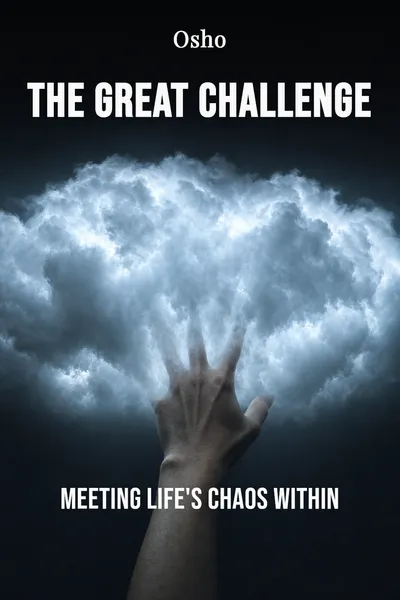
The Great Challenge
Meeting life's chaos within
Description
For most of his public life, Osho did not write books so much as answer questions. People came to him — devotees, doubters, journalists, seekers who had read too much and understood too little — and they asked. Does God exist? What is consciousness? Why do I feel empty even when everything is fine? The Great Challenge is a collection of those exchanges, and it opens where the modern mind least expects a spiritual teacher to begin: not with peace, but with chaos. Osho does not promise to organize the inner mess. He tells us to go into it.
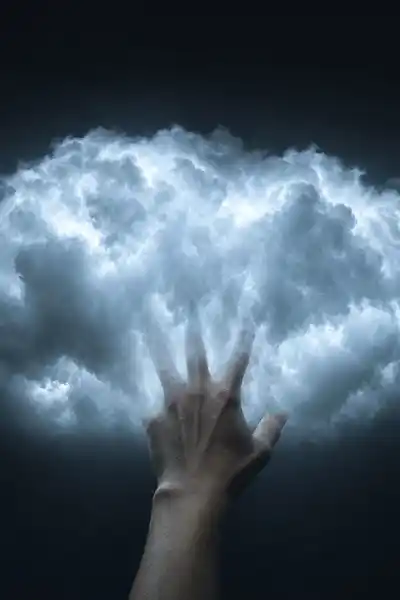
That instruction cuts against nearly everything the self-improvement industry sells. We are trained to manage the inner life — to control the racing thoughts, to still the anxiety, to arrive at some clean and quiet state. Osho's move is stranger and, in a way, more honest. Meditation, he says, means diving into the unconscious, being in it, being chaotic in the chaos, formless within the formless. It means letting go of the very self that keeps trying to fix everything. Float in the clouds, untethered. For a person raised on productivity and technique, this sounds like giving up. Osho insists it is the opposite.
He was a man of contradictions who made contradiction a method — trained in philosophy, fluent in Western science, and openly hostile to the idea that anyone should believe him. Across these dialogues he ranges over God, faith, intellect, intelligence, and the strange bond between master and disciple, and he keeps returning to a single wager about the human being in the twentieth century and after.
The question we’re asking : What does it mean to meet life's chaos by going into ourselves rather than escaping it?What we’ll see : How a teacher who distrusted belief turned meditation into an inner experiment for people who can no longer sit still.
Table of contents
01Chapter 1 — The chaos we keep trying to escape
The starting point of The Great Challenge is a diagnosis, not a comfort. Osho looks at the person in front of him — restless, divided, running from one distraction to the next — and names the condition plainly. We are full of noise we did not choose. Under the tidy surface of daily behavior sits an unconscious that churns with fear, desire, unfinished feeling, contradiction. Most of what we call living, in Osho's reading, is a long effort to keep that churning out of sight. We fill the day so we never have to meet it.
The religions and therapies on offer, he argues, mostly collaborate with this avoidance. They promise order. Follow the rules, repeat the mantra, adopt the belief, and the chaos will supposedly resolve into calm. Osho does not trust the promise. He suspects that the chaos is not a defect to be edited out of the human being but the raw material of the human being — the unlit part where the real energy lives. Trying to suppress it, he says, only drives it deeper, where it runs the show unseen. The controlled person is not free of chaos; they are ruled by it from below.

02Chapter 2 — Meditation is not concentration
If there is one confusion Osho works to dismantle across these dialogues, it is the equation of meditation with concentration. The Western mind, shaped by centuries of discipline and focus, hears the word and reaches for effort: narrow the attention, fix it on a point, exclude everything else. Osho says this is nearly the reverse of what he means. Concentration is a tightening. Meditation, as he uses the term, is a widening — an alertness with no object, an awareness that excludes nothing and clings to nothing.
Concentration also keeps the ego intact, and that, for Osho, is the problem. The one who concentrates is still there, working, achieving, in charge. Meditation asks that supervising self to dissolve. You cannot do meditation the way you do a task, because doing implies a doer, and the doer is what stands in the way. This is why he is suspicious of technique when technique becomes another performance — one more thing to get right, to be graded on, to fail at. The moment meditation becomes an ambition, the ambitious self has captured it.
03Chapter 3 — The master who refuses to be believed
Running through The Great Challenge is a relationship Osho takes seriously and treats with unusual honesty: the bond between master and disciple. It is easy to hear that phrase and picture submission — a follower handing over their judgment to an authority. Osho's version is deliberately harder to pin down, because the first thing he does with his own authority is refuse the one thing a spiritual teacher is usually given. He does not want to be believed.
Belief, in his account, is the enemy of knowing. To believe is to accept something on someone else's word, which means you have borrowed a conviction instead of arriving at one. Borrowed truth stays dead; it never becomes yours. So when skeptics challenge him on God, on faith, on the reality of consciousness, he does not defend a doctrine. He turns the question back. Do not believe me, he says, and do not disbelieve me either — both are ways of avoiding the experiment. Find out for yourself. His answers are less positions to adopt than provocations designed to send the questioner inward.
04Chapter 4 — A science of the inner, for the modern person
Step back from the individual answers and a larger project comes into view. What Osho is really proposing across these dialogues is a spirituality suited to the person of the contemporary world — someone shaped by science, skeptical of authority, uncomfortable in the old religious forms, and unable to pretend those forms still fit. He does not ask this person to become premodern. He asks them to bring the modern temperament all the way into the inner life, where it has rarely been allowed to go.
That means treating meditation as an experiment rather than a doctrine. The word Osho reaches for, again and again, is scientific — not in the sense of laboratories, but in the sense of a method you test in your own experience and keep only if it works. Nothing is to be taken on faith. This is why he can hold, without strain, both the ancient wisdom of the East and the analytical spirit of the West: he sees them not as rivals but as two halves of a single capacity, the outer science that maps the world and the inner science that maps the one who is looking. The tragedy of the modern person, in his telling, is to have developed one half and starved the other.
05Conclusion
The book ends where it began, with a person and a question. Osho never resolves the chaos into a neat teaching, because resolving it was never the aim. The invitation stays open: go in, dive, be formless within the formless, let go of the self that keeps trying to hold everything together. What he offers is not an answer to carry away but a way of meeting whatever comes — the fear, the emptiness, the ordinary turbulence of being alive — without flinching from it or dressing it up.
Related books