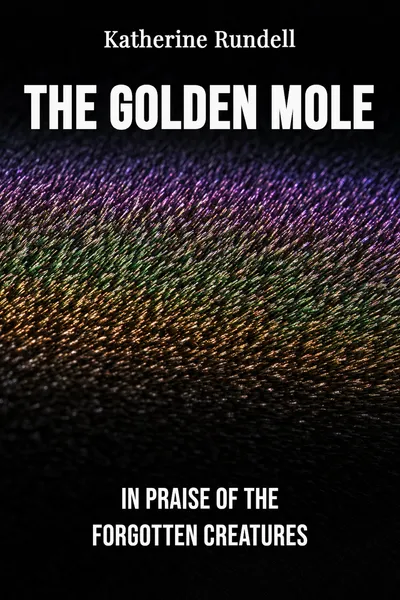
The Golden Mole
In praise of the forgotten creatures
Description
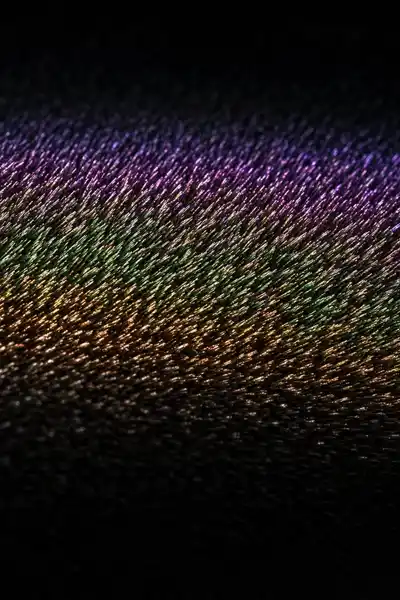
Somewhere in the deserts of southern Africa lives an animal that shimmers. The Cape golden mole has fur that catches the light in bronze, green, violet — an iridescence with no obvious purpose, since the creature is blind and spends its life underground. It has no external eyes to speak of, no visible ears, and a body built to "swim" through loose sand, surfacing only to hunt at night. Nobody it will ever meet can see how beautiful it is. Katherine Rundell, better known as a children's novelist, opens her book of essays with this small, glittering paradox: a thing of dazzling colour, hidden in the dark, unseen even by itself.
From that mole she moves outward into a whole menagerie. The pangolin, the only mammal wrapped in scales, which rolls into a ball so perfect that lions give up. The lemur, whose name comes from the Roman word for the spirits of the dead. The swift, the hedgehog, the seahorse, the narwhal whose tusk built the myth of the unicorn. Each gets a short chapter, part natural history, part folklore, part quiet astonishment. Rundell writes like someone leaning across a table to tell us the strangest true thing she knows — and then another, and another.
But the delight is edged. Nearly every creature she praises is, in some measure, disappearing. The pangolin is the most trafficked mammal on Earth. Whole families of animals are thinning out while we look away. The book keeps two feelings in the same hand: how marvellous these things are, and how close we are to losing them. That doubleness is the whole project — and it raises a question worth sitting with.
The question we’re asking : Why write a book of wonder about animals when the honest subject is extinction?What we’ll see : How a novelist turns a bestiary of odd, endangered creatures into a case for keeping the living world alive.
Table of contents
01 Chapter 1 — A blind swimmer in the sand
The golden mole is a good place to begin because almost nothing about it makes tidy sense. It is not closely related to the moles most of us picture; it belongs to an older, stranger branch of mammals. It hunts by sensing vibration, reading the desert through its skin and its jaw, detecting the faint scuttle of termites through the sand. Rundell relays that some species may pick up the drumming of insect colonies from a surprising distance, tuning into the ground the way we tune into sound. A creature that lives in near-total sensory darkness turns out to be exquisitely, precisely aware.
Then there is the shimmer. The iridescence comes from the structure of the hairs themselves, which scatter light into colour, the same trick that makes a beetle's back or a starling's throat gleam. In the mole it serves no courtship, no camouflage anyone can name. Rundell lets the mystery stand rather than solving it. Beauty here is not for us, and not obviously for the mole either. It simply is — a fact of the animal, offered without a bill attached.

02 Chapter 2 — The bestiary as a way of paying attention
The book's form is old and deliberate. Medieval bestiaries were catalogues of beasts, real and invented, each one carrying a moral or a story: the pelican that pierced its own breast, the lion that slept with its eyes open. Rundell knowingly borrows that shape. Her chapters are short, self-contained portraits, and she lets the folklore in — the narwhal's tusk sold as unicorn horn to credulous European courts, the hedgehog once believed to carry fruit home skewered on its spines, the bat tangled up for centuries with omen and dread.
But she is not nostalgic about the old errors. Alongside the myth she sets what we actually know now, and the true facts are usually stranger than the legends. The seahorse, where the male carries the pregnancy. The swift, which can stay airborne for months at a stretch, sleeping and mating on the wing, only touching down to nest. The lemur species of Madagascar, found nowhere else on the planet, spun off in isolation into dozens of improbable forms. The folklore and the biology sit side by side, and Rundell treats both as evidence of the same thing: that humans have always found these creatures worth telling stories about.
03 Chapter 3 — Wonder and grief share a page
The pangolin is where the book's two moods collide most plainly. Rundell describes it with real tenderness: the overlapping keratin scales, the long tongue anchored deep in its chest, the way it walks on its hind legs and hind knuckles, the way it curls into an armoured ball that has protected it from predators for millions of years. It is one of the oldest designs still walking around. And then the fact that undoes all of it — the armour that stops a lion is useless against a human hand. A person can simply pick the rolled ball up and carry it away.
That is why the pangolin is trafficked in enormous numbers, its scales sold for supposed medicine, its meat as a delicacy. Rundell does not turn the page into an infographic; she lets the horror sit inside the affection she has just built. Having made us love the animal, she tells us it is being erased, and the sequence is deliberate. Grief without prior wonder is just a statistic. Wonder followed by grief is a wound.
04 Chapter 4 — What a book of animals is really asking for
Step back from the individual creatures and a quieter argument comes into focus, one about the relationship between feeling and conservation. There is a long habit of treating them as separate departments: the scientists produce the data and the policy, while wonder is a soft, decorative afterthought, nice for children's books and nature documentaries. Rundell's whole method is a rebuttal of that split. She writes as though delight is not the reward for caring about the natural world but the engine of it — that people do not fight to save what leaves them cold.
This is why the form matters. A statistic about biodiversity loss slides off most of us; we have heard too many. A specific animal, made vivid enough that its disappearance feels personal, does not. By spending her pages making us love the golden mole and the pangolin and the lemur one at a time, Rundell is doing something a report cannot. She is manufacturing the attachment on which any real willingness to protect depends. The bestiary, that ancient form, turns out to be a machine for producing care.
05 Conclusion
We come back, at the end, to the mole in the dark, shining where nothing can see it. Rundell has spent her pages insisting that this uselessness is exactly the point — that the golden mole does not need to be beautiful for us, or profitable, or even known, to be worth keeping in the world. The colour it wears underground is a small argument against a purely useful way of valuing what lives.
Related books