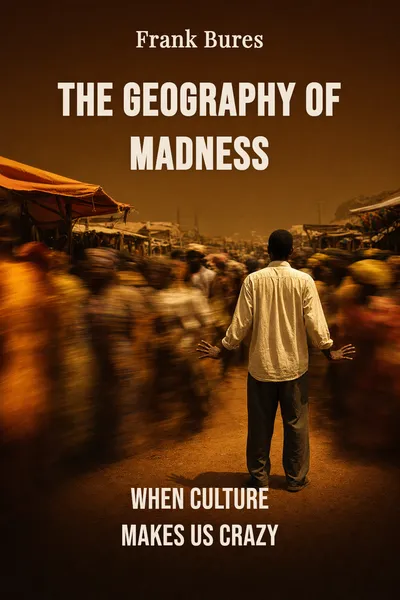
The Geography of Madness
When culture makes us crazy
Description
Somewhere in Nigeria, a man is walking through a market when a stranger brushes against him. A moment later he is screaming that his penis has vanished — retracted into his body, or stolen outright by the man beside him. A crowd forms. The accused is in real danger of being beaten, sometimes killed. And here is the part that resists every reflex a Western reader brings to it: the man's body is, by any physical examination, entirely intact. Nothing has been taken. Yet the terror is total, the conviction unshakeable, and the episode is common enough to have a name. Frank Bures, a magazine journalist with a taste for the unaccountable, went looking for the source of that terror.
His book, The Geography of Madness, is built around what psychiatry once filed under "culture-bound syndromes" — afflictions that appear in one part of the world and nowhere else. The stolen penis, called koro across parts of Asia and Africa. Amok, the sudden homicidal rage of Southeast Asia. Latah, the startle-trance of Malaysia. Written up in textbooks as curiosities from elsewhere, they read like a bestiary of other people's irrationality. Bures suspected that framing was hiding something, and he traveled — to Nigeria, to China, to Hong Kong, to the archives — to find out what.
What he came back with is stranger and closer to home than a catalog of foreign delusions. The syndromes that seemed to prove how different other minds are turn out to say something uncomfortable about every mind, including ours. The body, it appears, will believe what the culture around it insists is true.
The question we’re asking : Why do some illnesses exist in one culture and refuse to appear in any other?What we’ll see : A journalist chases the world's strangest afflictions and finds a mirror pointed back at his own certainties.
Table of contents
01 Chapter 1 — The man who was sure his penis was gone
Bures opens where the disbelief is hardest to hold: with the missing genitals. In parts of West Africa and, decades earlier, in waves across China and Singapore, men become convinced that their penis is shrinking, retracting, or has been magically stolen — often by a passing stranger, a con artist, a witch. The panic is genuine. Men have clamped their genitals with string or metal, called on family to hold on physically, and accused bystanders who were then attacked by mobs. In one Nigerian outbreak, the accusations turned lethal. The affliction is documented, recurrent, and, medically speaking, describes something that isn't happening.
To a reader raised on X-rays and lab results, the natural move is to file this as mass hysteria in a place that doesn't know better. Bures resists the move, partly because the more he looked, the less "not knowing better" explained. The men who felt their penises vanishing were not uneducated by their own standards; they were operating inside a world where genital theft is a known category of harm, the way we know that a virus is a known category of harm. The belief wasn't a failure of information. It was information — the wrong kind, but coherent, shared, and backed by everyone around them.

02 Chapter 2 — The list of syndromes that refuse to travel
The koro panic doesn't stand alone. Psychiatry accumulated a whole appendix of these things, and for a long time they lived at the back of the manual as the exotica of the field. There is amok, the Malay word behind our "running amok" — a man, usually, who broods in silence and then erupts into sudden, indiscriminate violence, after which he remembers nothing. There is latah, in which a startled person, often an older Malay woman, falls into a trance of compulsive mimicry and obscene outbursts, doing and saying whatever those around her prompt. There is the fright-sickness known in Latin America as susto, in which a shock is thought to dislodge the soul, leaving the person listless and wasting.
03 Chapter 3 — The story the body agrees to tell
To explain how a shared belief becomes a felt symptom, Bures reaches for the idea that our experience of the body is not a raw feed from the nerves but a story the brain is constantly assembling — from sensation, yes, but also from expectation. We feel what we have been prepared to feel. The most familiar proof sits in every drug trial: the placebo, an inert pill that reliably produces real relief because the person taking it expects relief. Expectation reaches down into physiology. Its darker twin, the nocebo, does the same in reverse — warn people of a side effect and a measurable fraction will develop it. Belief writes to the body, in both directions.
Culture, in this account, is the largest supplier of expectations we have. It tells us which sensations are dangerous, which are meaningless, what a symptom means, and what shape suffering should take when it comes. A man who has grown up knowing that genitals can be stolen has a script waiting; when anxiety or a stray sensation arrives, the script gives it a name and a narrative, and the fear does the rest. The symptom is not faked and it is not simply imagined. It is genuinely produced, the way a placebo genuinely heals — by a mind that has been told, all its life, how this is supposed to go.
04 Chapter 4 — What counts as a real illness anyway
The step Bures takes in the closing stretch is to point the whole apparatus back at the reader. If a symptom can be produced by a culture's story about the body, then the West is not the neutral laboratory from which the exotic syndromes are observed. It is another culture, with its own stories, generating its own conditions that flare, spread, and fade on cue. He notes how certain diagnoses arrive, sweep through a population, and recede as the cultural attention that fed them moves on — the way an outbreak of koro does. Ours have the vocabulary of medicine attached, which makes them feel like discoveries rather than scripts. But the pattern rhymes.
05 Conclusion
The book began with a man convinced his penis had been stolen, and it ends without ever making him ridiculous. That was Bures's quiet ambition all along: to travel far enough into the strangest afflictions on record that the strangeness stops belonging to other people. The koro panics, amok, latah, susto — each one that looked like a foreign malfunction turned out to be a working example of something we all do, which is feel our bodies through the stories we've been given about them.
Related books