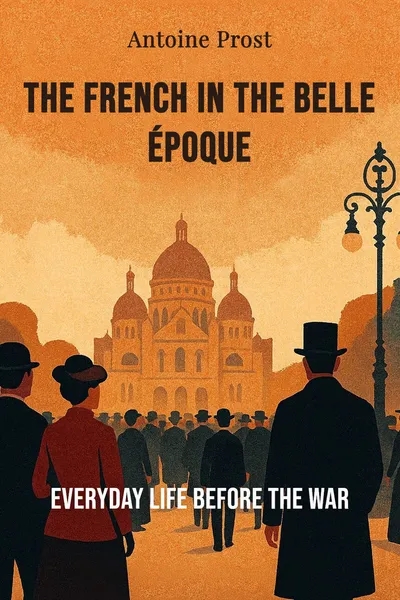
The French in the Belle Époque
Everyday life before the war
Description
On a summer morning around 1900, a French family woke in a house lit by oil lamps, drew water from a well or a shared pump, and set off on foot or by cart to a field that had barely changed since their grandparents worked it. Two-thirds of the population still lived in the countryside, most of it rural in a way that a Parisian could already treat as picturesque. The horse was the engine of the streets, the letter was the fastest way to reach someone far, and the electric light was a novelty you traveled to see. This was the France that a later generation would christen the Belle Époque — a name it never gave itself.
Antoine Prost, the historian who spent a career mapping how ordinary French lives were actually organized, went looking for that everyday world: what people ate, how they worked, when they married, what they feared, who they answered to. Not the France of cabaret posters and the 1889 Eiffel Tower and Proust's salons, but the France of the wash-house, the parish register, the recruiting board, the small shop that closed when the owner died. The gap between the two is wide, and it is the gap that makes the period worth revisiting.
Because the label is a trap. We inherited "Belle Époque" as a phrase soaked in nostalgia, and nostalgia edits. It keeps the champagne and drops the tuberculosis, keeps the boulevard and drops the sixty-hour week. Prost's project is to put the dropped things back and see what the years before 1914 actually felt like from inside a normal life.
The question we’re asking : What did ordinary life in France really look like in the years we now call the Belle Époque?What we’ll see : A country still rooted in the land and powered by muscle, slowly reached into by the Republic — and a golden age that only started glowing once the war had ended it.
Table of contents
01 Chapter 1 — A country still tied to the soil
In 1900, France was still a rural nation in a way that is hard to picture now. Something on the order of forty percent of the working population lived directly off agriculture, and a majority of the country lived in communes of fewer than a few thousand people. The peasant was not a folkloric survival; he was the statistical center of gravity. What Prost keeps insisting on is that this world moved by its own clock — the clock of seasons, harvests, and animals — not the clock of the factory or the office.
Life on the land was hard and getting harder in places. The phylloxera crisis had gutted the vineyards in the 1870s and 1880s, ruining smallholders across the south. Grain prices sagged under competition from American and Russian imports. A bad harvest was not an abstraction on a chart; it meant a winter of debt and thinner soup. And yet the small farm held on, because the family provided the labor and asked no wage of itself. Children worked young, women worked constantly, and the household was first of all a unit of production.

02 Chapter 2 — The city that ran on human muscle
The France that the nostalgic image remembers is the city, and Paris above all. But the working city of 1900 was not the city of the posters. It was crowded, noisy with hooves and iron wheels, and built on human effort to a degree we have forgotten. Water was carried, coal was hauled, laundry was scrubbed by hand in shared wash-houses by women whose arms did the work of a machine that did not yet exist in the home.
Work was long. The ten-hour day was a demand, not a fact, for most of the period; many trades ran eleven or twelve hours, six days a week. The 1906 law establishing the weekly rest day — one day off in seven — was a genuine advance precisely because it was needed. Factories existed, but so did an immense world of small workshops, artisans, and outworkers stitching and assembling at home for a piece rate. The line between employer and employee was often a single room.
03 Chapter 3 — The Republic reached into the village
The most durable change of these years was not economic but political and cultural: the Third Republic finished planting itself in French daily life. The instrument was the school. The Ferry laws of the early 1880s had made primary education free, compulsory, and secular, and by 1900 the results were arriving — a generation of children who could read, write, and count, taught by the schoolmaster, the famous instituteur, who became a fixture of the village alongside the priest and the mayor.
That trio marked a real struggle. The Republic was building a secular civic religion, and it collided with the Catholic Church that had shaped rural life for centuries. The conflict ran through the whole period and peaked in the 1905 law separating Church and State. In many villages this was not an abstraction from Paris; it was a fight over the crucifix in the classroom, over who buried the dead, over which authority a family owed its loyalty. Prost shows the Republic winning slowly, less by decree than by the accumulated habit of the school and the ballot.
04 Chapter 4 — The golden age that only glowed afterward
The phrase "Belle Époque" is not contemporary. Nobody living in 1905 called their exhausting, tubercular, six-day-a-week present a beautiful age. The name was applied later, in the 1920s and after, by people looking back across the trench of 1914–1918 at a world that the war had annihilated. It is a term of mourning disguised as a term of description, and this is the point Prost drives toward: the golden age is an artifact of grief, not a fact of the years it names.
What made those years beautiful in memory was, above all, that they came before. Before Verdun, before the million and a half French dead, before the maimed men on every village square. Set against that catastrophe, almost any prewar decade would shine. The oil lamps and the horse-drawn cabs, which had been ordinary and often miserable, became golden the moment the people who had lived by them were gone. Nostalgia does not remember life; it remembers the absence of the thing that ended it.
05 Conclusion
The family that woke by oil lamp around 1900 did not know it was living in a beautiful age, and by the standards of their own days it often was not.
Related books