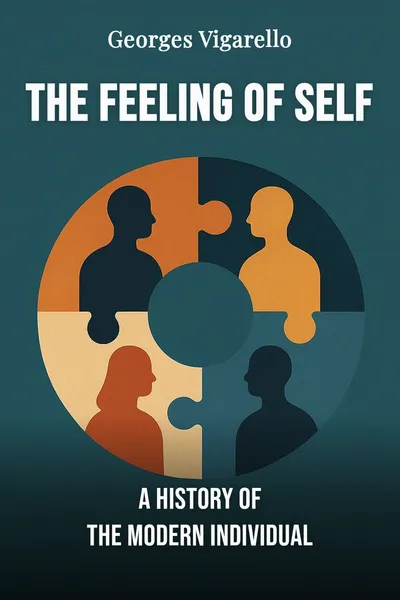
The Feeling of Self
A history of the modern individual
Description
There is a feeling most of us take for granted: the sense of having an inside. A private theatre where thoughts run, moods settle, and a continuous "me" watches its own life go by. It seems as old and as universal as the body itself — the one thing that surely never changed. Georges Vigarello, a French historian who has spent a career studying the body, cleanliness, fatigue and beauty, set out in The Feeling of Self to test that assumption. His answer is unsettling: this interior does not run through history unchanged. It has a date of birth, or rather several, spread across centuries. It was assembled.
Vigarello's method is to read what people said about themselves — in confessions, memoirs, medical treatises, novels, the slow drift of ordinary words. And what he finds in the medieval and early modern sources is a strange near-silence. People described their sins, their humours, their rank, their obligations to God and lord. What they rarely described was an inner landscape that belonged to them alone, distinct from the roles the world assigned. The vocabulary for it barely existed. You cannot easily feel what you have no words to name.
So the book follows a long, uneven construction site. Words appear, then meanings shift under them. The self stops being something read off the surface — the face, the bearing, the station — and becomes something buried, personal, worth exploring for its own sake. It is a history of how we came to believe we contain a hidden depth, and of how recently the walls went up around it.
The question we’re asking : Where did the sense of having a private inner self actually come from, and how recently was it built?What we’ll see : A long construction site running from a world with no "inside" to the modern individual who guards one.
Table of contents
01Chapter 1 — When the self had no inside
Start where Vigarello starts, in a world that thought about persons very differently from us. In late medieval and Renaissance sources, a human being was largely legible from the outside. Rank, dress, gesture and lineage told you who someone was; the face was read like a sign, the body like a document. The dominant grid was moral and religious — one confessed acts, sins, faults measured against a fixed order. What we would call psychology, an interior weather of moods and private motives, had almost no place to be recorded because it had almost no name.
This is the quiet shock of the early chapters. It is not that people had no feelings — of course they suffered, loved, feared, raged. It is that they had no habit of treating those feelings as a separate inner realm that defined the true self. Emotion was often understood through the body's humours, through external causes, through the pull of the world, rather than as the expression of a unique person hidden behind the eyes. The self was distributed across roles and relations, not concentrated in a private center.

02Chapter 2 — The word arrives, the feeling follows
Vigarello tracks the shift where a historian must: in words. He watches vocabulary thicken over the sixteenth and seventeenth centuries — terms for the intimate, the private, the personal, and eventually for a self conceived as an object one could examine. The French moi, the sense of an "I" that is also a thing to be studied, gains weight in this period. New words are not decoration. They are the scaffolding on which a new experience can be hung, and once they exist, people begin to notice sensations the old language could not hold.
Montaigne looms over this stretch of the story. Writing his Essays in the 1580s, he does something quietly radical: he takes himself as the subject, turning his own moods, contradictions and changes of mind into material worth examining at length. He is not confessing sins on a fixed list; he is observing a self that shifts from day to day and finding that shifting self interesting. Vigarello treats him less as a lone genius than as a signal — an early sign that the interior was becoming a legitimate territory to explore.
03Chapter 3 — The century that learned to look within
The eighteenth century is where Vigarello's slow construction accelerates. Introspection stops being an occasional exercise and becomes a cultural passion. Sensibility is prized; people learn to attend to the fine gradations of their own feeling, to weep, to thrill, to record the movements of the heart as if they were events worth chronicling. The private diary spreads. The novel, especially the novel of letters and inner monologue, teaches readers how a mind talks to itself and rehearses, page by page, the very habit of interiority it depicts.
Rousseau is Vigarello's emblematic figure here. His Confessions, published after his death in the late 1780s, promise something new: a total, unflinching account of a singular life, warts and secrets included, offered because this particular self is worth knowing in full. This is a different gesture from confessing sins. Rousseau claims that his uniqueness itself is the point, that the winding path of his feelings, resentments and desires forms a truth about who he is. The self has become not a moral ledger but a story with depth, mystery and a hidden core.
04Chapter 4 — Interiority was built, not found
Step back from the chronology and Vigarello's larger claim comes into focus. What feels like the bedrock of being human — the sense of an inner self, a private me at the center of experience — is a historical achievement, assembled over centuries rather than given at the start. This is a genuinely destabilizing idea, because interiority is exactly the thing that seems immune to history. Our thoughts feel like the one place the past cannot reach. Vigarello's patient reading suggests otherwise: even the feeling of having a hidden depth was made, and could have been made differently.
The consequence he draws is quietly striking. Privacy, in the sense we now defend so fiercely, is recent. The very notion that there is an inner life that belongs to us alone, that others have no automatic right to see, depends on the whole construction the book traces. You cannot protect an intimacy you do not yet believe you have. The walls around the self went up only once the room inside had been furnished — and both, on this account, are latecomers to human history, not its permanent architecture.
05Conclusion
Vigarello sets out to write a history of a feeling, and the feeling he chooses is the one that seems least likely to have a history at all. His conclusion, drawn from confessions and diaries, novels and medical treatises, from the slow thickening of ordinary words, is that the sense of an inner self was assembled piece by piece. A world that read persons off their surface gave way, across several centuries, to one that located the true self in a hidden depth worth exploring, expressing and guarding. The vocabulary came first, then the practices, then the rooms one could be alone in — and only at the end, the individual who takes all of this for granted.
Related books