The Evolution of Everything
How everything evolves without planning
Description
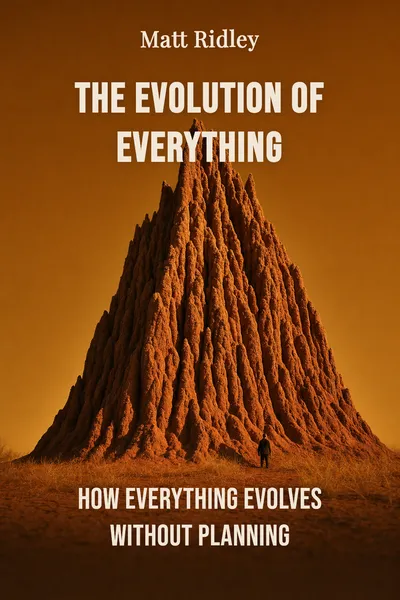
In 2015, the science writer Matt Ridley published a book with a title that sounds like a provocation and mostly turns out to be a promise: The Evolution of Everything. Ridley had spent a career writing about biology and economics — The Red Queen, The Rational Optimist — and here he tried to fuse the two into a single claim. The engine that Darwin found in nature, the slow accumulation of small changes with no designer at the wheel, is not confined to finches and orchids. It runs through language, money, technology, law, morality, even the way scientific ideas replace one another. Everything, Ridley argues, evolves. And almost nothing is planned.
That is a harder pill than it looks. We are built to see intention everywhere. A good economy must have been organized; a beautiful language must have been designed; a working institution must have had an architect. Ridley calls this reflex creationism, and he means it well beyond religion. We are, most of us, creationists about the human world — we assume that behind every ordered thing there stands someone who ordered it. The book is a long argument that this assumption is usually wrong, and that the ordered things we admire most tend to be the ones nobody was in charge of.
The claim is bold enough to be worth testing rather than cheering. Ridley writes with the confidence of a man who has picked a side, and the pleasure of the book is watching him drag one domain after another onto the same operating table. Whether the scalpel always fits is a fair question — and one we will not settle for him.
The question we’re asking : If order in nature needs no designer, does order in human affairs need one either?What we’ll see : How Ridley pulls one part of the human world after another out of the hands of its supposed inventors.
Table of contents
01 Chapter 1 — The skyhook and the crane
Ridley borrows a distinction from the philosopher Daniel Dennett, and it does most of the book's structural work. A crane builds from the ground up: it lifts by resting on what is already there, one supported step at a time. A skyhook lifts from above, hanging on nothing, an explanation that reaches down out of the sky to make sense of what happens below. Darwin's achievement, in Dennett's telling, was to replace a skyhook with a crane — to show that the design in living things is built from below by variation and selection, not lowered from above by a designer.
Ridley's wager is that we keep reaching for skyhooks in places where a crane would do the job. When something works well — a market, a legal system, the English language, the smartphone in a pocket — the instinct is to credit a mind: a planner, a founder, a genius, a god. The skyhook is comforting because it gives us someone to thank and someone to petition. It puts a hand on the tiller. The trouble is that most of the ordered things around us were not steered. They accreted.

02 Chapter 2 — How order shows up without a designer
Take language, one of Ridley's favorite examples. No committee invented English, and the committees that have tried to freeze languages in place have mostly failed. Words drift, grammar shifts, meanings slide, and out of millions of tiny uncoordinated choices a shared, rule-governed system persists — one complex enough that linguists still argue about how it works. Nobody planned it. It evolved, generation by generation, each speaker copying and slightly varying what they heard. It is a crane if ever there was one.
The same shape recurs, in Ridley's telling, across the economy. Prices are not set by a central mind that knows what everything is worth; they emerge from countless transactions, each carrying a scrap of information about scarcity and desire. This is the old insight of Friedrich Hayek, who argued that the market is a device for using knowledge that no single planner could ever assemble. The economy coordinates the actions of strangers who will never meet and who could not possibly explain, between them, how a pencil gets made. And yet the pencil arrives.
03 Chapter 3 — The myth of the great man
If evolution runs through history, then the people we place at the center of history start to look smaller. Ridley takes obvious pleasure in this demotion. The great man theory — the idea that events turn on the will of exceptional individuals — is, for him, another skyhook, a way of hanging enormous outcomes on a single hook of intention. Pull the individual out and, more often than he flatters himself, the outcome arrives anyway, carried by the current of ripe conditions.
His treatment of invention makes the point sharpest. Thomas Edison did not conjure the light bulb from nothing; roughly two dozen people were converging on incandescent lighting at the same moment, and Edison's genius lay as much in system-building and publicity as in the filament. The discovery arrived because the materials, the demand and the prior work had lined up. Had Edison never been born, Ridley suggests, we would still be reading by electric light, only under a different name in the textbooks.
04 Chapter 4 — Who governs when nobody is in charge
Step back from the individual examples and a single instinct is doing the work Ridley keeps attacking: our craving for a controller. We look at anything that functions and assume a hand must be steering it, because the alternative — that order can be genuine and yet unauthored — feels like a kind of vertigo. Ridley's whole project is an argument that we should sit with that vertigo rather than reach for the reassuring hand.
This is where the book turns from description into a worldview, and where its politics show. Ridley is a libertarian, and the bottom-up lens leads him to a consistent suspicion of top-down control: central planning, he argues, tends to jam the very evolutionary machinery that produces good outcomes, substituting one mind's guess for the distributed intelligence of many. Government, on this reading, is the skyhook we most stubbornly believe in — the designer we keep hiring to arrange what might arrange itself better without us.
05 Conclusion
The book began with a title that reads like a boast and ends up feeling more like a lens. Ridley wanted to show that the Darwinian move — order without a designer, design without a designer's mind — is not a quirk of biology but a general truth about how complex things come to be. Language, markets, technology, morality, science: each pulled, in turn, out of the hands of the founders and geniuses and planners we habitually thank for them, and handed back to the slow, blind, cumulative process he calls evolution.
Related books