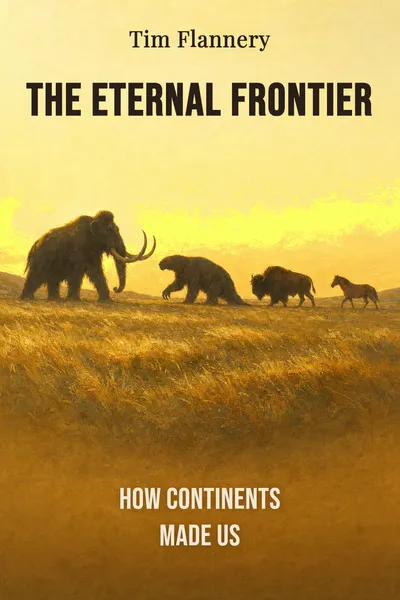
The Eternal Frontier
How continents made us
Description
About 65 million years ago, on a shallow sea near what is now the Yucatán, an asteroid roughly ten kilometers wide struck the Earth at a low angle from the southeast. Tim Flannery, in The Eternal Frontier, asks us to picture the trajectory: the rock came in over the future Gulf of Mexico, which means North America took the blow almost head-on. The impact vaporized rock, threw up a curtain of molten debris, and set the sky itself alight across the continent. Within hours, animals hundreds of kilometers away were being broiled where they stood. It was, Flannery writes, the worst place on the planet to be that morning — and the place his whole book begins.
Most accounts of that asteroid treat it as an ending: the day the dinosaurs died. Flannery treats it as a beginning. What interests him is not the extinction but the empty stage it left behind, and the strange, unruly cast that came to fill it over the next 65 million years. His subject is one continent — North America — watched across deep time like a single long-running character. Forests advance and retreat, animals wander in from Asia and South America, ice sheets grind south and pull back, and the land is remade again and again by arrivals it never asked for.
He is a scientist by training, and the pleasure of the book is that it never flattens into a timeline. It reads instead like a biography of a place that refuses to settle down — a continent that keeps opening itself to newcomers and being reshaped by them. That restlessness is the thread. It is also, Flannery argues, the thing that eventually produced us.
The question we’re asking : What does 65 million years of collisions, extinctions and arrivals reveal about the continent we now take for granted?What we’ll see : How one continent, struck and reshaped again and again, became a permanent frontier where nothing stayed settled for long.
Table of contents
01 Chapter 1 — The morning the sky fell
Flannery opens with the geometry of catastrophe, because geometry is what made North America's story different. The asteroid arrived on a shallow angle from the southeast, so the continent lay directly in the path of the blast. The immediate kill zone stretched for thousands of kilometers. Ejecta thrown into space fell back through the atmosphere as a rain of white-hot particles, heating the air until it glowed. Anything exposed on the surface across much of the continent was cooked. The old world of large dinosaurs, which had ruled for well over a hundred million years, ended in a matter of hours.
What followed the fire was worse in a slower way. Dust and soot blotted out the sun, photosynthesis stalled, and the food chains that depended on green plants collapsed from the bottom up. Flannery is careful about who survived and why. Size was a liability; anything large needed too much food to last through the darkness. The winners tended to be small, able to shelter, and willing to eat seeds, insects, carrion, or rotting debris — the leftovers of a dead ecosystem. Among them were the ancestors of mammals, creatures that had spent the age of dinosaurs staying out of the way.

02 Chapter 2 — A continent built by comings and goings
The most surprising thing Flannery does is refuse to treat North America's animals as native. Over deep time, almost everything came from somewhere else. The continent spent tens of millions of years connected, at one edge or another, to Asia and to South America, and its history is largely a record of what crossed over. When the sea levels dropped or land bridges rose, animals poured in; when the connections closed, whatever had arrived was left to adapt or vanish on its own.
The Bering land bridge is the recurring gateway to the west. Across it, at various times, came the ancestors of horses in one direction and, much later, mammoths and bison and eventually humans in the other. Flannery enjoys the irony that horses actually evolved in North America, spread to Asia, and then died out at home — so that the animal Europeans later reintroduced was, in the deepest sense, a returning native. The traffic ran both ways, and the continent was as much an exporter of species as an importer.
03 Chapter 3 — The forest that made the weather
If animals give the book its drama, plants give it its architecture. Flannery devotes real attention to the slow rise of North America's forests, and especially to its deciduous trees — the oaks, maples, hickories and their relatives that shed their leaves each autumn. In the warm, wet world of the early recovery, subtropical and evergreen forests spread widely. As the global climate cooled and grew more seasonal over tens of millions of years, a new strategy emerged: dropping leaves to survive a cold, dark season and flushing them again in spring.
That strategy turned out to be quietly powerful. A deciduous forest is not a passive backdrop. It cycles enormous quantities of water and carbon, feeds the soil with a yearly fall of leaf litter, and shapes the climate around it as much as the climate shapes the trees. Flannery describes the great eastern hardwood forests as an ecosystem the continent effectively invented for itself — a response to seasonality that then became a driver of the conditions animals had to live in.
04 Chapter 4 — The frontier never closed
Step back from the individual episodes and Flannery's larger argument comes into focus. His title is not decoration. He means that North America has functioned, across its whole post-impact history, as a frontier — a place defined less by what lives there than by its permanent openness to what might arrive next. Other landmasses spent long stretches isolated, evolving in private. North America kept its doors ajar, gathering immigrants from Asia and South America, absorbing invasions, weathering extinctions, and reinventing itself after each disturbance.
A frontier, in this sense, is not a line on a map but a condition. It is what you get when a place is never allowed to finish becoming itself. The asteroid set the pattern by clearing the stage; the land bridges kept it going by delivering new players; the ice ages reshuffled everything one more time. Each upheaval that might have ruined a settled continent instead gave this one another chance to recombine. Flannery's continent thrives precisely because it is unstable — because collision and arrival are its normal state, not its exception.
05 Conclusion
Sixty-five million years after the sky fell over the Yucatán, the continent that took the worst of that blow is unrecognizable — and, in Flannery's reading, entirely consi
Related books