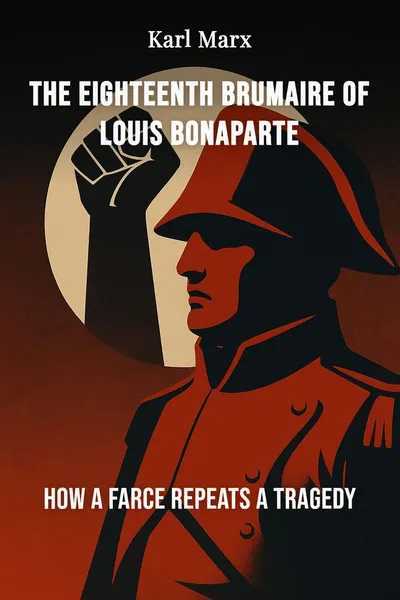
The Eighteenth Brumaire of Louis Bonaparte
How a farce repeats a tragedy
Description
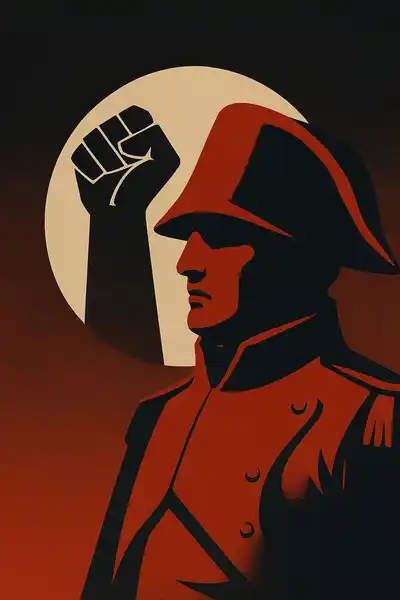
On the second of December 1851, the President of the French Republic dissolved the assembly that had elected him, arrested his opponents in their beds, and declared himself the sole authority in France. The date was chosen with care. It was the anniversary of Austerlitz, Napoleon Bonaparte's greatest battle, and of his coronation as emperor. The man behind the coup was his nephew, Louis-Napoleon Bonaparte, whom nearly everyone in French politics had treated as a mediocrity — a serial plotter who had already botched two earlier attempts to seize power and been laughed out of the country for it. Within a year he would crown himself Napoleon III.
Karl Marx watched this from exile in London, and what he wrote about it between December 1851 and March 1852 became one of the strangest and sharpest political books of the nineteenth century. It was not a history in the usual sense. It was an attempt to explain how a man of no obvious talent, backed by no obvious force, could walk into the vacuum left by three years of revolution and take everything. The revolution of 1848 had promised a republic. It ended with an emperor. Marx wanted to know exactly how that reversal had been engineered — and by whom.
His answer refused the two easy explanations on offer. It was not that a great man had imposed his will, and it was not that a scheming individual had simply tricked the nation. Something in the structure of French society, Marx argued, had made the coup not just possible but almost necessary — had prepared the throne and then produced the man to sit on it. The book is his attempt to show the machinery working underneath the drama.
The question we’re asking : How does a mediocre adventurer end up emperor of France, and what does the way it happened reveal about who actually holds power?What we’ll see : A coup read not as the triumph of one man but as the failure of every class that tried to rule before him.
Table of contents
01Chapter 1 — The nephew nobody feared
Louis-Napoleon was, by any conventional reading, a preposterous candidate for supreme power. He had spent much of his life in exile, cultivating a legend built entirely on his surname. In 1836 he had tried to raise a garrison at Strasbourg against the July Monarchy and failed almost instantly. In 1840 he landed at Boulogne with a hired boat, a tame eagle, and a handful of followers, expecting the army to rally to the Bonaparte name; instead he was arrested, tried, and sentenced to life in a fortress, from which he eventually escaped disguised as a workman. Serious politicians regarded him as a joke.
When the 1848 revolution swept away the monarchy and established the Second Republic, this same man was elected president in December of that year by an overwhelming majority. Marx's point is that the very qualities that made Louis-Napoleon seem ridiculous to the political class were what made him electable. He stood for nothing in particular, which meant almost everyone could read their own hopes into him. To the peasantry he was the return of the great Napoleon, the emperor of legend who had given them their land. To the frightened bourgeoisie he promised order. To the army he promised glory and pay.

02Chapter 2 — Every class that could not rule
To explain the vacuum, Marx turns to the revolution that created it. The events of 1848 to 1851 are, in his telling, a sequence in which one social force after another stepped forward to govern and was pushed off the stage. The February revolution of 1848 briefly united everyone against the monarchy. But the moment the old order fell, the coalition that had toppled it split apart along the lines of the interests underneath it, and each fragment revealed that it could neither rule alone nor tolerate the rule of the others.
The Parisian workers rose first and were crushed in the June days of 1848, drowned in blood by a republic that the bourgeoisie now controlled. The industrial and financial bourgeoisie, having disposed of the workers, found itself divided against the landed interests and the older aristocratic factions — the two rival royalist camps, one loyal to the Bourbons and one to the Orléans line, who could not even agree on which king to restore. The republican middle class, the party of the lawyers and journalists who had proclaimed the republic, discovered it had no independent social base and dissolved into irrelevance. Marx works through each of these defeats with something close to grim relish.
03Chapter 3 — The state that floats above
This is where the book makes its most original move. If no class could rule, what governed France? Marx's answer is the state itself — the vast apparatus of army, police, bureaucracy and clergy that had been built up over centuries and that now, for a brief moment, seemed to have detached itself from any single class and to stand above society. Louis-Napoleon did not rule as the agent of the bourgeoisie or the aristocracy. He rode this apparatus, this half-million-strong machine of officials and soldiers, and made himself its head.
But Marx does not conclude that the state had become genuinely neutral or independent. The Bonapartist regime, he argues, still served the interests of order and property — it protected the bourgeoisie precisely by relieving it of the dangerous business of governing. What looked like the state rising above all classes was really the state guaranteeing the social power of the ruling class while suspending its political power. The bourgeoisie got to keep its wealth on condition that it kept quiet and let an adventurer and his soldiers run the country.
04Chapter 4 — The farce that history keeps
Step back from the sequence of events and the book reveals what it is really a theory of: how political spectacle and inherited language do the work of class rule. Marx is fascinated that the actors of 1848 could not simply act; they had to dress up. The revolutionaries of the great French Revolution had draped themselves in the costumes and slogans of ancient Rome, borrowing Roman virtue to give their bourgeois struggle a heroic grandeur. The men of 1848 borrowed in turn from 1789, and Louis-Napoleon borrowed most shamelessly of all from his uncle, restaging the empire as a kind of pantomime.
This is the point of the famous line that opens the book. Hegel had remarked somewhere that great world-historical events occur twice; Marx adds that Hegel forgot to say the first time as tragedy, the second as farce. The great Napoleon was a genuine world-historical force who reorganized Europe; his nephew was a copy, a man playing the part in borrowed costume, and the gap between the original and the imitation is the gap between tragedy and farce. The nephew could only take power by wrapping himself in the dead grandeur of the uncle.
05Conclusion
Louis-Napoleon reigned as Napoleon III for eighteen years, longer than his uncle, until a disastrous war with Prussia in 1870 collapsed his empire as suddenly as he had built it. Marx, writing in 1852, could not have known that ending, but the book had already located the weakness: a regime resting on isolated peasants, a bought army, and a bourgeoisie that had traded its voice for its property could improvise for a long time, yet never quite stand on solid ground. The adventurer stayed on the throne by continuing to perform.
Related books