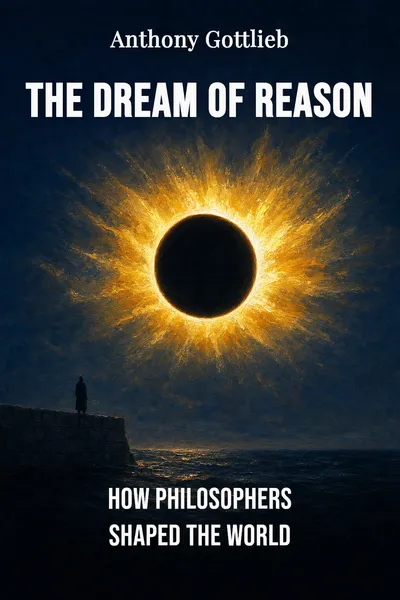
The Dream of Reason
How philosophers shaped the world
Description
Sometime around 585 BC, a merchant from the Greek city of Miletus is said to have predicted a solar eclipse. His name was Thales, and whether or not he really called the date, the story stuck for a reason. Thales looked at the world and decided it could be explained without reaching for the gods. Water, he said, was the origin of everything. The answer was wrong. The move was revolutionary. For the first time, someone was trying to account for nature using nature itself, and asking others to check his reasoning rather than take his word.
That gesture — explain the world, then defend the explanation — is where Anthony Gottlieb begins The Dream of Reason, his history of Western philosophy from the Greeks to the Renaissance. Gottlieb, a former editor at The Economist, wrote it as a corrective. Most histories of philosophy, he argues, read the past backwards, treating old thinkers as rough drafts of modern ones. He wanted to meet them on their own terms: as people arguing, often brilliantly and often wrongly, about questions nobody had asked before.
What emerges is less a gallery of statues than a long, unfinished conversation. Ideas we now file under science, theology, or logic all started in the same restless inquiry, before anyone had drawn the borders between them. Following that inquiry means watching a way of thinking invent itself, split apart, and hand off whole territories to the disciplines it spawned.
The question we’re asking : How did a handful of arguments, started twenty-five centuries ago, come to shape the way an entire civilization understands reality, knowledge, and how to live?What we’ll see : A journey through the thinkers who turned wonder into method, and the debates that keep dividing them long after the answers were supposed to arrive.
Table of contents
01Chapter 1 — The men who asked the first questions
Before Socrates, there were the thinkers we lump together as the Presocratics, and Gottlieb treats them not as primitives but as the people who set the agenda. They were scattered across the Greek world, from Miletus on the coast of Asia Minor to the colonies of southern Italy, and they disagreed about almost everything. What united them was the conviction that the universe had an underlying order the mind could grasp. Thales picked water. Anaximenes picked air. Heraclitus said everything flows and nothing stays, that you cannot step into the same river twice.
Against him stood Parmenides, who argued the opposite with unsettling force: change is an illusion, and reality is a single, unchanging whole. It sounds like a party trick until you follow the logic, which is airtight enough that philosophers have wrestled with it ever since. Parmenides forced a problem onto the table that would not leave — how can something come from nothing, and if it cannot, how does anything ever change? His pupil Zeno backed him up with paradoxes about arrows that never arrive and runners who never catch the tortoise.

02Chapter 2 — What the Greeks were really arguing about
Then comes Athens, and the three figures who anchor the popular image of philosophy. Socrates wrote nothing, charged no fees, and wandered the city asking people to define the words they used most confidently — justice, courage, piety — until they discovered they could not. Gottlieb is careful here. The Socrates we know is mostly Plato's Socrates, a character shaped by a devoted student, and separating the man from the portrait may be impossible. What survives is the method: relentless questioning that exposes how little we actually know, offered as the beginning of wisdom rather than a humiliation.
Plato took that method somewhere Socrates might not have followed. If the world of the senses is always shifting and unreliable, Plato reasoned, then real knowledge must be of something else — perfect, eternal Forms that ordinary objects merely imitate. A drawn circle is never quite a circle; the true circle exists only in thought. This was Parmenides' unchanging reality reborn as a whole theory of knowledge, ethics, and politics. Gottlieb admires its ambition while noting how much of it rests on a hunch that has never been proven.
03Chapter 3 — Reason claims the whole world
The Greeks were not the end of it, and Gottlieb spends real time on what came after the classical age, when philosophy turned from mapping the cosmos to the more urgent question of how to live in it. The Stoics taught that we control only our own judgments, and that peace comes from wanting what actually happens. The Epicureans, often caricatured as pleasure-seekers, in fact prescribed a quiet life of modest wants and good friends, arguing that the fear of death and the gods was the real source of human misery. The Sceptics, most radically, suspended judgment on everything, on the grounds that certainty was a trap.
These were philosophies for living, and they spread across the Roman world as practical wisdom rather than academic speculation. Gottlieb notes how much of what we now call self-help is warmed-over Stoicism, minus the rigorous metaphysics that gave it teeth. The ancient schools were not offering tips for a better morning. They were arguing about the nature of the good life from first principles, and expecting you to follow the argument wherever it led.
04Chapter 4 — When philosophy stopped being everything
Step back from the parade of names and Gottlieb's deeper argument comes into view. Philosophy, in his telling, is not a fixed subject with a stable territory. It is the study of questions before anyone has figured out how to answer them reliably. The moment a method emerges that produces agreement — measurement, experiment, mathematics — that region breaks away and becomes a science of its own. Philosophy is the parent that keeps sending its children off to make their fortunes.
This is why the history reads as a story of shrinkage that is really a story of success. Thales asking what the world is made of was doing physics before physics existed. Aristotle cataloguing creatures was doing biology. The questions about matter, motion, and living things eventually found their own tools and left home, taking their answers with them. What stays behind in philosophy is stubbornly the hard core: the questions where no reliable method has appeared, and perhaps none ever will. What is a mind? What makes an action right? Why is there something rather than nothing?
05Conclusion
Thales predicting his eclipse and Descartes doubting his way to certainty are separated by more than two thousand years, but they are doing the same thing. Both are refusing to accept the world on authority, insisting instead that it must yield to reasons a person can check. Gottlieb's history is the long record of that refusal — brilliant, quarrelsome, and never finished. The specific answers keep expiring; the appetite for asking does not.
Related books