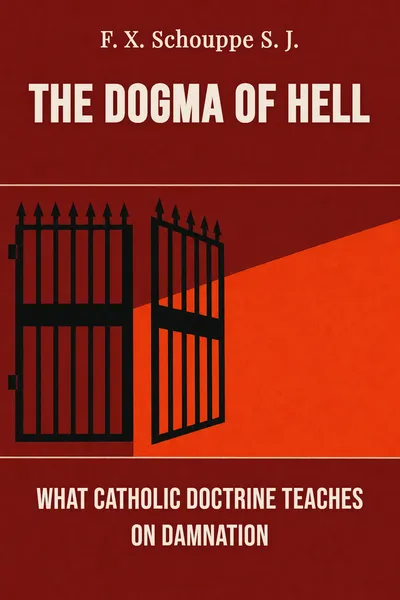
The Dogma of Hell
What Catholic doctrine teaches on damnation
Description
In 1883, a Belgian Jesuit named François-Xavier Schouppe published a book with a title that leaves nothing to the imagination: The Dogma of Hell. He was a theologian and seminary teacher, the kind of man who wrote manuals for the training of priests, and he set out to do something unfashionable even in his own century. He wanted to state, plainly and without softening, what the Catholic Church actually teaches about eternal damnation — and to make his readers feel the weight of it. The book is short, insistent, and entirely uninterested in reassuring anyone.
Schouppe was writing at a moment when hell was already becoming an embarrassment in polite European conversation. Educated people found it crude, primitive, incompatible with a God of love. His answer was not to argue in the abstract. He piled up scripture, the councils, the theologians, and then — this is the part that makes the book strange to modern eyes — dozens of stories from the lives of the saints and from ordinary deathbeds, accounts of visions, apparitions, and warnings. His method was devotional and apologetic at once: prove it, then make it real enough to change how a person lives.
For a reader today, believer or not, the book is a window onto a way of thinking that once organized whole lives. It treats damnation not as a metaphor or a scare tactic but as a settled fact about the universe, as literal as gravity. What Schouppe assembles is less an argument than a portrait — of a doctrine, and of the seriousness the Church once attached to getting it right.
The question we’re asking : What does traditional Catholic doctrine actually teach about hell, and why did a nineteenth-century Jesuit think it needed defending?What we’ll see : A faithful reading of Schouppe's classic exposition — its foundations, its anatomy of eternal punishment, its use of the saints, and what a doctrine of damnation is doing inside a religion of love.
Table of contents
01 Chapter 1 — A place the Church has never argued itself out of
Schouppe's first move is to establish that hell is not an optional belief a Catholic can quietly set aside. It is dogma — a truth the Church holds as revealed and binding — and he wants that word taken at full strength. He walks through the scriptural ground first. The Gospels, on his reading, are not shy about it. He points to the repeated language of Christ himself: the exterior darkness, the weeping and gnashing of teeth, the fire that is not extinguished, the worm that does not die. These are not, Schouppe insists, the Church's later invention. They are attributed to Jesus, and they recur.
From scripture he moves to tradition, and here his argument is one of continuity. The councils, the Fathers, Augustine, Aquinas — all affirm the reality of hell and, crucially, its eternity. That last point is the one Schouppe defends most stubbornly, because it is the one his contemporaries most wanted to soften. Surely, the objection went, a merciful God would not punish forever a sin committed in a moment. Schouppe answers that the gravity of an offense is measured not by how long it took to commit but by the one offended, and that a sin against an infinite God carries a weight the human mind cannot feel.

02 Chapter 2 — The two fires: loss and pain
Having established that hell exists, Schouppe turns to what it actually is, following the classic theological anatomy with care. Damnation, in this tradition, is not a single undifferentiated misery. It has two components, ranked precisely. The first and greater is the pain of loss — the eternal separation from God. The soul was made for God as its final end, and losing that end permanently, by one's own doing, is the deepest wound. Schouppe stresses that on earth we cannot register how great this loss is, because we have never possessed God fully enough to miss him fully.
The second component is the pain of sense — the suffering inflicted by fire. Schouppe does not flinch from literalism. He takes seriously the scriptural language of real fire and defends it against those who would reduce it to a figure of speech for inner anguish. His reasoning is that the damned are punished in body as well as soul, and bodily suffering requires more than metaphor. He is careful, though, to say the manner of that fire remains partly mysterious, unlike the ordinary flame we know.
03 Chapter 3 — When the saints came back to talk about it
The strangest part of Schouppe's book is where he leaves the theologians behind and turns to stories. Having proven the doctrine from scripture and tradition, he wants to make it vivid, and his instrument is the vast devotional literature of visions, apparitions, and deathbed accounts. He gathers case after case — a saint granted a glimpse of the abyss, a soul returning to warn the living, a sinner dying in a manner that seemed to reveal his fate. For Schouppe these are not idle marvels. They are witnesses.
He draws heavily on figures whose visions the Church has held in high regard. He recounts what tradition attributes to Teresa of Ávila, who described being shown the place prepared for her had she persisted in her faults, and who came away marked for life by the sight of a narrow, foul, suffocating space. He relays accounts associated with visionaries and older stories of the departed appearing to confirm, in a single terrible sentence, that they were lost forever. The cumulative effect is deliberate: the doctrine is not only reasoned, it is attested by people the Church honors as holy.
04 Chapter 4 — Why a merciful Church keeps the door of hell open
Step back from Schouppe's fire and stories and one question hangs over the whole book: how does a religion whose central claim is the love of God insist so firmly on eternal punishment? The obvious modern intuition is that the two cancel each other — that a truly merciful God could not permit hell, and so the doctrine must be a relic to be discarded. Schouppe's tradition answers with something more unsettling. Hell, on this view, is not the failure of mercy. It is the price of taking human freedom seriously.
The logic runs like this. If the choice for or against God is real, it must be capable of being made permanently, or it was never a real choice at all. Love that cannot be refused is not love. To insist that everyone will be saved regardless of what they choose is, in this reading, to empty human decisions of their weight and to treat people as objects to be arranged rather than free agents. Hell is what respect for freedom looks like when freedom is used to say no. That is why Schouppe can hold, without contradiction, that the God who is love has prepared such a place — because he will not force the will he made free.
05 Conclusion
Schouppe finished where he began, with the conviction that the most dangerous thing a person could do about hell was to stop thinking about it. He had marshaled scriptures, councils, and theologians, then handed the reader a gallery of visions and warnings — all pointed at one end: that the doctrine should move from the head to the life. For him the proof was never the point. The point was that a truth this large, if it is true, cannot be held lightly, and that most people hold it lightly precisely because they never let themselves picture it.
Related books