The Discovery of the Unconscious
How the mind was mapped
Description
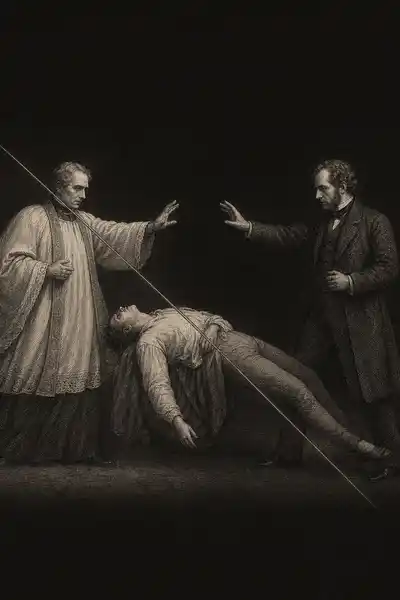
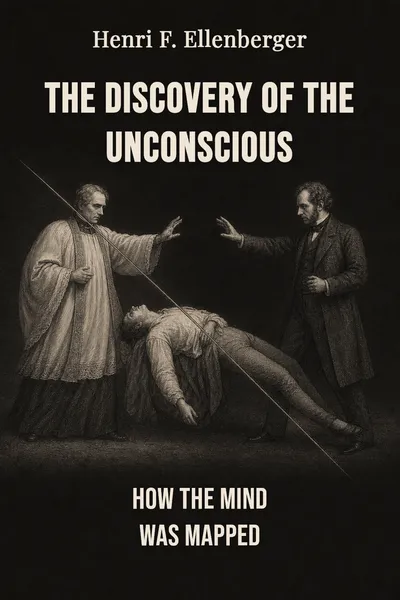
In 1775, in the Bavarian town of Ellwangen, a priest named Johann Joseph Gassner was drawing enormous crowds. People came sick and left cured, or said they did, after he commanded their afflictions to leave in the name of Christ. The Church grew uneasy and called in a witness to observe him: Franz Anton Mesmer, a Viennese physician who claimed he could produce the very same convulsions and cures without any appeal to God at all, using something he called animal magnetism. Two men, two explanations, one identical scene of a body seized and released. The confrontation was, in a sense, the moment a religious cure became a medical one.
The Swiss psychiatrist Henri Ellenberger spent decades tracing that hand-off and the many that followed it. His 1970 book, The Discovery of the Unconscious, runs to more than nine hundred pages and refuses the story most of us half-remember — the one where Freud, working alone around 1900, lifted the lid on a hidden mind nobody had suspected. Ellenberger's account is stranger and more crowded. The unconscious, he shows, was not discovered in a single consulting room. It was assembled, slowly, out of exorcism, mesmerism, hypnosis, and folk healing, passed from hand to hand across two centuries before anyone gave it a theory.
What Ellenberger built is less a biography of an idea than a genealogy of a craft — the craft of reaching whatever in us lies below awareness and doing something with it. He follows the healers who could induce a trance long before anyone could explain one, and the patients whose divided selves became the raw material of a science. By the time he reaches the famous names, they look less like founders and more like heirs.
The question we’re asking : Where did the idea of an unconscious mind actually come from, if not from a single genius in Vienna?What we’ll see : How a lineage of healers, magnetists and hypnotists slowly built the material that four rival systems would later claim as their own.
Table of contents
01Chapter 1 — The healer before the doctor
Ellenberger begins where medicine did not yet exist as we know it: with the healer whose authority came from a shared belief in the cause of suffering. For most of human history, disorders of the mind were read as intrusions — a spirit, a curse, a possession — and the cure matched the diagnosis. The exorcist worked because patient and community agreed on what was wrong. Gassner's crowds convulsed and recovered because they inhabited the same world he did. This is the first of Ellenberger's quiet arguments: a treatment that reorganizes the mind does not need to be true to work. It needs a story both parties accept.
When Mesmer stepped in to say the same convulsions could be produced by an invisible fluid coursing between bodies and stars, he kept the theatre and swapped the metaphysics. Animal magnetism was wrong about physics — there is no such fluid — but it moved the cure out of the sacred and into something that presented itself as natural science. Mesmer treated patients around a wooden tub, the baquet, filled with magnetized water and iron filings, and his salons in Paris in the 1780s became a scandal precisely because they worked often enough to be taken seriously.

02Chapter 2 — The long apprenticeship of the trance
The next stretch of the story is the slow domestication of the trance. One of Mesmer's disciples, the Marquis de Puységur, discovered in 1784 that magnetizing a young peasant named Victor Race did not produce convulsions but a strange lucid sleep — the man spoke, answered questions, obeyed, and remembered nothing afterward. Puységur had stumbled onto what would eventually be called hypnosis, and with it the unsettling spectacle of a second self, articulate and cooperative, that the waking person had no access to. The material of a divided mind was now visible to anyone willing to look.
For decades this remained on the margins of respectable medicine, kept alive by magnetizers and showmen. It re-entered the clinic in the second half of the nineteenth century through two rival French schools that Ellenberger sets against each other with real relish. At the Salpêtrière hospital in Paris, Jean-Martin Charcot treated hypnosis as a neurological state peculiar to hysterics, demonstrated before audiences on his famous patients. At Nancy, Hippolyte Bernheim countered that hypnosis was nothing pathological at all — merely heightened suggestibility, present in most ordinary people. Bernheim, over time, won the argument.
03Chapter 3 — Four systems out of one lineage
Ellenberger's last great movement gathers what he calls the systems of dynamic psychiatry — Janet, Freud, Adler, Jung — and reads them not as four separate revelations but as four ways of arranging one inheritance. He treats each with the same instrument, an unusually thorough life-and-context, restoring the milieu each man drew on and rarely credited. The effect is to make the family resemblance impossible to miss. All four assume a mind with depths, forces in conflict, and symptoms that mean something the patient does not consciously know.
Freud is the pivot, and Ellenberger is scrupulous rather than reverent. He shows Freud arriving in Paris to study under Charcot, absorbing the hypnotic tradition, then abandoning hypnosis for free association while keeping its central bet — that a hidden layer governs the visible one. Psychoanalysis, in this account, is a brilliant reworking of materials long in circulation: repression as a sharper form of dissociation, the talking cure as a descendant of the magnetic rapport. Ellenberger neither diminishes Freud's originality nor lets the founding myth stand unexamined.
04Chapter 4 — A history that refuses the founding myth
Step back from the parade of healers and the thing Ellenberger is really doing comes into focus: he is arguing about how ideas come to exist at all. The conventional history of science loves the founding moment — the apple, the bathtub, the lone mind that saw what others missed. The Discovery of the Unconscious is built to dissolve that story. Ellenberger reads each supposed breakthrough back into the culture, the patients, the rivals and the folk practices that made it thinkable, and what survives the reading is a picture of discovery as inheritance and rearrangement rather than sudden vision.
This matters most for the field he loves. Psychoanalysis had, by 1970, told a heroic story about itself — a science born whole from Freud's self-analysis, resisted by a prudish world. Ellenberger, himself a psychiatrist, does not attack that story so much as surround it with context until it can no longer stand alone. He shows that the unconscious was a working object of European healing long before it had a name, and that Freud's genius lay less in discovering it than in giving a scattered tradition a coherent, transmissible form. It is a generous demotion.
05Conclusion
Return to Ellwangen, and to the two men facing the same convulsing body — the priest who commanded a demon and the physician who invoked a fluid. Neither was right about the cause, and it hardly mattered; both were reaching a part of the sufferer that the sufferer could not reach alone. Ellenberger's nine hundred pages are, in the end, an extended study of that reach and of the many names it has worn: possession, magnetism, suggestion, dissociation, repression. The costumes are period pieces. The underlying encounter is continuous, which is why he could draw an unbroken line from the exorcist to the analyst's couch.
Related books