The Diamond Sutra and The Sutra of Hui-neng
Enlightenment cuts through all illusion
Description
Somewhere in a walled-up cave near Dunhuang, on the old Silk Road, a scroll sat sealed for the better part of a thousand years. When it came to light in 1900, it turned out to carry a date — the equivalent of May 11, 868 — and a printer's colophon saying it had been made for free distribution. That scroll, a woodblock-printed copy of the Diamond Sutra, is the oldest complete printed book in the world that carries its own date. The text itself is much older, composed in India somewhere around the fourth century, and it had already been traveling and being copied for five hundred years before that particular version rolled off the blocks.
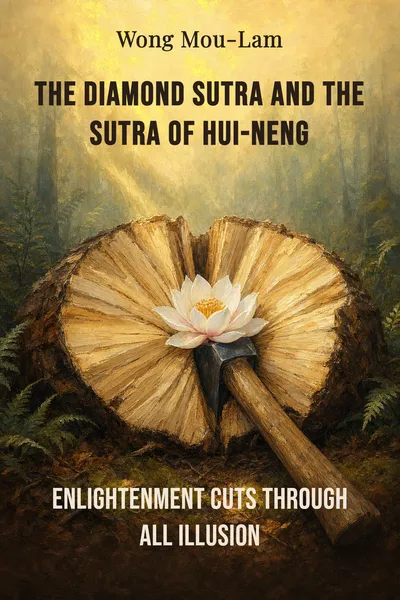
The book Wong Mou-Lam translated pairs that ancient scripture with a second one that could hardly feel more different in texture. The Diamond Sutra is spare, austere, almost mathematical in the way it keeps dismantling its own statements. The Sutra of Hui-neng — often called the Platform Sutra — reads like a life story, the account of a poor, unlettered woodcutter from southern China who, the tradition says, heard a stranger reciting the Diamond Sutra in a marketplace and was cracked open by a single line of it. He would become the sixth patriarch of Chan, the Chinese form of Buddhism that reached Japan as Zen.
Read side by side, the two texts do something one alone could not. One is the diamond blade; the other is the man it cut. Between them sits the whole wager of the Zen tradition: that the deepest understanding is not something we build up over years but something already present, waiting to be uncovered the moment the right words strip away what was hiding it.
The question we’re asking : How can a scripture famous for negating everything it says become the hinge on which an entire tradition of awakening turns?What we’ll see : How a diamond-hard dialogue and the memoir of an illiterate woodcutter came to carry the central claim of Zen — and why that claim still unsettles us.
Table of contents
01Chapter 1 — A book that cuts, and the oldest one we can hold
The name is worth taking seriously. In Sanskrit the text is the Vajracchedika Prajnaparamita — roughly, the perfection of wisdom that cuts like a diamond, or like a thunderbolt. The image is not decorative. A diamond is the hardest known thing, and what it cuts here is not stone but the mind's habit of dividing the world into fixed objects: self and other, this and that, sacred and ordinary. The sutra's whole method is to hold up one of these divisions and slice through it, again and again, until the reader stops trusting the divisions at all.
That printed scroll from 868 gives the text a strange double life. It is a religious document about letting go of all attachment to things, and it is also, physically, the most venerable dated printed object we possess — a thing, an object, that collectors and historians treasure precisely because it is old and rare. There is a quiet irony in that, and the sutra would probably approve of noticing it, since it spends its pages warning against getting attached to exactly this kind of value.

02Chapter 2 — The dialogue on the further shore
The Diamond Sutra is built as a conversation. The setting is deliberately plain: the Buddha has finished his meal, put away his bowl and robe, washed his feet, and sat down. No thunder, no miracles. Then an elder disciple named Subhuti rises and asks the question that opens everything — how should someone who wants to awaken settle the mind, and how should they master it? Everything that follows is the Buddha answering, and then complicating his own answer.
The core teaching is that a bodhisattva, someone committed to freeing all beings, must work without clinging to the idea of a self who works, of beings to be freed, or of any fixed reward for freeing them. He should give, the text says, without dwelling on the giving. He should act without resting his mind on any object at all — not on sights, sounds, smells, or ideas. The moment the mind lands on something and grips it, it has already lost the openness the practice is pointing toward. Wisdom here is not knowing more; it is holding less.
03Chapter 3 — The woodcutter who never learned to read
The second text turns the abstraction into a person. Hui-neng, who lived from 638 to 713, tells his own story in its opening pages. His father died young; the family was poor; he supported his mother by selling firewood. One day, delivering wood to a shop, he heard a customer reciting the Diamond Sutra, and at the line about letting the mind arise without resting on anything, something in him opened. He asked what the man was reciting and where he could learn more, and set off north to find the fifth patriarch, Hung-jen.
When he arrived, the patriarch tested him. A southerner, a laborer — how could such a man expect Buddhahood? Hui-neng's reply is one of the tradition's treasured moments: people may come from north and south, but the Buddha-nature knows no north and south. He was put to work pounding rice in the back, an illiterate kitchen hand among learned monks, for months. The hierarchy of the monastery had already decided what he was. The teaching he was living inside had not.
04Chapter 4 — What sudden means
Read together, the two texts push toward a single, disquieting claim about where understanding lives. Hui-neng became associated with what later came to be called the sudden school — the insistence that awakening is not reached by gradual polishing but breaks through all at once, because the nature it reveals was never absent to begin with. Shen-hsiu's mirror needs endless wiping. Hui-neng's verse says there is nothing to wipe. If the Buddha-nature is already complete in everyone, then enlightenment cannot be an achievement earned step by step; it can only be a recognition, sudden as the woodcutter's moment in the marketplace.
This is why the illiteracy in the story matters so much and is repeated so insistently. It is not a hardship the hero overcomes on his way to learning. It is the point. The Diamond Sutra had already cut away the idea that the teaching is a possession to be transmitted, a raft to be clung to; the Platform Sutra puts a man in front of us who owns none of the scholarship and sees more clearly for it. The two scriptures reinforce each other exactly here: the one dismantles the authority of the text, the other dismantles the authority of the credential.
05Conclusion
The sealed scroll from Dunhuang and the memoir of the woodcutter come from different worlds — one an Indian scripture pressed into ink on the Silk Road, the other a Chinese life story shaped by later hands. Wong Mou-Lam's pairing of them lets us see why the tradition treats them as a single lesson. The Diamond Sutra supplies the blade: the patient, unsettling work of cutting through every fixed division the mind tries to rest on. Hui-neng supplies the demonstration that the blade actually works — that a single line of it, heard in a marketplace by someone with no learning at all, was enough.
Related books