The Detail
Looking closely at painting
Description
There is a way of standing in a museum that everyone knows. We take a few steps back, we let the whole picture settle into place, we recognize the scene — a Nativity, a banquet, a woman at a window — and then we move on. The composition, the theme, the name of the master: that is what a painting is supposed to give us, all at once, from the right distance. Daniel Arasse spent a career suspecting that this respectable way of looking misses almost everything. An art historian who died in 2003, he wrote a book, published in France in 1992, whose whole argument fits in its title: le détail. Not the grand design, but the fly on the ledge, the thread on a sleeve, the reflection nobody is meant to notice.
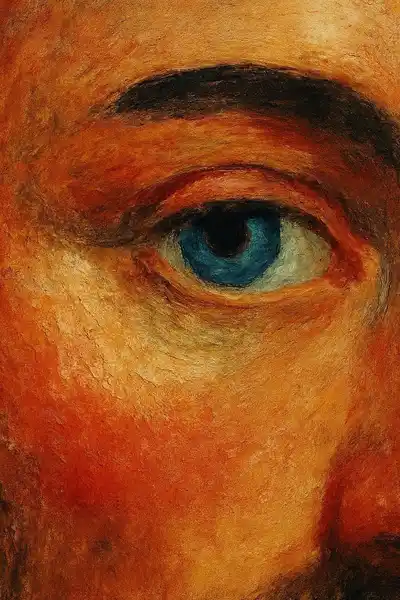
His wager was that the small thing is not a footnote to the picture. Sometimes it is the door. The detail is where the painter's hand shows, where the eye is trapped, where meaning quietly leaks or contradicts itself. Step too far back and the fly disappears into the varnish. Lean in — close enough that a guard clears his throat — and the whole picture reorganizes around that one spot. Arasse wanted to write the history of art from that uncomfortable distance, the one that respectable viewing forbids.
What follows is his argument for close looking as a method, told through pictures he could not stop returning to. It is less a theory than an invitation to change how we stand in front of a painting.
The question we’re asking : What happens to a painting when we stop taking it in at a glance and lean into the one spot we were not supposed to see?What we’ll see : How the smallest thing on a canvas can turn out to hold the most, and why the eye that leans in sees what the eye that steps back cannot.
Table of contents
01Chapter 1 — A word that means two things at once
Arasse begins with a problem hiding in plain sight: the word itself. In French, as in English, "detail" points in two opposite directions. There is the détail as a small part — a hand, a buttonhole, the glint on a pearl. And there is le détail as an act, from détailler, to cut up, to break something whole into pieces so it can be examined one at a time. The first is a thing in the picture. The second is something we do to the picture. The confusion is not a nuisance to be cleaned up; it is the whole subject.
This matters because the two meanings pull against each other. When a painter puts a fly on a painted ledge, that fly is a detail in the first sense — a chosen part of the composition. But when we walk up close and lose sight of everything except that fly, we are performing a detail in the second sense: we are cutting the painting apart with our eyes, isolating a fragment the artist embedded in a whole. Arasse's book lives in the gap between what the painter placed and what the viewer detaches.

02Chapter 2 — The painter who signs in the corner of a mirror
Some details are the painter's way of getting into his own picture. The most famous case Arasse returns to is the mirror in Jan van Eyck's double portrait of a couple, painted in Bruges in 1434. On the back wall, a convex mirror the size of a coin reflects the whole room in reverse — the backs of the two figures, and, in the doorway, two more people who are not otherwise in the painting. One of them, tradition holds, is the painter. Above the mirror, in careful script, van Eyck wrote a line that translates roughly as "Jan van Eyck was here."
Arasse's point is not the identification, which scholars still argue over. It is the scale. Everything that certifies the painter's presence, his eye, his witness, is compressed into an object a few centimeters across, tucked at the vanishing point where the whole perspective converges. The mirror is the smallest thing in the room and the place where the picture folds back on itself to say: someone made this, someone stood here and looked. You cannot see any of it from the museum distance. You have to come close, and coming close is exactly the movement the mirror rewards, because it turns you, the viewer, into the figure in the doorway.
03Chapter 3 — When the eye gets too close for comfort
There is a threshold in looking, and Arasse is fascinated by the moment we cross it. Step back and a Vermeer is a woman reading a letter in a quiet room. Step in, closer than politeness allows, and the pearl at her ear dissolves into two dabs of white, one thick, one thin, sitting on the surface with no pearl underneath at all. The illusion does not survive the approach. What survives is paint, and the strange discovery that the paint and the pearl were never the same thing.
This dissolution used to frighten the tradition, and Arasse traces the anxiety. For centuries, theorists warned that too much attention to detail was a lower kind of skill, the province of Flemish miniaturists rather than Italian masters of grand design. The detail was suspected of femininity, of excess, of a seductive fussiness that distracted from the noble whole. To lose yourself in the sheen of a fabric or the veins of a leaf was, supposedly, to fail to grasp the picture's real subject. There was a moral charge to standing back and a faint disgrace in leaning in.
04Chapter 4 — The picture is not a window
Step back from Arasse's own argument and a larger claim comes into view about what a painting fundamentally is. The tradition since the Renaissance liked to imagine the canvas as a window — a transparent opening onto a scene, best viewed from the distance that makes the glass invisible. On that model, the ideal viewer is the one who forgets the surface entirely and looks straight through to the story. The detail is a nuisance in this scheme, a smudge on the glass that stops us seeing out.
Arasse's whole book is a refusal of the window. A painting, for him, is not a transparency but a surface, worked by a hand, that holds its meaning as much in how it is made as in what it shows. And a surface is something you cannot look through; you can only look at it, and the closer you look the more of it there is. The detail, on this view, is not a flaw in the window but proof that there was never a window at all — only paint, arranged by someone, waiting for someone else to come near enough to notice.
05Conclusion
Arasse died in 2003, a few months after recording a series of talks on painting that made him, briefly and improbably, a public voice in France for the pleasures of looking slowly. His book on the detail stayed with the same conviction from beginning to end: that the small thing is not beneath the grand design but often runs deeper than it, and that the history of art looks different when written from up close. The fly, the mirror, the two dabs of white — these were not curiosities to him. They were where painting keeps what it does not say out loud.
Related books